The airships of steampunk, with their brass gondolas and patched canvas, are a dream built on something real. For about forty years, from the first flight of a Zeppelin in 1900 to the Second World War, enormous rigid airships crossed oceans, bombed cities, carried passengers in dining rooms with linen on the tables, and caught the imagination of the world. Two names from that age are still searched for more than any others: the R101 airship, Britain's great hope, which crashed in France in 1930, and the Hindenburg disaster of 1937, which was filmed as it happened.
This guide tells the true story behind the steampunk airship: the balloons that came first, Count Zeppelin and his rigid airships, the British airships from the R33 to the R100, the loss of the R101, the Hindenburg, the reasons the great airships fell out of use, and the airships that fly today. Many people died in these craft, and this guide tries to tell their story plainly and with respect. Where the sources disagree, it says so. Our guide to steampunk airships covers the imagined ones.
Balloons before airships
People flew in balloons long before they flew in airships. In France the Montgolfier brothers, paper makers from Annonay, gave their first public demonstration of a hot-air balloon there on 4 June 1783. On 19 September that year a balloon of theirs carried a sheep, a duck and a rooster at Versailles before King Louis XVI and Marie Antoinette, and all three animals came down safely. On 21 November 1783 Pilâtre de Rozier and the marquis d'Arlandes made the first free flight with people aboard, rising from the Château de la Muette near Paris and travelling about nine kilometres in some 25 minutes. On 1 December the scientist Jacques Charles went up in a balloon filled with hydrogen, the lightest of all gases, which would lift almost every airship that followed.
A balloon has one great weakness: it goes where the wind takes it. The idea of a steerable balloon, an airship, came almost at once. Within months, a French army engineer, Jean-Baptiste Meusnier, had drawn a long, streamlined envelope driven by propellers and steered by a rudder, though it was never built.
The first powered airships
On 24 September 1852 the French engineer Henri Giffard flew about 27 kilometres from Paris in a hydrogen airship driven by a small steam engine of about three horsepower turning a propeller. It was the first engine-powered flight. Giffard could make turns and circles, but the wind was too strong for him to fly back against it. In 1884 two French army officers, Charles Renard and Arthur Krebs, flew an airship called La France, driven by an electric motor and a heavy battery, eight kilometres in 23 minutes and landed where they had started: the first fully controllable free flight.
Three kinds of airship
Airships come in three kinds, and the difference matters to the rest of this story. A non-rigid airship, usually called a blimp, keeps its shape only by the pressure of the gas inside, like a balloon. A semi-rigid airship has a pressurised envelope with some structure, such as a keel, along its length. A rigid airship has a framework of metal rings and girders covered in fabric, with many separate gasbags inside. The rigid design allowed airships to be far larger than any blimp, and almost all the famous ones were rigid.
Count Zeppelin and the rigid airship
The rigid airship belongs to one man more than any other. Ferdinand von Zeppelin was a German count and army officer who retired in 1890, at 52, and spent the rest of his life on airships. His German patent for a steerable aircraft was granted on 31 August 1895, and his first airship, LZ 1, flew over Lake Constance in southern Germany on 2 July 1900. It was damaged on landing, repaired and flown again that October. Zeppelin's ships were so successful that his name became the ordinary word for a rigid airship.
The first airline
In 1909 a company called DELAG was founded to carry passengers by Zeppelin, and it is often called the world's first airline. Its first commercial flights were in 1910. By the outbreak of war in August 1914 it had made 1,588 flights and carried 10,197 fare-paying passengers, mostly on pleasure trips between German cities.
Zeppelins at war
The First World War turned the airship into a weapon. On the night of 19 to 20 January 1915 two German Navy Zeppelins, L 3 and L 4, bombed Great Yarmouth, King's Lynn and villages along the Norfolk coast in the first air raid on Britain. Many more raids followed, London among their targets. The figure usually given is 557 people killed in England in 51 raids, though counts vary between sources. For people on the ground the raids were terrifying: a huge shape in the night sky, and bombs falling without warning. Count Zeppelin did not see the end of the war; he died in 1917.
Britain's airships, from the R33 to the R100
Britain built rigid airships of its own during the war and in the years after, each given a number with the letter R. Two of them, the sister ships R33 and R34, first flew in March 1919, the R33 on 6 March and the R34 on the 14th.
The R34 crosses the Atlantic
The R34, built by William Beardmore and Company at Inchinnan near Glasgow, made one of the great flights of its age. It left East Fortune in East Lothian on 2 July 1919 and reached Mineola on Long Island, New York, on 6 July, after a flight of 108 hours: the first crossing of the Atlantic by air from east to west. Because nobody on the ground in America had handled a big rigid airship, one of the officers, Major E. M. Pritchard, jumped by parachute to direct the landing, and so became the first person to reach American soil by air from Europe. The R34 flew home to Pulham in Norfolk between 10 and 13 July in 75 hours, making the first return crossing. Less than two years later, in January 1921, it struck a hillside on the North York Moors at night and was damaged beyond saving.
The R33 and the R38
The R33, built by Armstrong Whitworth in Yorkshire, had a long career at Pulham. On the night of 16 April 1925 a gale tore it from its mooring mast with twenty crew aboard and blew it across the North Sea to the Dutch coast; the crew kept it in the air through the night and brought it home the next afternoon. Later it was used for trials in which small fighter aircraft were launched from beneath it, before it was broken up in 1928.
The R38 ended in tragedy. It was built for the Admiralty and sold to the United States Navy, and on 24 August 1921, during a trial flight, it broke apart over the Humber near Hull. Forty-four of the 49 men aboard were killed: 28 of the 32 Britons and 16 of the 17 Americans. The technical inquiry found that the design had made no allowance for the forces the air puts on a ship in hard turns.
The Imperial Airship Scheme
In 1924 the government launched the Imperial Airship Scheme, championed by Lord Thomson, the Secretary of State for Air, to link Britain with the distant parts of the Empire by regular passenger airship. Routes were planned to Egypt, India, Canada and, later, Australia. Two airships were ordered as a deliberate competition. The R100 was built by the Airship Guarantee Company, part of Vickers, at Howden in Yorkshire, with a design team led by Barnes Wallis. The R101 was designed and built by the government's own Royal Airship Works at Cardington, near Bedford.
The R100 first flew on 16 December 1929. On 29 July 1930 it left Cardington for Canada and reached its mast at St-Hubert, outside Montreal, after 78 hours, then flew home in 57 and a half. It was the scheme's great success.
The Cardington sheds
The two giant hangars that housed these ships still stand at Cardington, and Historic England lists both at Grade II*. No. 1 Shed was built in 1916 and 1917 for the Admiralty and enlarged in 1926 and 1927 so that the R101 could be built inside it; it is the only British airship hangar from before 1918 still standing where it was built. No. 2 Shed, beside it, was made in 1928 from a hangar moved from Pulham and enlarged to hold the R100. Each is about 812 feet long and 180 feet high. Seen across the Bedfordshire fields, they show better than any photograph how big these airships were.
The R101 and its crash in 1930
The R101 was the largest airship of its day. It first flew on 14 October 1929, and was later lengthened from 731 to 777 feet by adding an extra gasbag, so that it held about five and a half million cubic feet of hydrogen.
The flight to India
On the evening of 4 October 1930 the R101 left its mast at Cardington for Karachi, then in India, by way of Ismailia in Egypt. Lord Thomson, the minister who had championed the scheme, was aboard, together with Sir Sefton Brancker, the Director of Civil Aviation, and senior members of the design team.
Shortly after two o'clock in the morning of 5 October, near Beauvais, the R101 went into a dive, recovered briefly, and came down at the edge of a wood by the village of Allonne. The hydrogen caught fire and within minutes the ship was a burning frame.
Those who died
The RAF Museum records that 54 men were aboard: 37 crew, five officers, six officials of the Royal Airship Works and six passengers. Forty-six died that night, and two more died later in hospital at Beauvais, so that 48 were lost and six survived. Among the dead were Lord Thomson and Sir Sefton Brancker. The youngest was 18 and the oldest 53.
The bodies were brought home by special trains. On 10 October they were carried from Victoria Station to Westminster Hall, where the 48 coffins lay in state under Union flags and thousands filed past, in a queue said to stretch about two miles. A memorial service was held at St Paul's Cathedral, and the next day the coffins travelled on to Bedford. The men were buried together in a single grave in the churchyard at Cardington, close to the sheds where the airship was built. The monument over the grave, designed by Sir Albert Richardson, carries their names and is itself a listed building, and the RAF ensign from the airship's tail hangs in the church. A memorial at Allonne was unveiled in 1933.
What went wrong
The inquiry, chaired by Sir John Simon, concluded that a tear had probably opened in the outer cover near the bow, letting one or more of the forward gasbags fail, so that the ship became too heavy at the nose to recover. It thought a spark igniting the hydrogen the most likely cause of the fire, but the cause was never established. The government abandoned British airship development in 1931, and the R100, the successful ship, was broken up inside No. 1 Shed that December and sold for scrap for less than £600.
The Hindenburg disaster, 1937
The most famous airship of all was German. The LZ 129 Hindenburg, named after Paul von Hindenburg, President of Germany from 1925 to 1934, first flew on 4 March 1936. At 245 metres, about 804 feet, it was longer than any airship before it, and it held about 200,000 cubic metres of gas. In its first season it made 17 round trips across the Atlantic, ten to the United States and seven to Brazil, carrying 2,798 passengers in cabins with a dining room, a lounge and windows along the decks. On 1 August 1936 it flew over the opening ceremony of the Olympic Games in Berlin.
Hydrogen, not helium
The Hindenburg was designed to use helium, which does not burn. Helium was rare and in practice available in quantity only from the United States, and an American law of 1927 controlled its export. When the export was refused, the designers changed the ship to use hydrogen, which lifts more and costs less but burns readily in air.
Lakehurst, 6 May 1937
The Hindenburg left Frankfurt on the evening of 3 May 1937 on its first North American trip of the year. On 6 May, at about 7.25 in the evening, as it came in to land at the Naval Air Station at Lakehurst, New Jersey, fire broke out near the tail. The flames spread forward through the hydrogen cells, and the ship sank to the ground in about half a minute; accounts give 32, 34 or 37 seconds. Of the 97 people aboard, 36 passengers and 61 crew, 35 died: 13 passengers and 22 crew. A member of the ground crew was also killed, bringing the toll to 36. Sixty-two of those aboard survived, many of them badly burned.
What makes the Hindenburg disaster so well remembered is that it was recorded. Four newsreel teams were filming the landing, and a Chicago radio reporter, Herbert Morrison, recorded an eyewitness account that was broadcast the next day. His distress as he described the fire is one of the best-known recordings ever made. Later his sound was laid over the newsreel film, which is why many people believe the two were recorded together.
The cause
The Smithsonian's National Air and Space Museum notes that both the German investigation and the American one concluded that hydrogen leaking from a gas cell had mixed with the air and been lit by a spark, possibly from static electricity built up in the stormy weather. Other explanations have been put forward over the years. One argues that the coating on the outer skin helped the fire spread; another, that the ship was sabotaged. Neither inquiry supported sabotage, and no solid evidence for it has ever been produced. The exact cause will probably never be known.
Why airships fell out of use
The Hindenburg disaster destroyed public confidence in passenger airships almost overnight, but it was not the only reason they faded. The Graf Zeppelin, the Hindenburg's older sister, had one of the finest records of any aircraft: 590 flights, nearly 1.7 million kilometres, 13,110 passengers and a flight round the world in 1929 that took 21 days, 5 hours and 31 minutes, with no passenger or crew member injured in flight. Even so, it was withdrawn after the Hindenburg burned, and made its last flight on 18 June 1937. It and its successor, the Graf Zeppelin II, were broken up in 1940.
The weaknesses
- Weather. Airships were huge and light, and storms destroyed many of them. The American Navy's USS Akron, filled with helium, came down in a thunderstorm off New Jersey on 4 April 1933, and 73 of the 76 men aboard died, twice as many as on the Hindenburg. Its sister, the Macon, was lost at sea in 1935, though all but two of its crew were saved.
- Gas. Hydrogen burns; helium was scarce and expensive, and controlled by one country.
- Speed. By the late 1930s aeroplanes were crossing the Atlantic faster than any airship.
- Size and cost. A rigid airship needed sheds the size of Cardington's and large ground crews to handle it, and each loss was a disaster for the country that built it.
The blimps carry on
Smaller non-rigid blimps, filled with helium, lasted longer. The United States Navy used them through the Second World War to patrol for submarines, and kept flying them into the 1960s. Its last airships made a final ceremonial flight over Lakehurst, the same base where the Hindenburg burned, on 31 August 1962.
Airships today
Airships never quite disappeared. Since the 1960s almost every airship built has been filled with helium, and they have been used where hovering slowly matters more than speed: advertising, tourist flights, carrying cameras over sports events, and surveys and observation from the air. The best-known are the Goodyear blimps in the United States, which since 2014 have been semi-rigid ships based on the German Zeppelin NT design.
Airships at Cardington again
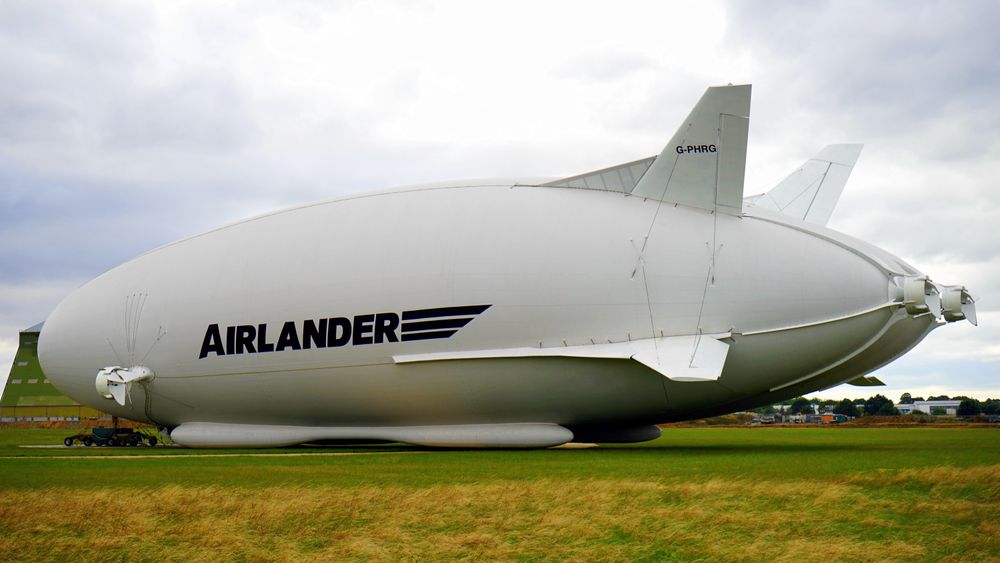
Cardington's sheds saw airships again in the 2010s. The Airlander 10, a hybrid airship that gets part of its lift from helium and part from its flattened shape, was first built for a United States Army programme and flew first in 2012 at Lakehurst. When that programme was cancelled, its British makers bought it back and rebuilt it at Cardington, where it first flew as the Airlander 10 on 17 August 2016. A week later it was damaged in a heavy landing, and in November 2017 it broke from its mooring in high wind and was deflated. It was retired in 2019, and its makers plan to build more. Plans are not the same as airships in service, and only time will tell whether the large passenger airship returns.
From history to steampunk
Steampunk keeps the airship's beauty and leaves out its dangers: the brass, the gondolas and the promenade decks, without the hydrogen. Knowing the real history makes a steampunk airship better drawn and a character's story richer. Our guide to how to draw steampunk shows how to draw one, and our guide to the best steampunk films lists the films in which airships fill the sky. For the Victorian ideas that came before them, see where steampunk came from, and for the machines that travelled on the ground and the sea, see our guide to steampunk trains, cars and machines.