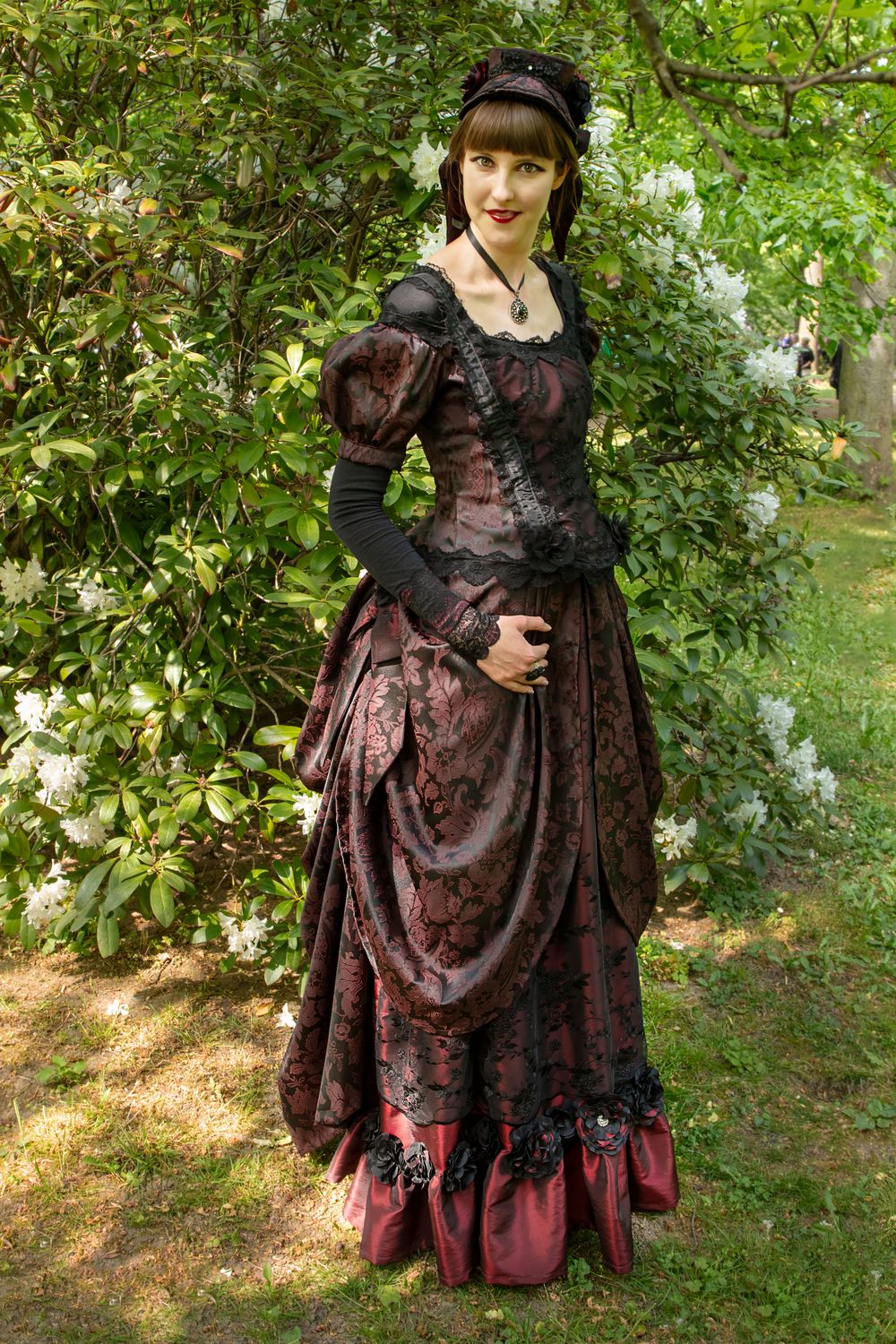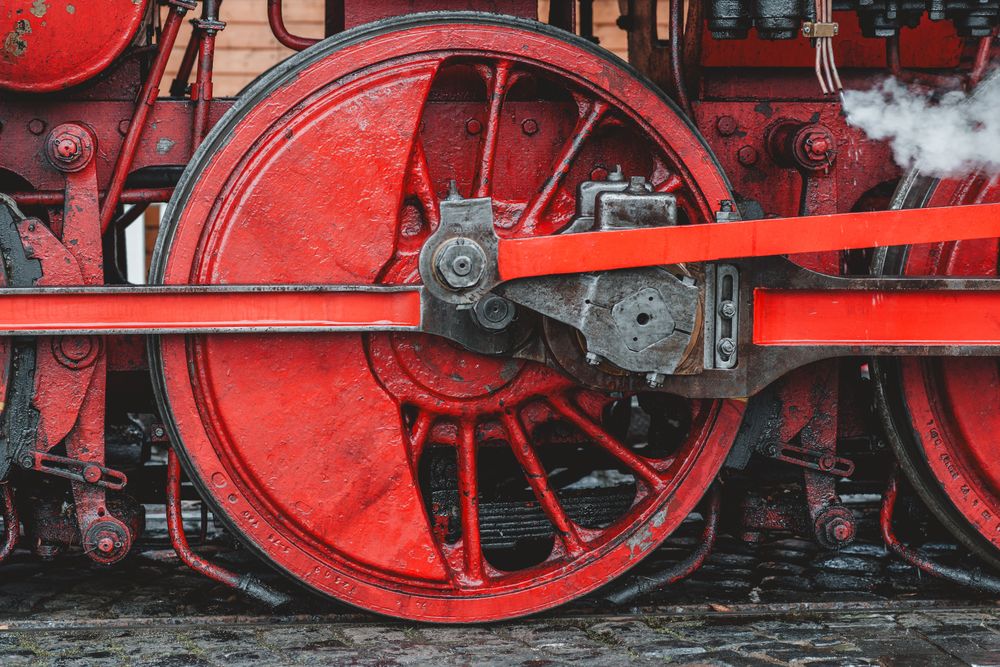
Steampunk machines are the heart of the style. A steampunk train with brass boilers and a riveted cab, steampunk cars that puff smoke instead of exhaust, walking engines and submarines with portholes: all of them grow out of the real machines that the Victorians built and rode in. The steam locomotive, the traction engine and the iron steamship were the wonders of their age, and the age of steam is the reason steampunk has the word steam in its name.
This guide looks at the real machines first and the imagined ones after: the steam locomotive, the railways and stations of Victorian Britain, steam on the road, ships and submarines, the walking machines of books and films, how to draw and build steampunk vehicles of your own, and where in Britain you can still see real steam at work. The gears and engines inside these machines have their own guide, cogs, gears and machines.
The age of the steam locomotive
A steam locomotive is a moving steam engine. A fire in the firebox heats water in the boiler, the steam drives pistons back and forth in the cylinders, and rods turn that motion into the turning of the wheels. The used steam is blown up the chimney, and in doing so it draws air through the fire and makes it burn harder. Everything a steampunk artist loves is there on the outside: the wheels, the rods, the pipes, the domes and the gauges in the cab.
Trevithick and the first locomotives
The first locomotive to run on rails was built by the Cornish engineer Richard Trevithick. On 21 February 1804, at the Penydarren ironworks near Merthyr Tydfil in South Wales, it hauled ten tons of iron, five wagons and about seventy men for almost ten miles, to win a bet of 500 guineas between two ironmasters. The journey took just over four hours. In 1808 Trevithick ran another engine, Catch Me Who Can, on a circular track in London near today's Euston Square, charging a shilling a ride, but the track was too weak and he built no more railway engines.
The Stockton and Darlington, and Rocket
The Stockton and Darlington Railway, opened on 27 September 1825 in County Durham, is described as the world's first public railway to use steam locomotives. Its first engine, Locomotion No. 1, was built by Robert Stephenson and Company of Newcastle, and the railway's two hundredth anniversary was marked in 2025.
Four years later came the most famous locomotive of all. In 1829 the new Liverpool and Manchester Railway held the Rainhill Trials to choose its engines. Rocket, designed by Robert Stephenson, was the only engine to finish, averaging 12 miles an hour and reaching 30, and won the £500 prize and the contract. The Science Museum Group explains that its boiler, with many tubes carrying the hot gases through the water, and its blast pipe, which sends the used steam up the chimney, were a great advance. When the railway opened in 1830, Rocket struck and fatally injured William Huskisson, a Member of Parliament.
Victorian railways and stations
In the 1840s Britain went railway mad. Wikipedia's account of the Railway Mania records that it reached its peak in 1846, when Parliament passed 263 acts setting up new railway companies, with routes totalling about 9,500 miles proposed. Many were never built, and many investors lost their money, but about 6,220 miles of line came from the schemes of those years.
Broad gauge and railway time
Two things had to be settled for the railways to work as one system. The first was the gauge, the distance between the rails. Most lines used 4 feet 8 and a half inches, but Isambard Kingdom Brunel built the Great Western Railway to a broad gauge of 7 feet and a quarter of an inch. A royal commission favoured the narrower gauge in 1846, and the Great Western finished converting its last broad gauge track on 21 May 1892.
The second was time. Every town used to keep its own local time by the sun. In November 1840 the Great Western became the first railway to run its timetable to London time, and the others followed over the next few years. Railway time became the legal time of the whole of Great Britain in 1880. Our guide to steampunk clocks tells the story of the station clock.
Stations, the cathedrals of the age
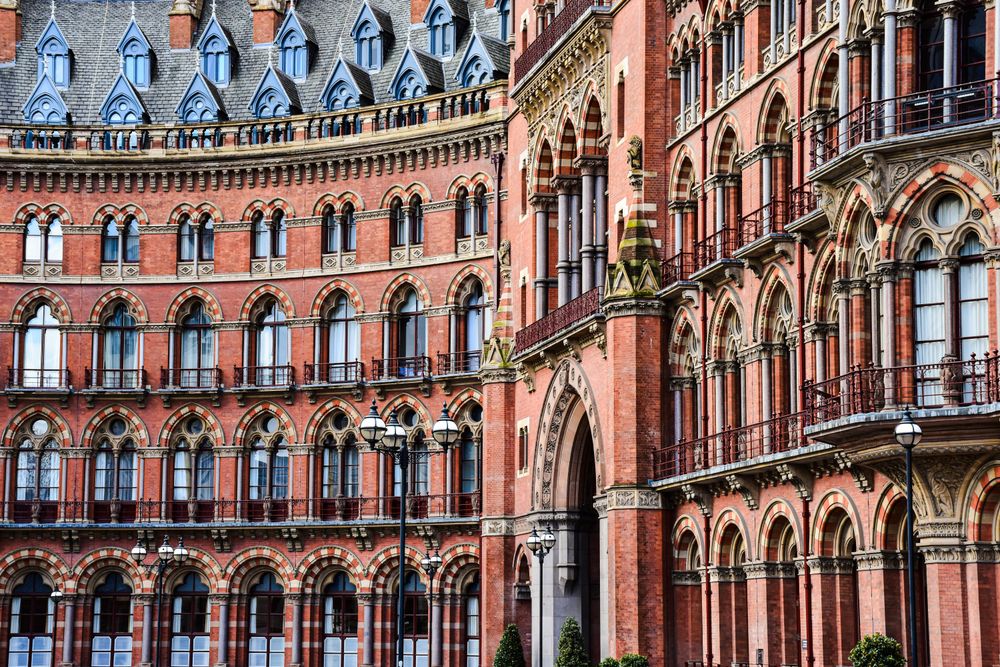
The Victorians built their great stations like palaces at the front and halls of iron and glass behind. St Pancras in London opened on 1 October 1868 as the terminus of the Midland Railway. Its train shed, designed by William Henry Barlow, was then the largest single-span roof in the world, and across its front stands the red-brick Gothic hotel designed by George Gilbert Scott. In the 1960s it was nearly demolished, until a campaign led by the poet John Betjeman and the Victorian Society saved it. It was listed at Grade I in 1967 and has been the London terminal for Eurostar since 2007.
Underneath London, the Metropolitan Railway opened on 10 January 1863 between Paddington and Farringdon Street, the world's first underground railway for passengers. Its gas-lit wooden carriages were hauled by steam locomotives through the tunnels, which is about as steampunk as a real railway can be. Our guide to Victorian London describes the city it ran beneath.
What makes a steampunk train
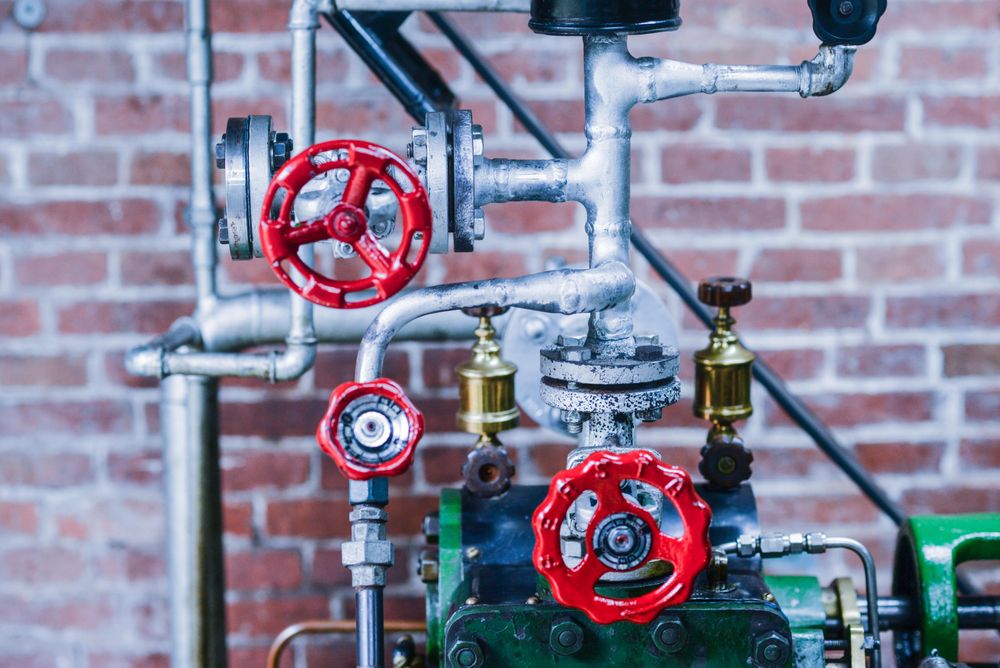
A steampunk train takes the real Victorian locomotive and turns every dial up. The boiler grows larger and is banded in brass; the chimney becomes taller or sprouts a cluster of smaller ones; the driving wheels are bigger and redder; pipes, valves and gauges spread across the outside where a real engine would hide them. The carriages behind are usually first class at its grandest, with polished wood, lamps and buttoned leather seats, or else armoured wagons with riveted plates and gun ports. Many steampunk trains also borrow from the great stations, with iron and glass roofs, clocks and Gothic towers in the background. The trick is to keep the shape of a real locomotive, so that the eye recognises it, and to change the surface and the scale.
Steam on the road: traction engines and early cars
Steampunk cars are not as fanciful as they look, because steam ran on roads before it ran on rails. In France, Nicolas-Joseph Cugnot built a steam carriage in 1769 and 1770 to haul heavy guns for the army, and the original still survives in the Musée des Arts et Métiers in Paris. On Christmas Eve 1801 Trevithick's road engine, the Puffing Devil, carried six passengers up Camborne Hill in Cornwall; a few days later it was left unattended with its fire burning, the boiler ran dry and it burned out. In 1803 he drove a steam carriage through the streets of London, but it cost more to run than horses and was given up.
The man with the red flag
Victorian law kept steam on the road slow. The Locomotive Act of 1865, known as the Red Flag Act, limited road engines to 4 miles an hour in the country and 2 in towns, required a crew of three, and made one of them walk at least 60 yards ahead with a red flag. An act of 1878 dropped the flag, though a man still had to walk ahead. In 1896 a new act freed light motor vehicles of under three tons from the old rules and raised their limit to 14 miles an hour, though some accounts give 12. Motorists celebrated on 14 November 1896 with a run from London to Brighton, and the London to Brighton Veteran Car Run, revived in 1927, is still held for cars built before 1905.
Traction engines
A traction engine is a steam tractor on heavy iron wheels, and it is the nearest real thing to a steampunk car. Thomas Aveling's work of 1859, which made a portable farm engine drive itself, is often taken as its start. There were general engines that drove threshing machines by a belt, ploughing engines that worked in pairs, winding a plough across a field on a wire rope, road locomotives that hauled heavy loads and showmen's fairground rides, and steamrollers for making roads. Petrol lorries and tractors replaced them, and the last new traction engine built in Britain was sold in 1944. Thousands survive: the Traction Engine Register counted 2,851 self-moving engines and wagons in the UK and Ireland in 2016, and steam rallies, held since the 1950s, are where most people see them working.
Steam cars and the petrol car
Karl Benz applied for a patent for his three-wheeled petrol car on 29 January 1886, and the petrol engine slowly won the road. Steam cars held on for a while, and in 1906 a Stanley steam car set the record for the fastest mile, at about 127 miles an hour, but the Stanley factory in America closed in 1924. Steampunk cars imagine the road not taken: a world where steam won.
What makes a steampunk car
Steampunk cars usually look like a cross between a carriage and a traction engine. The body is open or has a canopy, with a high seat for the driver, large spoked wheels and a boiler and chimney at the front or the back. Brass lamps, a horn, a pressure gauge and a steering wheel on a tall column finish it. Some go further, with tracks instead of wheels, a balloon overhead or a cabin like a railway carriage. The real machines of the 1890s, with their wooden wheels, leather seats and brass fittings, are the best place to look for ideas, and the veteran cars that still drive to Brighton show exactly how they sat on the road.
Ships, submarines and Nemo's Nautilus
The Victorian steamship was as great a wonder as the train. Brunel's SS Great Britain, floated out at Bristol on 19 July 1843, was the first large ocean-going ship to combine an iron hull with a screw propeller, and from 1845 to 1853 she was the largest passenger ship in the world. For almost thirty years from 1852 she carried emigrants to Australia. She ended her working life in the Falkland Islands, was brought home to Bristol in 1970 and now stands in the dry dock where she was built.
Captain Nemo's Nautilus
The most famous steampunk vessel is older than steampunk itself. In Jules Verne's Twenty Thousand Leagues Under the Seas (1870), Captain Nemo commands the Nautilus, a submarine seventy metres long, driven by electricity from batteries, with a grand salon, a library of about 12,000 books, an organ that Nemo plays in the evenings and great windows onto the sea. Verne named it after a real submarine, the Nautilus that the American engineer Robert Fulton built in 1800. Nemo and his ship return in The Mysterious Island (1875). Almost every steampunk submarine since, with its rivets and brass portholes and a captain's cabin full of books, owes something to Verne's.
The real submarine
Real submarines came to the Royal Navy at the very end of Victoria's reign. Its first, Holland 1, was built by Vickers at Barrow-in-Furness and launched on 2 October 1901. It sank in 1913 while being towed to the breakers, was found and raised in 1982, and is now displayed at the Royal Navy Submarine Museum in Gosport.
Walking machines and mechs
Steampunk loves a machine that walks. Today such a machine, with a pilot inside, is often called a mech, but the idea is Victorian. In 1868 the American writer Edward S. Ellis published The Steam Man of the Prairies, a dime novel, a cheap paper adventure story, in which a teenage inventor builds a giant steam-powered man to pull his carriage across the plains. It is described as the first American science fiction dime novel.
Verne followed in 1880 with The Steam House, in which a party of British travellers crosses India in a house on wheels drawn by Behemoth, a steam-powered mechanical elephant. H. G. Wells gave the walking machine its darkest form in The War of the Worlds, serialised in 1897 and published as a book in 1898, in which Martians stride across Surrey and London in three-legged fighting machines armed with a heat-ray. A modern sculpture of one stands in Woking, where much of the story is set.
In modern books and films
Philip Reeve's novel Mortal Engines (2001) imagines whole cities on wheels and engines, called Traction Cities, that hunt and devour smaller towns, with London the greatest of them. In Hayao Miyazaki's animated film Howl's Moving Castle (2004), based on Diana Wynne Jones's novel of 1986, a rambling castle walks across the countryside on mechanical bird's legs, powered by a fire demon called Calcifer. Our guide to animated steampunk films and series has more of these.
Why walking machines suit steampunk
A walking machine shows its workings more openly than any other. Every leg needs joints, rods and pistons, and every step can be seen as well as heard, which is exactly what steampunk likes. It also carries a hint of danger, because a machine that walks can go where trains and cars cannot. When you design one, think about how it balances: two legs are hard to believe, while four or six, like an animal or an insect, look as if they might work.
Drawing and building steampunk vehicles
A good steampunk vehicle looks as if it could work. The best way to get there is to start from a real machine and change it, rather than to start from nothing.
Drawing one
- Start from something real. Draw a steam locomotive, a traction engine or a horse-drawn carriage from a photograph first, so that the proportions are right.
- Put the workings outside. Add a boiler, a chimney, pistons and rods to the wheels, and pipes that go somewhere. A pressure gauge by the driver's seat and a whistle on top tell the eye it runs on steam.
- Rivet the joins. A row of small circles along each seam turns a plain shape into riveted plate.
- Think about the driver. Where does the driver sit, where does the coal go, and how does anyone climb aboard? Answering those questions makes a drawing convincing.
- Mix in a little fantasy. Legs instead of wheels, a balloon above a carriage, or a train with a propeller: one impossible idea on a believable machine works better than ten.
Our guide to how to draw steampunk shows how to draw gears, pipes and machines step by step.
Building a model
Models are easier than they look. Cardboard tubes make boilers, bottle tops and jar lids make wheels and gauges, and paint can turn plastic into brass, copper and rusty iron. An old toy train or car is a ready-made base: add a chimney, pipes and a boiler and repaint it. Hot-glue guns, craft knives and spray paint need care, and our guide to making steampunk props safely covers using them. A model is one thing; never alter a real vehicle, a pram or a mobility scooter, or anything someone will ride, in ways that could affect how it steers or stops.
Where to see real steam in Britain
Britain is one of the best places in the world to see real steam, and nothing helps a steampunk drawing or costume more than standing next to a working engine. Museums with permanent collections are listed here; which engines are on show or in steam changes through the year, so check each museum's own website before you travel.
Railway museums
The National Railway Museum in York is free to enter and is the place for locomotives. It describes Flying Scotsman as the world's most famous steam locomotive, and the Science Museum Group lists Rocket in the museum's Great Hall. Its sister museum, Locomotion, in Shildon, County Durham, calls Shildon the world's first railway town and shows Locomotion No. 1; entry is also free. In Swindon, STEAM, the Museum of the Great Western Railway, tells the story of the railway and of the great works where its engines were built. At Didcot in Oxfordshire, the Great Western Society, a charity, runs Didcot Railway Centre around an engine shed of 1932, with a collection of Great Western locomotives, carriages and buildings.
Ships and submarines
In Bristol, Brunel's SS Great Britain can be seen in her dry dock on the harbourside, where the site, now called Bristol Dockyards, includes a museum about Brunel. In Gosport, the Royal Navy Submarine Museum shows Holland 1 and HMS Alliance, a submarine you can go aboard. For stationary steam engines, the great pumping and mill engines, our guide to cogs, gears and machines lists museums where they run.
Heritage railways and steam rallies
Most people who see steam in Britain see it on a heritage railway: a line kept or rebuilt by volunteers, where steam trains run on certain days for visitors. The Heritage Railway Association has about 300 members, among them heritage railways, tramways, cliff railways and museums, and says they welcome more than 13 million visitors a year. There is very likely one within reach of you. Steam rallies, where traction engines, steamrollers and fairground engines gather in a field, are held across the country through the year. Many heritage railways also hold steampunk days, which our guide to steampunk events in the UK covers.