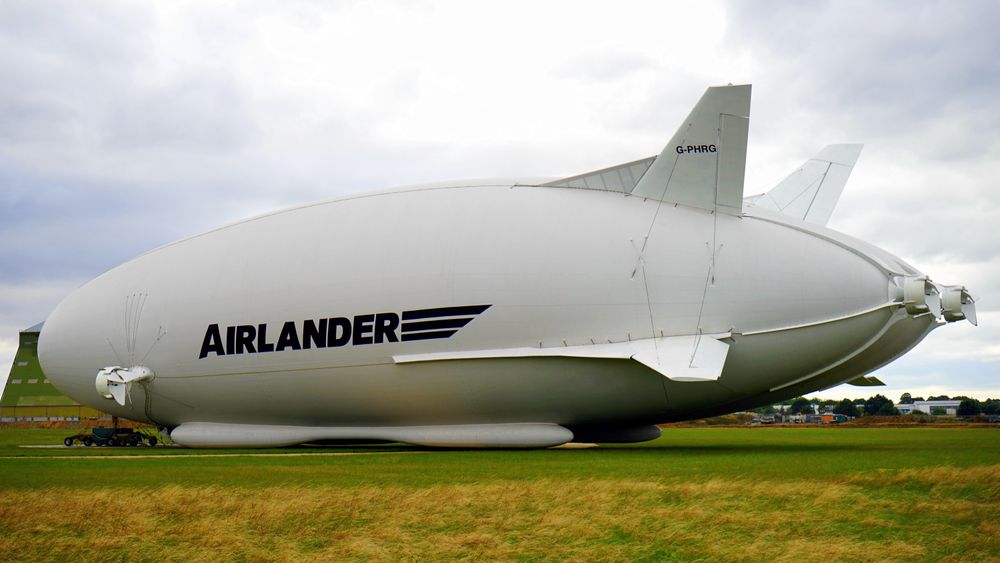
Steampunk airships are the style's favourite machine. Look at any steampunk picture, film poster or book cover and there is a good chance a great ship floats somewhere in its sky: a long envelope of patched fabric, a wooden gondola hung beneath it, brass propellers turning, and a captain at the rail with goggles and a telescope. The airship steampunk imagines is older, grander and stranger than any that flew, but it grew out of real machines and real stories.
This guide explains why airships belong to steampunk, the flying machines in the books of Jules Verne and H. G. Wells, what a steampunk airship looks like, where they appear in films, games and books, how to draw or build your own, and the airship captain as a character. The real airships, from the first steam-driven flight to the Hindenburg, have a guide of their own, and this one ends with a short look at them.
Why airships belong to steampunk
An airship is a powered aircraft that is lighter than air: it floats because the gas inside it weighs less than the air around it, and engines and propellers drive it along. That makes it different from a balloon, which drifts with the wind, and from an aeroplane, which stays up only while it moves forward.
A real machine of the steam age
Airships belong to steampunk for a simple reason: the first one was driven by steam. On 24 September 1852 the French engineer Henri Giffard flew from the Hippodrome in Paris to Trappes, some 17 miles away, in an airship powered by a single-cylinder steam engine. According to the Science Museum Group, it lacked the power to turn against the wind and fly home, but Wikipedia counts it the first powered and controlled flight, and it took place in the middle of Queen Victoria's reign.
The future that never came
The rest of the airship's history makes it even more suited to the style. For a few decades in the early twentieth century, great airships carried passengers across oceans in comfort, and then, after the crash of the British R101 in 1930 and the German Hindenburg in 1937, they all but vanished. Steampunk is fond of futures that the past imagined and never reached, and the airship is the clearest example of all: a real technology, graceful and enormous, that might have ruled the sky and did not.
Freedom and adventure
An airship also carries a feeling. It moves slowly, sees everything, needs no roads or rails, and can go anywhere the wind allows. In stories it becomes a home, a ship's company and a way of escaping the rules of the ground. That is why so many steampunk characters are captains, navigators, engineers and sky pirates, and why the airship appears again and again in steampunk books, films and games.
Airships in Verne, Wells and early stories
The Victorian writers whose books steampunk grew from were fascinated by flight, and the machines they imagined still shape the way steampunk draws the sky.
Jules Verne's balloons
The French writer Jules Verne made his name with flight. His first great success, Five Weeks in a Balloon (1863), follows Dr Samuel Fergusson, his manservant Joe and his friend Dick Kennedy, a professional hunter, across Africa in a balloon filled with hydrogen, using an invention of Fergusson's that lets him rise and fall without letting out gas or throwing out ballast. Many people remember a balloon in Around the World in Eighty Days too, but that is the film's doing: the flight by balloon in the 1956 film directed by Michael Anderson is not in Verne's novel.
Robur and the Albatross
Verne's most important flying machine is the Albatross, in Robur the Conqueror (1886), published in English as The Clipper of the Clouds. The members of a ballooning club in Philadelphia, the Weldon Institute, are certain that the future of flight is lighter than air, and they are building a great dirigible of their own. A stranger called Robur interrupts their meeting to tell them they are wrong, and carries off their president and secretary on a voyage round the world in his own machine.
The Albatross is not, strictly, an airship at all, because it carries no gas. In the English translation on Project Gutenberg, it is a deck a hundred feet long and twelve wide, like a ship with a pointed bow, with thirty-seven masts that carry seventy-four spinning screws to hold it up instead of sails, and two larger screws to drive it forward. It is built of paper pressed until it is as hard as metal, powered by electric batteries whose secret Robur keeps to himself, and run by a crew of eight. A flying ship with masts, cabins, a galley and a glass wheelhouse is close to the steampunk airship people draw today. Robur returned in Master of the World (1904), in a machine called the Terror that could travel as a car, a boat, a submarine and an aircraft.
H. G. Wells and The War in the Air
The English writer H. G. Wells imagined airships at war. The War in the Air, written in 1907 and published in 1908, follows Bert Smallways, a young man from a London suburb, who is carried off in a balloon and finds himself aboard a German air fleet setting out to attack the United States. Wells describes the German airships as fish-like, held together by ribs of steel and aluminium, with their gas bags filled with hydrogen. They bomb New York, and the war that follows spreads round the world until civilisation collapses. A preface to a reprint edition points out that, when the book was written, the aeroplane was little more than a rumour to most people. Where Verne's flying machines promise adventure, Wells's warn of what flight could do to cities, and steampunk borrows from both.

Lighter or heavier than air
Robur's quarrel with the Weldon Institute was a real argument of his day: would the future belong to craft that floated, or to machines that flew by their own power? History answered with the aeroplane. Steampunk usually refuses to choose, and its airships often have gas envelopes, wings, masts and a dozen propellers all at once.
What a steampunk airship looks like
A steampunk airship takes the shapes of real airships and exaggerates them, adding the ship of sail, the railway carriage and the Victorian drawing room.
The envelope
A real airship has two main parts. The envelope is the great body that holds the lifting gas, and the gondola is the enclosed cabin hung below it, holding the crew, the engines and the cargo. Real airships came in three kinds: rigid ones, with a metal frame inside holding separate gas bags, like the Zeppelins; semi-rigid ones, with a keel along the bottom; and non-rigid ones, often called blimps, kept in shape by the pressure of the gas alone. A steampunk envelope is usually the long cigar shape of the rigid airship, but drawn in patched canvas or riveted plates, often with ribs showing through, netting and ropes over the top, and sometimes a second or third envelope side by side.
The scale
Real airships were enormous. The first Zeppelin, LZ 1, was about 128 metres long, and its gondolas looked like small boats hung beneath it. Steampunk artists often play with that scale in both directions: some draw a whole town or a palace hanging below a vast envelope, others a little one-person craft no bigger than a rowing boat, with a balloon above and a pedal-driven propeller behind.
The gondola
The gondola is where the steampunk imagination runs free. It may be a wooden sailing ship with its masts cut short, a railway carriage, a brass submarine or a whole floating house with balconies and bay windows. Inside there is a bridge with a great wheel, speaking tubes and gauges, a saloon with leather armchairs and a chart table, and an engine room of pipes, valves and furnaces.
The details
- Propellers, often several, on brackets, booms or masts, turned by belts and gears.
- Sails and fins, borrowed from sailing ships and fish, for steering and show.
- Funnels and smoke, because a steampunk airship is usually driven by steam, even though a real one would have had to keep fire well away from its gas.
- Brass, copper and wood, rather than the aluminium and fabric of real airships.
- Flags, figureheads and names painted on the side, as on a ship.
The gas
Real airships used hydrogen, which gives the most lift and is cheap but burns very easily, or helium, which does not burn but is rare and expensive. Stories sometimes make the danger part of the drama, and sometimes invent a new gas, or a mineral, to do the lifting instead.
Airships in films, games and books
Airships fill steampunk fiction. These are some of the best known, each checked against a good source.
Films
Hayao Miyazaki's animated film Castle in the Sky (1986) has some of the best-known airships in steampunk: the air pirates' ship, the small flying machines the pirates use, and the huge military airship Goliath, all hunting for the legendary flying castle of Laputa, named after the flying island in Jonathan Swift's Gulliver's Travels (1726). Stardust (2007), directed by Matthew Vaughn from Neil Gaiman's novel of 1999, has a band of sky pirates in a flying ship led by Captain Shakespeare. The Three Musketeers (2011), directed by Paul W. S. Anderson, adds airships to Alexandre Dumas's novel. Our guides to the best steampunk films and animated steampunk films and series have many more.
Books
- The Warlord of the Air (1971) by Michael Moorcock sends an Edwardian soldier into an alternative 1973 where the old empires still rule and the skies belong to their airships.
- Northern Lights (1995) by Philip Pullman has the Texan aeronaut Lee Scoresby, who carries its heroine, Lyra, in his balloon, and a military airship that arrives near the end.
- Mortal Engines (2001) by Philip Reeve has the aviator Anna Fang and her airship, the Jenny Haniver, and a neutral flying city called Airhaven.
- Airborn (2004) by Kenneth Oppel is set aboard a passenger airship, the Aurora, with a fourteen-year-old cabin boy as its hero; the ship floats on an invented gas the book calls hydrium.
- Leviathan (2009) by Scott Westerfeld, illustrated by Keith Thompson, is named after its whale airship, a living creature and the finest beast in the British fleet.
Our guide to steampunk books covers these and the writers who came after.
Why the airship keeps returning
Writers and film-makers come back to airships for practical reasons as well as romantic ones. An airship can carry characters anywhere in the world in a few scenes, it gives them a home and a crew to argue with, and it makes a wonderful setting for a chase, a storm or a fight on deck. It also looks right in any period from the 1850s to an imagined future, which is why it fits Victorian adventures, wartime stories and far-future worlds alike.
Games
In Final Fantasy VI (1994), the gambler Setzer Gabbiani owns the world's only known airship, and airships are one of the main ways of crossing the world, as in most games in the series. BioShock Infinite (2013) is set in Columbia, a city floating in the air in 1912. Airship Pirates (2011), a role-playing game published by Cubicle 7 for Cakebread & Walton, is built on the world of the American band Abney Park, whose story has them take over a time-travelling airship, HMS Ophelia. Our guide to steampunk games has more.
Drawing or building your own airship
An airship is one of the most satisfying things in steampunk to draw or make, because it is built from simple shapes and can carry as much detail as you like.
Drawing one
Start with the envelope, a long oval, and draw a line along its middle to show which way it points. Hang the gondola below it with straight lines for the rigging, and keep the gondola small; real gondolas were tiny beside their envelopes, and the contrast makes a drawing look enormous. Then add the details from the list above: ribs or panels on the envelope, propellers, fins, portholes and a rail along the deck. Shade the envelope as a cylinder, darker underneath, so that it looks round and heavy with gas. Our guide to how to draw steampunk takes you through it step by step.
Building a model
A model airship can be made from almost anything. A balloon covered in papier mache makes an envelope; a plastic bottle works too. The gondola can be made from card, balsa wood or a small box, and buttons, beads, washers and old watch parts make propellers and fittings. Paint it in brass, copper and dark wood, hang it from the ceiling with fishing line, and it will turn gently in the air. If you use a craft knife or a glue gun, work on a cutting mat, keep fingers behind the blade, and paint in the open air or a room with the window open.

An airship to wear
A small model airship can also become part of a costume. Fixed to the band of a top hat, it turns the hat into a captain's or an aeronaut's at once; hung from a belt on a short chain, it becomes a curiosity to talk about. Keep it light, fix it firmly with thread or a strong clip rather than relying on glue alone, and make sure it has no sharp points at the height of other people's eyes in a crowd.
In a game
Many people build airships in games, where they can be as large as they like. Our guide to building steampunk in Minecraft shows how to build one block by block, with an envelope, a gondola and copper for the brass.
The airship captain as a character
The airship captain is one of the most popular steampunk characters, and it is easy to see why. A captain has authority, a ship, a crew and a store of stories, and the costume is practical as well as striking.
The costume
A captain's outfit usually starts with a long coat or a naval-style jacket with brass buttons, worn over a waistcoat and shirt. Add a peaked cap, a tricorn or a top hat, a pair of flying goggles, leather gauntlets and good boots. The tools of the trade finish it: a brass telescope, a compass, a pocket watch, a map case, a speaking trumpet. A sky pirate adds sashes, scarves and borrowed finery; a navy officer keeps it neat and pressed.
The crew
An airship needs more than a captain, which is what makes it such a good idea for a group. Friends can be the navigator with charts and dividers, the engineer in an apron with oil on her face, the ship's doctor with a bag of instruments, the cook, the stoker, the lookout with a spyglass and the passenger who is not what she seems. Give the ship a name, paint it on a badge, and the whole crew has a story ready made.
Ranks aboard
Steampunk crews usually borrow their ranks from the navy, because an airship is a ship. A captain commands, a first officer or lieutenant stands in for the captain, a midshipman learns the trade, and a bosun keeps the crew in order. An invented air service, with its own name and badge, lets a crew wear smart uniforms without borrowing a real regiment's.
Writing the story
A good captain's story fits in a few lines: the ship's name, where she sails from, what she carries and what went wrong on her last voyage. A cargo airship out of a northern port, carrying tea and trouble, with a captain who has never told the crew she is afraid of heights, gives you a costume, a conversation and a reason for every object you carry. Our guide to steampunk names and characters shows how to build one, with real Victorian names, ranks and titles.
The real airships behind the dream
Behind every steampunk airship stand the real ones. After Giffard's steam-driven flight of 1852, the rigid airship followed in Germany: the first Zeppelin, LZ 1, flew from a floating hangar on Lake Constance on 2 July 1900. Over the next decades airships grew into the largest flying machines of their age. Britain built its own at Cardington in Bedfordshire, and the R101 crashed in France in 1930 on its first overseas voyage. The German Hindenburg caught fire while landing in New Jersey in 1937, and the age of the great passenger airship ended with it.
Those stories are told with the care they deserve in our guide to the real airships: the R101, the Hindenburg and after, with the dates, the people and what happened. Knowing them adds something to the steampunk airship: it is a dream, but a dream with real engines, real crews and a real history behind it.