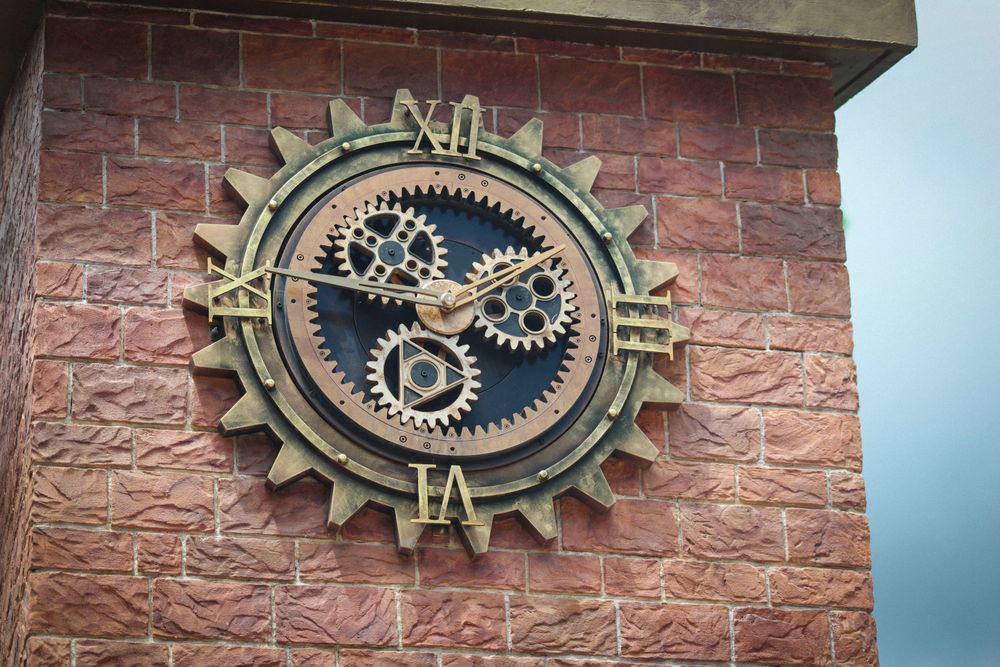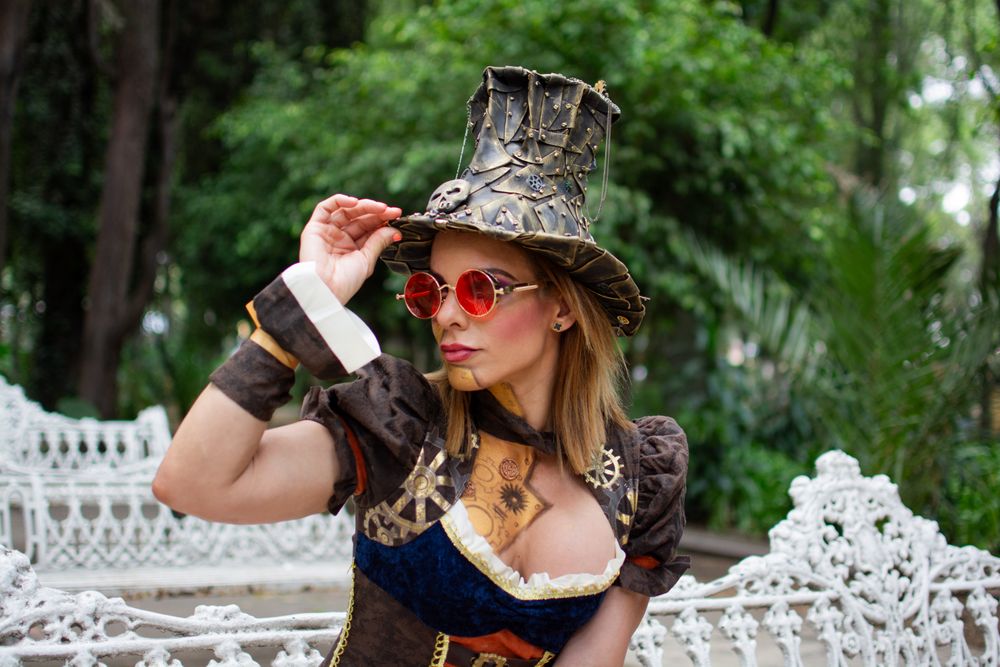
If you have seen a top hat with a pair of brass goggles on its brim, or a clock with all its gears open to view, you have seen steampunk. This guide answers the question most people start with, what is steampunk, and then goes further: what the word means, who first used it, what the style looks like, and what people actually do with it. It is the starting point for everything else on this site.
What steampunk means, in one sentence
Steampunk is a style of stories, clothes, art and objects that imagines the nineteenth century, usually Victorian Britain, as if its steam engines, clockwork and brass instruments had kept on growing into a whole world of invention.
That is the steampunk meaning in one sentence. The dictionaries say much the same thing in their own words. Merriam-Webster's steampunk definition describes science fiction about nineteenth-century societies that run on steam power, real or imagined. The Encyclopedia of Science Fiction, the standard reference work on the subject, calls it an alternate history of the nineteenth century, most often an England full of inventions, which usually stops short of the First World War in 1914.
Both definitions start with books, because that is where the word started. Today it means far more than a kind of novel. When people ask what is steampunk style, they usually mean the look: the leather, the brass, the goggles and the gears. When they talk about being a steampunk, they mean the people who dress in that style, build things in it and meet up in it. All three uses are right, and this guide covers each in turn.
The simplest way to hold the idea in your head is as a question. What if the future the Victorians imagined had actually happened? What if there were airships over London, submarines powered by strange engines, and calculating machines the size of a room, all built with the materials and the manners of the 1800s? Steampunk is the answer people have been dressing up, writing and building ever since.
Part of its appeal is that it is optimistic about machines in a way modern life often is not. A steampunk machine is something a person could understand, mend and be proud of, made by hand from metal and wood, with every part visible. It belongs to an age of explorers and inventors, when it seemed that one determined person in a workshop could change the world. People who love steampunk often say that what draws them is that feeling of curiosity and craft, as much as the clothes.
Where the word came from
The word is younger than most people expect. It was coined by the American writer K. W. Jeter in a letter to Locus, the magazine of the science fiction and fantasy trade, printed in its April 1987 issue. Merriam-Webster gives 1987 as the word's first known use.
Jeter was writing about a small group of novels by himself and two friends, Tim Powers and James Blaylock, which were all set in a Victorian past full of strange machines and stranger events. The books he had in mind included his own Morlock Night (1979), in which the underground Morlocks from H. G. Wells's The Time Machine come back through time to invade the sewers of Victorian London, Powers's The Anubis Gates (1983) and Blaylock's Homunculus (1986). He suggested, half seriously, that this kind of Victorian fantasy needed a name for the whole group, and offered steampunk.
The joke was in the second half of the word. In the early 1980s a new kind of science fiction had become fashionable under the name cyberpunk: gritty stories about computers, hackers and a dark, high-tech future. The writer Bruce Bethke had coined that word as the title of a short story published in 1983. Jeter swapped the computers for steam, and steampunk was born as a play on cyberpunk. Merriam-Webster gives exactly that origin: steam, plus the end of cyberpunk.
The word stayed among readers of science fiction for some years. The Encyclopedia of Science Fiction finds little sign of wider use before about 2006. By around 2007 it had also come to mean a style of retro clothing with goggles and clockwork accessories, and by the end of that decade it was being described as a way of life, in the way that punk and goth are. The full story, from Jules Verne to the present day, is told in our guide to where steampunk came from.
The three ingredients: the Victorian age, steam and clockwork, the future that never came
Almost everything that people call steampunk is made from the same three ingredients. Once you can see them, you can recognise the style anywhere, and you can tell when something is only borrowing the name.
The age: Victorian Britain
Queen Victoria reigned from 1837 to 1901, and that century gives steampunk its clothes, its manners and its buildings. Frock coats, corsets, bustles and top hats; brick railway stations, iron bridges and gas lamps; the language of explorers, engineers and gentlemen's clubs. Some steampunk is set in Paris or the American West, and some in invented worlds, but the Victorian age is the base it nearly always starts from.
The power: steam and clockwork
In a steampunk world there are no microchips and no plastic. Machines are driven by steam, springs and gears, and they are built from brass, copper, iron, wood and leather. Just as important, the workings are left on show. A steampunk clock lets you see its wheels turning; a steampunk gadget has its pipes, rivets, dials and gauges on the outside. The look comes from showing how a thing works rather than hiding it inside a smooth case.
The dream: the future that never came
The third ingredient is imagination. Victorian writers dreamed of machines their own century could not yet build. Jules Verne gave Captain Nemo a submarine, the Nautilus, in Twenty Thousand Leagues Under the Seas (1870). H. G. Wells gave his inventor a machine for travelling through time in The Time Machine (1895), and described it as made partly of nickel, partly of ivory and partly of rock crystal. Steampunk takes those dreams and asks what the world would have looked like if they had come true.

What steampunk looks like
The steampunk look is easy to spot once you know its parts. The colours are warm and dark: brass, copper, bronze, brown leather, dark wood and the deep reds and greens of Victorian rooms. The materials are the ones a nineteenth-century workshop would have used, never shiny plastic. The details are mechanical: gears and cogs, gauges and dials, rivets, valves, pipes and springs.
On a person, the look starts with Victorian clothes, such as a waistcoat, a long coat, a blouse, a corset, a long skirt or a pair of breeches, and then adds the workings: a pair of goggles, a leather belt with pouches, a pocket watch, a brass gauntlet or a hat that seems to have been given a job. In a room, it is exposed brick, iron pipes, glowing bulbs in cages, old maps, brass instruments and clocks with their faces cut away. On screen, it is airships, steam locomotives, submarines and inventors' workshops crowded with half-finished machines.
What separates steampunk from a simple Victorian costume is that sense of invention. A Victorian top hat is history. The same top hat with goggles on the brim and a small brass gauge on the band has become steampunk, because it now tells a story about the person wearing it. Our guide to the steampunk aesthetic goes through the colours, materials and details one by one, with a checklist for recognising the style.
Steampunk as a story: books, films and games
Steampunk began on the page, and books remain at its heart. After Jeter, Powers and Blaylock, the novel that brought the idea to a wider readership was The Difference Engine (1990) by William Gibson and Bruce Sterling, two of the best known writers of cyberpunk. It imagines a Victorian Britain in which Charles Babbage's mechanical computer was actually built, and follows the changes it brings to London in 1855. Later books took the idea in many directions. Philip Reeve's Mortal Engines (2001), first published in Britain, imagines a far future in which London has become a city on wheels that hunts smaller towns.
Comics and films carried the style further. The League of Extraordinary Gentlemen, a comic by Alan Moore and Kevin O'Neill first published in 1999, gathers characters from Victorian novels, among them Captain Nemo and Allan Quatermain, into a team working for the British Empire in 1898. It was made into a film in 2003. In Japanese animation, Hayao Miyazaki's Castle in the Sky (1986) has sky pirates, airships and a flying castle, and Katsuhiro Otomo's Steamboy (2004) follows a boy inventor from Manchester to London. Martin Scorsese's Hugo (2011) centres on a clockwork automaton hidden in a Paris railway station in 1931.
Games let you walk around inside the style. Frostpunk (2018), made in Poland, puts you in charge of a city that must survive a frozen alternate 1886 around a single great coal-fired generator. The Order: 1886 (2015) is set in an alternate Victorian London full of strange weapons and machines. Television had its own early example: The Wild Wild West, an American series broadcast from 1965 to 1969, sent two government agents across the nineteenth-century West with a train full of gadgets, and it was remade as a film in 1999.
What these stories share is not a plot but a mood. They take a world that looks like the nineteenth century and fill it with inventions that century never had, then ask what those inventions would do to the people living with them. Some are light adventures, some are dark, and some are funny. Our guide to the best steampunk films goes through many more, along with the animated films and series that have done so much to spread the look.
Steampunk as something people do: dressing up, making and meeting
For many people steampunk is not something they read or watch so much as something they do. There are three main ways in, and most steampunks do a bit of each.
Dressing up
The most visible side of steampunk is the clothes. People put together outfits that look as if they belong to an explorer, an inventor, an airship captain or a lady adventurer, built on Victorian shapes and finished with goggles, leather and brass. There are no rules and no uniform; the fun is in inventing a character and dressing as them. Our guide to steampunk fashion takes you through it from head to foot. If you wear a corset as part of an outfit, lace it so that you can still breathe and move easily, and take it off if you feel faint.
Making
Steampunk has always been a style for people who like to make things. Many outfits are built rather than bought: a hat fitted with old watch parts, a ray gun made from a toy and a few plumbing fittings, a lamp built from pipes and an old valve. Making is part of the point, because a steampunk object should look as though someone invented it. Our guide to making steampunk props safely covers the tools, the materials and the care that making needs.
Meeting
Steampunks gather at weekends, fairs and conventions, often in towns with Victorian streets or old railway buildings. People come dressed as their characters, walk the town, show what they have made, listen to music and talk. A first visit is the easiest way to see the whole style in one place. See our guide to UK events for where steampunks gather and how to find each organiser's dates.
What steampunk is not
Because the word is used so widely, it helps to know what does not count.
Steampunk is not simply Victorian. A historically accurate Victorian dress, worn exactly as it would have been in 1880, is Victorian costume. It becomes steampunk when something impossible or invented is added: a mechanical arm, a pair of aviator's goggles, a gadget whose purpose you can only guess. The difference is explained in full in our guide to steampunk, gothic and Victorian.
Steampunk is not the same as gothic either. Gothic dress tends towards black, lace, velvet and a love of darkness and romance. Steampunk prefers brown and brass, and its mood is more adventure than melancholy. The two can be combined, and often are, but they start from different places.
Steampunk is not a set of gears glued onto anything. A cog stuck to a hat for no reason looks like decoration; a cog that seems to drive something looks like steampunk. The best pieces suggest that every part has a job, even when the job is imaginary.
And steampunk is not a real period of history. The Victorians had steam engines, railways, telegraphs and the first electric lights, but they did not have steam-driven computers or airship fleets. Steampunk is a dream about the past, not a record of it, which is why it is free to borrow, change and invent.
Nor is it only for one kind of person. Steampunk is not tied to an age, a body shape or a budget, and it has no official version. Some steampunks spend years on a single outfit; others wear a waistcoat and a pair of goggles and are just as welcome. Because the style is invented, nobody can tell you that you have got the history wrong.
Related styles: dieselpunk, clockpunk and others
Steampunk has relatives. Each borrows its name from the same joke on cyberpunk and each imagines a different age of machines.
- Dieselpunk moves the clock forward to the years between the two world wars and on into the 1950s, when diesel engines took over from steam. Think of art deco, aeroplanes, tanks, chrome and pinstripes.
- Clockpunk moves it back to the sixteenth, seventeenth and eighteenth centuries, the age of clockwork, gears and machines drawn in the manner of Leonardo da Vinci's notebooks.
- Atompunk imagines the years from 1945 to 1969, the age of the atom, the jet and the space race, with its rockets and rounded shapes.
- Gaslamp fantasy is a name for stories set in a romantic, smoky nineteenth-century city, most often London, with more magic and less machinery than steampunk.
- Silkpunk is the writer Ken Liu's name for stories drawn from East Asian history, where the technology is made from bamboo, paper and silk instead of brass and iron.
The edges between them are soft. A story can move from steam to diesel as it goes on, and many people who enjoy one enjoy the others. On this site we stay with steampunk and the Victorian world behind it.
How to start
You do not need to buy anything or join anything to start. Here are the simplest first steps, in the order most people take them.
- Look at it. Watch one of the films named above, or read one of the books, and notice what makes it feel steampunk. The guide to the steampunk aesthetic will help you name what you are seeing.
- Choose a character. Decide who you would be in a steampunk world: an explorer, an engineer, an airship pilot, a scientist or someone of your own invention. The character decides the outfit.
- Start with clothes you have. A plain white shirt or blouse, a waistcoat, dark trousers or a long skirt and a pair of boots make a good base. Our guide to a steampunk costume on a budget shows how far that base will take you.
- Add one piece of workings. A pair of goggles, a pocket watch on a chain or a leather belt is enough to turn ordinary clothes into steampunk.
- Make something. Even a small thing, a brooch from an old watch or a badge from a gear, teaches you how the look is put together.
- Go and see it. When you are ready, visit a gathering and meet the people who wear it.
A few habits help from the beginning. Keep a notebook or a folder of pictures of outfits, rooms and objects you like, and look for what they have in common. Pay attention to colour before decoration: an outfit in brown, cream and brass will look more steampunk with no gears at all than a black one covered in them. And take your time. Most people's first outfit is simple, and most people's favourite outfit is one they have added to, piece by piece, over several years.
If you would rather read and watch than dress up, that is steampunk too. Many people enjoy the books, films and art without ever owning a pair of goggles, and the history behind the style, from the railways to the airships, is fascinating in its own right.
Steampunk is a broad and welcoming style. It has no single right way to do it, only the shared idea of a Victorian future that never quite happened, built with your own hands and imagination.