Put a Victorian lady, a goth and a steampunk side by side and a stranger could easily take them for the same thing. All three might wear a long dark skirt, a high lace collar, a corset or a top hat. Yet they come from quite different places. Victorian is a real period of history. Gothic is a mood that runs from medieval cathedrals, through frightening novels, to a music scene of the 1980s. Steampunk is a modern invention: the Victorian age imagined with its machines left on show. This guide takes the steampunk, gothic and Victorian styles one at a time, then puts them side by side so the differences are easy to see.
Knowing which is which helps in two ways. If you are dressing up, it tells you which pieces to choose. If you are reading about any of the three, it keeps the history from getting tangled.
Victorian: the real nineteenth century
Victorian means anything from the reign of Queen Victoria, who came to the throne on 20 June 1837 and reigned until her death on 22 January 1901. That is more than sixty-three years, long enough for fashion to change many times over. So Victorian dress can mean several very different shapes.
How women's clothes changed
In the 1840s skirts were wide and dome-shaped, held out by layers of petticoats stiffened with horsehair. In 1856 came the cage crinoline, a frame of steel hoops that did the same job with far less weight, and skirts reached their widest in the early 1860s. By the late 1860s the fullness had moved round to the back, and in the 1870s the bustle arrived: a pad or frame worn under the skirt at the back to hold up the gathered fabric. It shrank towards the end of that decade, then came back around 1883 in a larger, shelf-like form. By the 1890s crinoline and bustle had both gone. Skirts fell in a plain A-line shape, and the volume moved up to the sleeves, which grew into great puffs at the shoulder, at their largest around 1896.
Under all of these sat a corset. The V&A's collection shows how corsets changed through the reign, from hand-sewn cotton stiffened with whalebone to stiffer shapes moulded with steam, and, in the 1880s, boning covered in leather. The important point for anyone dressing up is that a Victorian corset was underwear, there to shape the dress over it, not to be seen.
How men's clothes changed
Men's dress changed more slowly. In the 1840s a gentleman wore a close-fitting frock coat that reached to the calf, a waistcoat and a top hat. Over the next decades the frock coat shortened to the knee for business, and a looser, shorter jacket appeared for less formal wear. By the 1870s three-piece suits, a jacket, waistcoat and trousers all cut from the same cloth, were growing popular. The top hat stayed the hat for formal dress, while the round, hard bowler, designed in London in 1849 for gamekeepers whose top hats kept being knocked off by branches, became the hat for more casual occasions.
Not all black
The Victorian age is often pictured in black, and much of it was. When Prince Albert died on 14 December 1861, the Queen went into mourning and wore black for the rest of her life, almost forty years. Mourning dress had strict stages, and a widow could be expected to wear it for as long as four years. But the same age was also full of strong colour. In 1856 the young chemist William Perkin, trying and failing to make the malaria medicine quinine, found instead a purple dye he called mauveine, one of the first of the new artificial dyes. Demand rose after Queen Victoria and the French Empress Eugénie were seen in the colour, and the Science Museum still holds a piece of mauve-dyed fabric supplied for one of the Queen's dresses. The new dyes were brighter than the old natural ones and faded less, and Victorian dresses came in purples, greens and reds, tartans and patterned silks.
The Victorian age also built things. The Great Exhibition, held in Hyde Park from 1 May to 15 October 1851 in the Crystal Palace, a huge building of iron and glass, drew about six million visitors, and its working machinery was one of the most popular sights. That side of the age, the engine house rather than the drawing room, is the part steampunk takes and runs with. For the real clothes of the period, see our guides to Victorian fashion for women and Victorian mourning dress.
Gothic: darkness, romance and the medieval revival
Gothic is a slippery word, because it has meant three different things over the centuries, and all three feed into the gothic look people wear today: a way of building, a kind of story, and a music scene.
The medieval churches
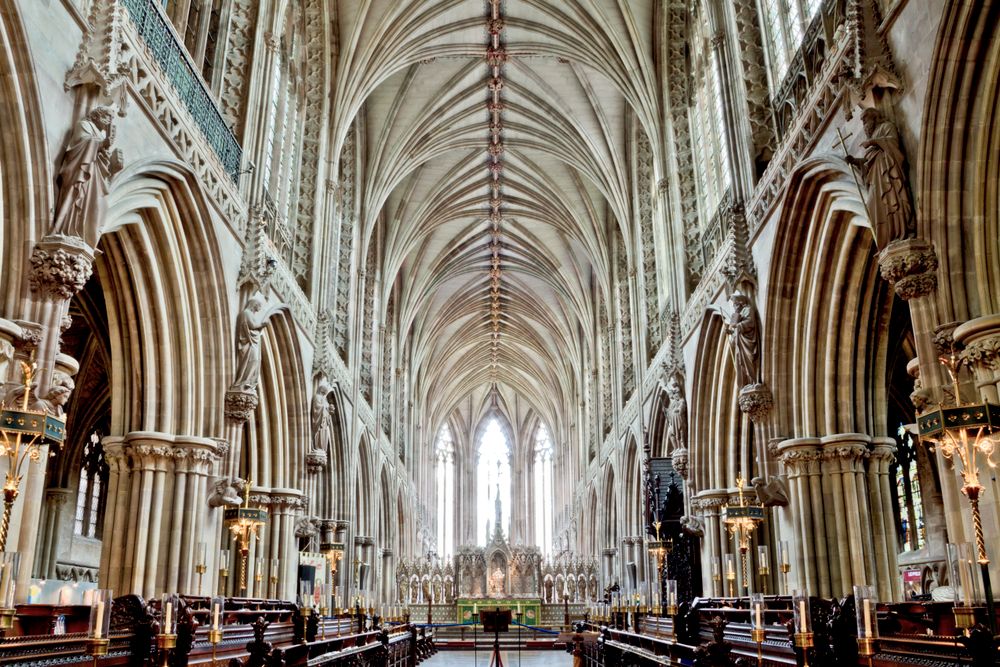
The first Gothic was a way of building. It began in northern France in the twelfth century. The choir of the Abbey of Saint-Denis, near Paris, rebuilt between 1140 and 1144 for Abbot Suger so that more light could pour in through larger windows, is usually counted as the first Gothic building. The style's marks are pointed arches, ribbed stone ceilings, flying buttresses that prop the walls up from outside so they can be taller and thinner, and great windows of stained glass. The name itself began as an insult. Renaissance writers, among them the Italian artist and writer Giorgio Vasari in 1550, called the style barbarous and blamed it on the Goths. The insult stuck, and became the name.
The Gothic Revival
From the eighteenth century the British fell back in love with the Middle Ages. In 1749 the writer Horace Walpole began Strawberry Hill, his villa at Twickenham, in the Gothic manner, and it became the founding house of the Gothic Revival in England. After a fire destroyed most of the old Palace of Westminster in 1834, the new Houses of Parliament went up in the Gothic style, laid out by Charles Barry, with the outside decoration and the interiors by Augustus Pugin. By the middle of the nineteenth century the Gothic Revival was the leading style of building in the Western world, used for churches, public buildings and railway hotels. So the Victorians were themselves gothic, in this one sense: many of their buildings were pointed, carved and medieval in spirit.
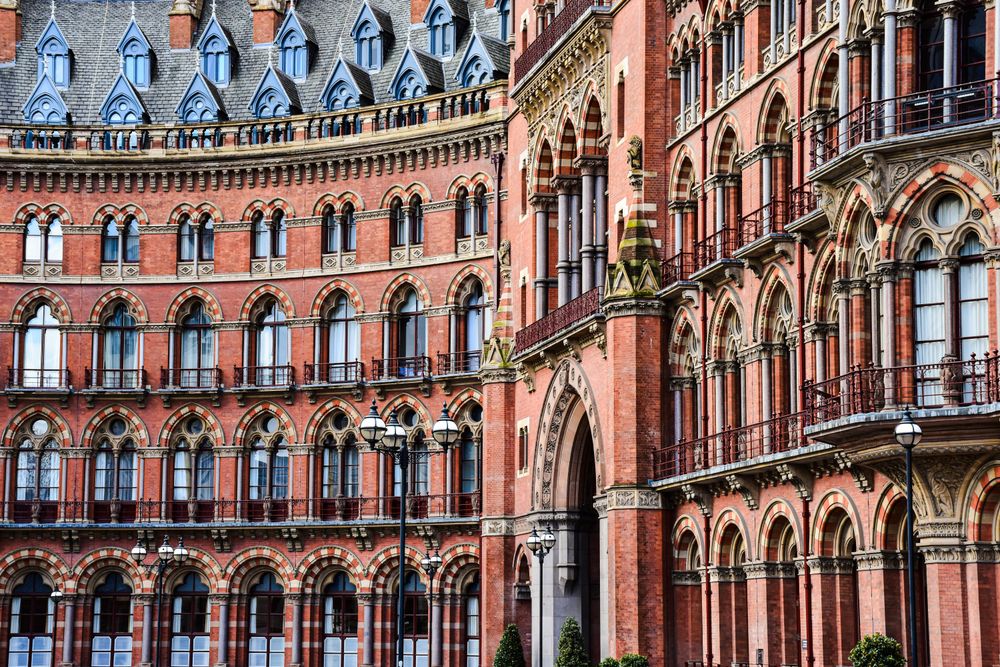
The hotel at St Pancras station in London, built between 1868 and 1876 to the designs of George Gilbert Scott, is one of the best-known examples, and it is now listed at Grade I. Our guide to Gothic Revival architecture covers these buildings in detail.
The Gothic novel
Walpole gave the word its second meaning too. In 1764 he published The Castle of Otranto, usually counted as the first Gothic novel: a story of a cursed castle, secret passages and doom from beyond the grave. A whole kind of fiction followed, full of ruins, storms, ghosts and dread. Mary Shelley's Frankenstein, published without her name on 1 January 1818, is both a Gothic novel and one of the first works of science fiction, which makes it a distant ancestor of steampunk as well. Bram Stoker's Dracula, published in 1897, was shaped in part by his stay in Whitby in the summer of 1890. In the town's library he found an 1820 book that mentioned a fifteenth-century prince called Dracula, and in the novel a ship runs aground below Whitby's East Cliff with its crew dead.
The goth scene
The third meaning is the one most people have in mind today. Goth, as a music scene and a way of dressing, grew up in Britain in the early 1980s, out of the post-punk music of the late 1970s and around nightclubs such as the F Club in Leeds and the Batcave, which opened in Soho, London, in July 1982. Goths took the black of the Victorian mourner, the romance of the Gothic novel and the drama of old horror films, and wore them: mostly black clothes, dark make-up and eyeliner, black hair, silver jewellery, and clothes borrowing from Victorian and Elizabethan dress.
So gothic, in any of its three senses, is about mood. It looks backwards, to the medieval and the macabre. It cares about darkness, beauty, death and longing. It has no particular interest in machines, and that is the clearest line between it and steampunk.
Steampunk: the Victorian age with its machines left on show
Steampunk is by far the youngest of the three. The word was first used by the American writer K. W. Jeter in a letter printed in the April 1987 issue of Locus, the American trade magazine of science fiction and fantasy publishing. He was looking for a name for the Victorian fantasies that he and two friends, the writers Tim Powers and James Blaylock, were writing, and offered steampunk as a playful twist on the word cyberpunk, a kind of science fiction about computer networks. Jeter's own Morlock Night, from 1979, was a sequel to H. G. Wells's The Time Machine.
The idea behind steampunk is a question: what if the future the Victorians imagined had actually arrived? Captain Nemo's submarine, the Nautilus, in Jules Verne's Twenty Thousand Leagues Under the Seas (1870), and the machine the Time Traveller builds in H. G. Wells's The Time Machine (1895), are the kind of thing steampunk pictures as part of everyday life. In 1990 William Gibson and Bruce Sterling's novel The Difference Engine imagined a Victorian Britain transformed by the mechanical computers of Charles Babbage.
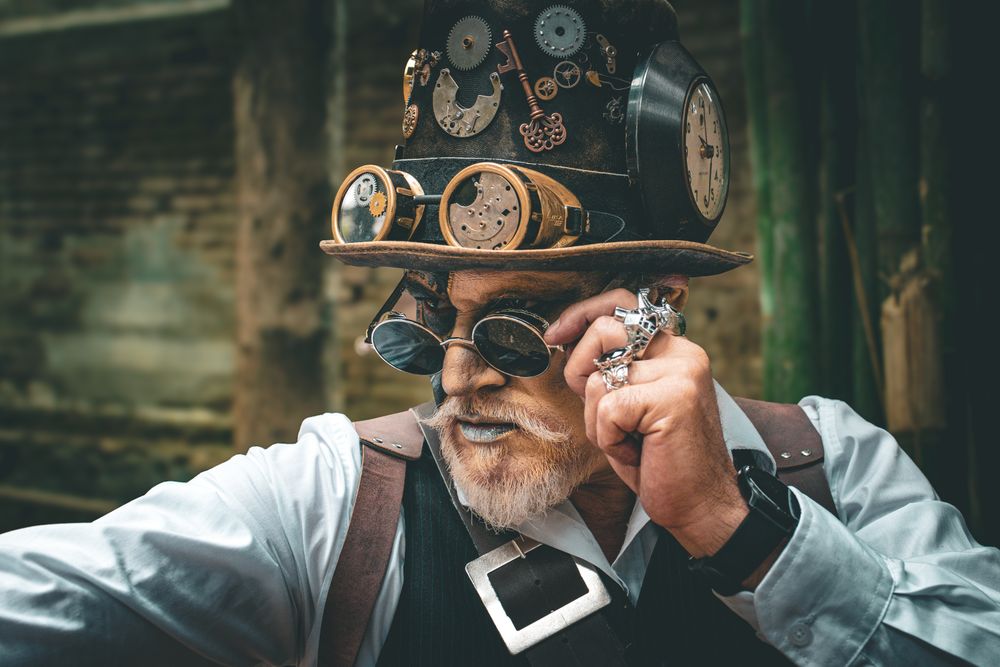
By around 2007, steampunk had become a way of dressing as well as a kind of fiction, with gatherings following in America and in Britain. The clothes start from the Victorian wardrobe, then add the machine age on top: brass goggles, gauges, cogs, leather straps and buckles, tools and instruments. The key idea is that the workings are left on show. A Victorian woman hid her corset under her dress; a steampunk often wears hers on the outside, fastened with buckles. A Victorian gentleman's top hat was plain; a steampunk's has gauges and a pair of goggles fixed to it.
Steampunk is also cheerful in a way gothic usually is not. Its heroes are explorers, inventors, airship captains and engineers. It looks forward, to adventure and invention, rather than back to ruins and graveyards. For the full story of the word and the books, see where steampunk came from, and for how to recognise the look, our guide to the steampunk aesthetic.
The same top hat, worn three ways
The top hat is the easiest way to see the difference, because all three styles wear one, and it looks quite different in each.
The Victorian top hat
Tall, black and smooth, with a narrow band and a curled brim. It was the gentleman's formal hat for most of the century, and worn properly it says one thing: respectability. A Victorian would wear it with a frock coat or a morning coat, a waistcoat and a white shirt with a high collar.
The gothic top hat
The same hat, but the mood changes. A goth might wrap it in black lace or hang a short veil from the brim, and add a black rose, a feather, a silver skull or a ribbon in deep red or purple. It is worn with black: a long coat, velvet, lace at the throat, silver rings. The hat becomes part of a picture of mourning and romance, closer to an undertaker or a vampire than to a banker.
The steampunk top hat
The same hat again, but now it has a job. A pair of goggles sits on the brim. A gauge, a small cog or a brass fitting is fixed to the band, perhaps with a leather strap and buckle. The hat may be brown rather than black, or a shorter, more battered shape, as if it had been out in the weather on the deck of an airship. It is worn with a waistcoat in a warm colour, leather straps, a pocket watch on a chain, and boots. The hat suggests a person who makes things and goes places.
The lesson carries over to almost every other piece. A corset, a long coat, a lace blouse or a pair of boots can belong to any of the three styles. What changes is what you add to it and the colours around it. Our guide to steampunk hats and top hats goes further into hats of every kind.
Colours compared
Colour is the quickest way to tell the three apart from across a room.
Victorian colours
The real Victorian palette was wider than most people expect. Mourning black was everywhere, and when the first deep mourning ended, a widow moved into what was called half-mourning, when grey, lavender and mauve were allowed. But ordinary day and evening dresses came in the bright new dye colours from the late 1850s onwards, alongside greens, blues, plums, tartans and richly patterned silks.
Gothic colours
Gothic starts from black and stays close to it. Its accent colours are deep and cool: blood red, wine, purple, bottle green, with silver rather than gold for metal. White appears as pale lace, or as pale make-up. The mood is night time.
Steampunk colours
Steampunk is warmer. Its colours are the colours of its materials: brown and tan leather, brass and copper, aged bronze, dark wood, cream linen, rust and the faded khaki of a travelling coat. Black is used, but it is usually lifted by a warm metal. Where gothic chooses silver, steampunk chooses brass. Where gothic is night time, steampunk is lamplight in a workshop.
A simple test works most of the time. If the metal is silver and the main colour is black, the outfit leans gothic. If the metal is brass or copper and there is brown leather in it, it leans steampunk. If there is no added metal at all, and the clothes would not look out of place in a photograph from 1880, it is Victorian.
Where they overlap: gothic steampunk
The three were never sealed off from each other. The encyclopedia of science fiction describes the first steampunk novels, by Jeter, Powers and Blaylock, as largely gothic in their vision, set in a dark, Dickensian London where strange life stirred in the cellars and sewers. When steampunk turned into a way of dressing, it borrowed from styles that were already wearing Victorian clothes, the romantic side of the goth scene among them. So it is no surprise that the two meet.
Gothic steampunk, sometimes called goth steampunk or steamgoth, keeps the black and the mood of gothic and adds the machinery of steampunk. Picture a black corset with fittings of gunmetal or blackened brass instead of bright brass, a black top hat with smoked goggles on the brim, a long black coat crossed with leather straps, and a pocket watch in a dark case. The stories it suggests are darker too: a mad scientist's laboratory, a Victorian ghost hunter's kit, an undertaker who repairs clockwork figures in his spare time, or Frankenstein's workshop moved forward fifty years.
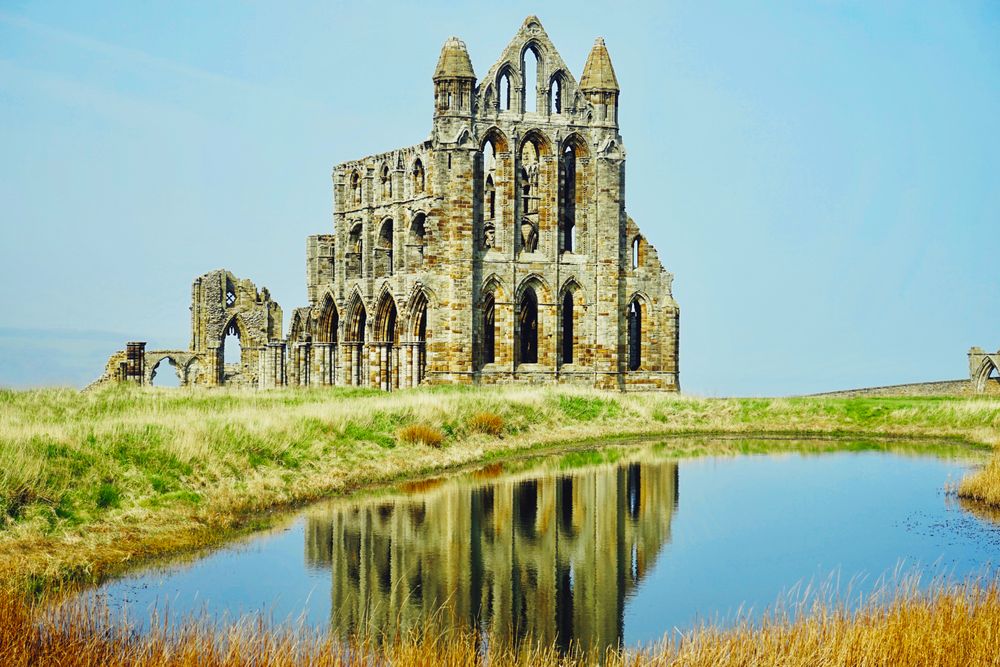
One material sits happily in all three styles: jet, a black stone formed from fossilised wood. The jet found on the Yorkshire coast around Whitby became fashionable for jewellery in the Victorian age, and Queen Victoria wore Whitby jet while in mourning for Prince Albert. A jet brooch is Victorian by history, gothic by colour, and with a small brass cog beside it, gothic steampunk.
The overlap runs both ways. A gothic outfit with one or two machine details, such as a cog brooch at the throat or a watch chain across a black waistcoat, can read as gothic steampunk without losing its gothic heart. The trick is to decide which one leads. If the mood is mourning and mystery, gothic leads and the brass is a hint. If the story is invention and adventure, steampunk leads and the black is simply a choice of colour.
Which one you are dressing as
If you are putting an outfit together, decide early which of the three you are aiming for, because that decision settles most of the choices that follow.
- Victorian, if you want to look like a real person from a real year. Pick a decade, because a crinoline of 1860 and a bustle of 1885 do not belong together, and leave out anything the Victorians did not have.
- Gothic, if you want darkness and romance. Start from black, choose silver, lace, velvet and deep reds or purples, and let the Victorian shapes carry the feeling of the past.
- Steampunk, if you want a character with a job and a story. Start from Victorian shapes, then add the working parts: goggles, leather, brass, tools, a watch, a map case. Ask what your character does, and let the kit show it.
- Gothic steampunk, if you want both: black and mood from gothic, machinery from steampunk, with the metal darkened to match.
None of these is a rule anyone enforces. Steampunk in particular has no official dress code, and most people at a gathering are glad to see any of the four. But the clearer you are about which one you are wearing, the more the outfit hangs together, and the easier it is for other people to read it at a glance. For a full walk-through of building an outfit, see our complete guide to steampunk fashion, and for the bigger picture, our guide to what steampunk is.
A side-by-side table
The table puts the main differences in one place.
| Victorian | Gothic | Steampunk | |
|---|---|---|---|
| What it is | A real period of history | A mood: medieval churches, then novels, then a music scene | A modern style that imagines the Victorian age with its machines on show |
| When | 1837 to 1901, Queen Victoria's reign | Churches from the 1140s, the Gothic novel from 1764, the goth scene from the early 1980s | The word from 1987, the way of dressing from the 2000s |
| Mood | Respectable and proper | Dark, romantic, melancholy | Adventurous, inventive, curious |
| Main colours | Black and dark tones, bright new dye colours, half-mourning greys and mauves | Black, with deep red, purple and wine | Brown, tan, cream and rust, with brass and copper |
| Metal | Little, small and discreet | Silver | Brass, copper and bronze |
| The corset | Underneath, never seen | Often on show, usually black | Often on show, in leather or patterned fabric, with buckles |
| The top hat | Plain black | Black, with lace, a veil or a rose | With goggles, gauges or cogs |
| Typical extras | Gloves, a fan, a parasol, a pocket watch | Lace, silver crosses, skulls, black roses | Goggles, gears, tools, maps, leather straps |
| Machines | All around, but never worn | None | Worn on the body |
The bottom row is the one to remember. The Victorians lived among steam engines and wore none of them. Gothic is not interested in engines at all. Steampunk takes the engines of the Victorian age and puts them on the body, which is the single thing that makes it steampunk.