A Victorian dress is the foundation of almost every steampunk outfit for women, but there was no single Victorian dress. Queen Victoria reigned for almost 64 years, from 1837 to 1901, and in that time Victorian fashion changed its shape again and again: from bell-shaped skirts over layers of petticoats, to the vast steel-hooped crinoline, to the bustle that pushed all the fullness to the back, to the tall collars and huge sleeves of the 1890s. A woman who married in the year Victoria was crowned would hardly have recognised the clothes her granddaughter wore at the end of the reign.
This guide follows Victorian fashion for women from 1837 to 1901, decade by decade, and then looks at the corset, at bonnets, hats and gloves, and at mourning dress and colour. Knowing which decade a shape belongs to helps when you are choosing or making a costume, and it is what makes a steampunk outfit look like the nineteenth century rather than a fancy dress shop. Our guide to steampunk, gothic and Victorian explains how the real period and the steampunk version differ.
Early Victorian dress, 1837 to the 1850s
Victoria was 18 when she came to the throne in 1837. The fashions of her early reign were modest and demure, with long lines that drew the eye down. The V&A notes that a heightened sense of propriety came in with her accession, and early Victorian dress reflects it.
The bodice and sleeves
In the 1840s the shoulders of a dress were narrow and sloping, and the waist was long and came to a point at the front. Day bodices often had pleats running in a triangle from the shoulders to the waist. Sleeves were narrow, with the fullness falling lower down the arm. Evening gowns could be worn off the shoulder with wide flounces of lace at the elbow. As the 1850s went on, sleeves opened out into the wide pagoda sleeve, worn over separate white undersleeves.
Skirts and petticoats
Skirts were long, full and bell-shaped, and they were held out by petticoats, several layers of them. The V&A describes these layers as heavy, hot and unhygienic. The stiffest were made of a woven fabric of horsehair and linen called crinoline, a name that would later pass to a very different garment.
Hair and shawls
Hair was usually parted in the centre, with long curls hanging beside the face or the side hair smoothed down over the ears, and the rest gathered at the back of the head. Shawls returned with the narrow shoulder line. They were usually square, worn folded into a triangle, and stayed in fashion through the 1860s. A large patterned shawl over a plain dress is one of the simplest ways to give a costume an early Victorian look.
Paris and the first couturier
Fashion in Britain followed Paris, and in 1858 an Englishman, Charles Frederick Worth, opened his own fashion house there. Wikipedia describes him as the first couturier, a designer whose name stood behind the clothes, and his influence helped make Paris the centre of fashion for the next hundred years. Fashion plates in women's magazines carried the Paris styles to British dressmakers, who copied them for their customers.
Taking the early look into a costume
For a costume, the early Victorian look is the quietest of the reign: a fitted bodice with a pointed waist, a long full skirt, a shawl and a bonnet. It suits a character who is meant to look respectable, a governess or a clergyman's daughter with a secret, and it makes a good contrast with the brass and leather that steampunk adds.
The crinoline
The crinoline is the shape most people picture when they think of Victorian dress. In 1856 a new kind appeared: the cage crinoline, a frame of steel hoops, joined by tapes, that grew wider towards the hem. The first patent was taken out in Paris in April 1856, though who invented it is not certain. It replaced the heavy petticoats at a stroke. It was light, it let the legs move freely inside, and it could fold up when the wearer sat down.
Crinoline mania
Sewing machines and steel wire made the cage cheap to produce, and women of every class wore one. Wikipedia records that a single London factory could make up to 4,000 a day at the height of the fashion. The magazine Punch called the craze for ever larger skirts crinoline mania and mocked it endlessly. The crinoline reached its largest by about 1860. Claims that skirts reached ten yards round are thought improbable; the historian Alison Gernsheim put the real limit at five and a half to six yards around the hem.
The dangers
The crinoline had real dangers. The V&A notes that the light, wide skirts were linked to serious accidents around open fires, and women were burned to death when their dresses caught alight. Florence Nightingale estimated that at least 630 women died from their clothes catching fire in 1863 and 1864, though reliable figures are rare. Hoops caught on carriage wheels, furniture and machinery, and a strong wind could blow a wearer off her feet.
New colours
The crinoline years were also the years of new colours. In 1856 a young London chemist, William Perkin, trying to make the malaria drug quinine, made instead a purple dye from chemicals in coal tar. The Science Museum notes that demand rose when Queen Victoria and Empress Eugénie of France were seen in the colour, which became known as mauve. Bright pinks named magenta and solferino followed in 1860. For the first time, vivid colours were cheap enough for ordinary dresses.
The Garibaldi blouse
Military styles crept into women's clothes too. Empress Eugénie made a shirt or jacket named after the Italian general Giuseppe Garibaldi fashionable in 1860, and it became popular in England after Garibaldi visited in 1863. Worn with a dark skirt, its military air suits a steampunk adventurer well.
The crinoline changes shape
In the early 1860s the crinoline flattened at the front, and by about 1864 most of its fullness had moved to the back. A half crinoline, the crinolette, flat at the front with hoops only behind, took over from the middle of the decade. The full cage went out of fashion in the second half of the 1860s, about 1868 according to the V&A and from about 1866 according to Wikipedia.
The bustle
The bustle was the crinoline's successor. All the fullness of the skirt was gathered at the back, over a frame or pad tied on below the waist, and the front fell nearly flat. Fashionable women of the time often avoided the word bustle, which they thought vulgar, and called it a tournure or a dress improver.
The first bustle, the 1870s
The V&A dates the bustle as a separate undergarment to the 1870s. Early in the decade, skirts were full at the back and trimmed with pleats, flounces and frills, and an overskirt was often drawn up behind into a draped puff called a polonaise. By the middle of the decade the skirt had narrowed and the fullness had dropped lower.
The long, slim line
In the second half of the 1870s the bustle almost disappeared. Bodices became long and boned, running down over the hips like armour, which is why they were called cuirass bodices after the breastplate a soldier wore. Princess-line dresses, cut in one piece from shoulder to hem, came in too, and many skirts ended in long trains. Hats were small and perched high on the head, often with a veil.
The second bustle, the 1880s
The bustle came back around 1883, as the V&A dates it, or a little earlier, and this time it was larger and stiffer, with steel strips that made it jut out almost at a right angle behind, a shape often called a shelf. It was at its largest in about 1886 to 1888. Bustles came in different sizes for different times of day: a small one for walking, a modest one for the afternoon, and a large one for the ballroom. One design, the New Phantom, patented in 1884, folded up when the wearer sat down. In the late 1880s the bustle was dropped, and only a small pad was left.
Why steampunk loves the bustle
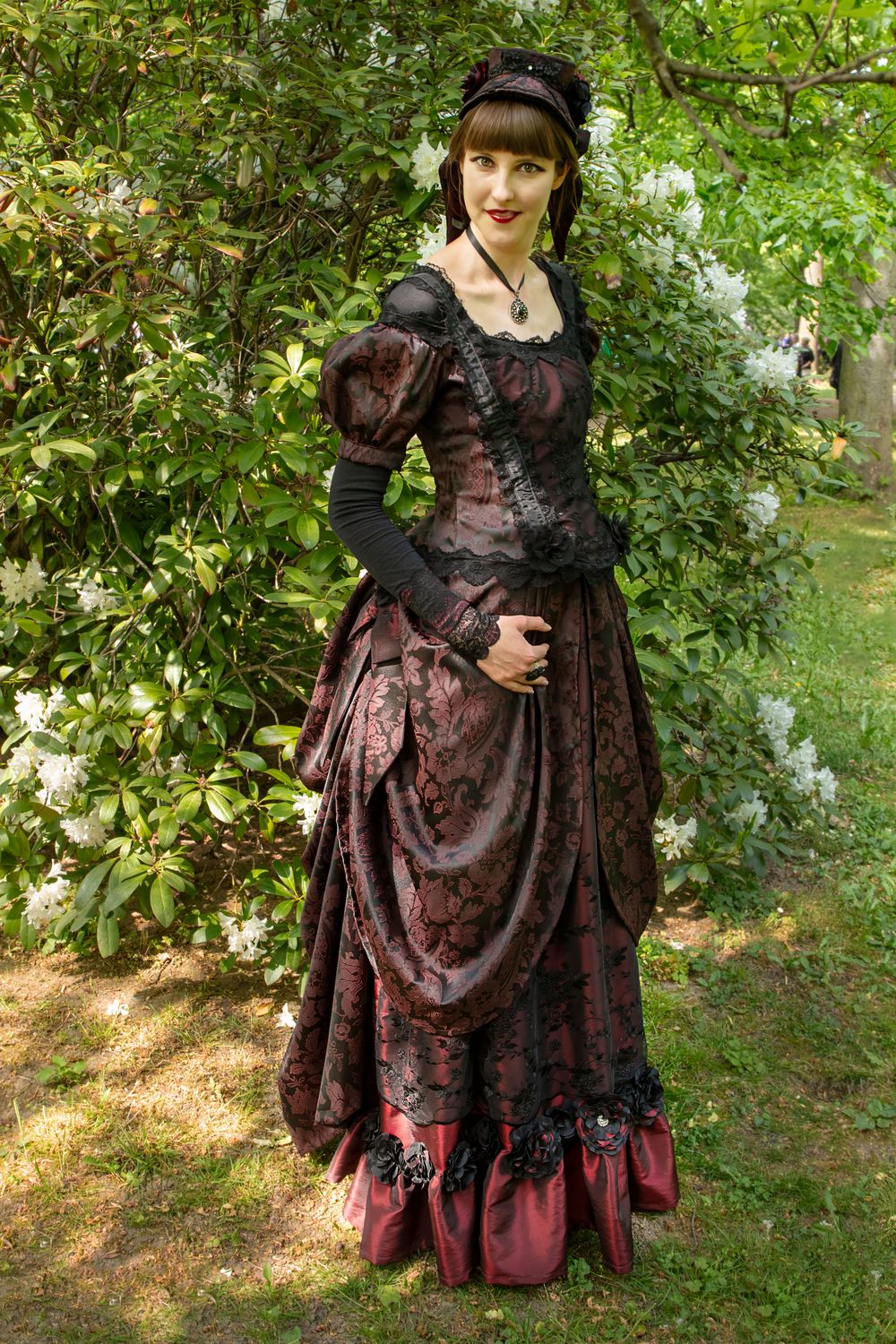
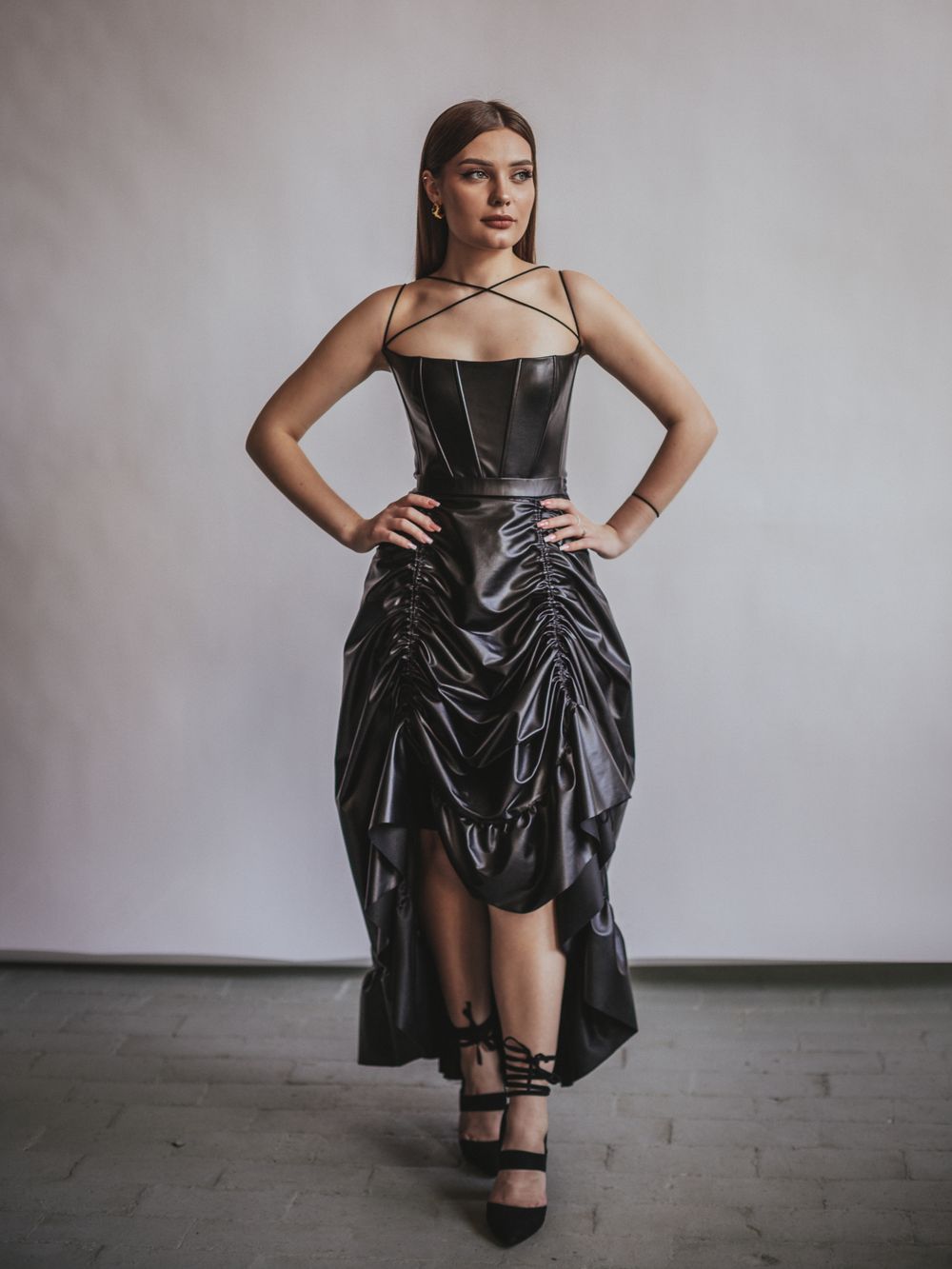
Of all the Victorian shapes, the bustle is the one steampunk has taken most to heart. It works over boots, it leaves the front of the skirt free for walking, and the gathered back gives a costume a strong outline from the side. Many steampunk skirts are short at the front and long and gathered at the back, an exaggerated version of the bustle skirt, and a bustle pad under a plain skirt is an easy way to suggest the 1870s or 1880s.
The 1890s: big sleeves and the new woman
The last decade of the reign brought a new shape. The skirt became smooth over the hips and flared towards the hem, first in an A-line and then in a trumpet shape. The volume moved up to the sleeves. The leg-of-mutton sleeve, huge at the shoulder and tight on the forearm, came back, and it was at its largest around 1895 before shrinking again late in the decade. Collars rose high up the neck. Late in the 1890s corsets grew longer and pushed the body into an S-shaped curve, the line that would carry into the next century.
Hair changed with the clothes. After 1892 it was worn looser and wavier, under the influence of the Gibson Girl, the American illustrator Charles Dana Gibson's drawings of a tall, confident young woman, and by the end of the decade a large bun high on the head was common. In 1892, too, a French magazine, La Mode Pratique, became the first to print photographs of fashions instead of drawings.
Blouses, suits and sport
Many women now wore a blouse with a separate skirt, or a tailored jacket and skirt for walking, which looked much more like modern clothes. Sport changed dress too. The safety bicycle, with its low frame, made cycling popular with women, and it pushed them towards practical clothes. The Rational Dress Society, founded in London in 1881 with Lady Harberton as its president, argued for divided skirts, and Lady Harberton herself cycled in a shorter skirt over full trousers. Trousers gathered at the ankle under a short skirt had been called bloomers since the 1850s, after the American campaigner Amelia Bloomer.
The new woman
In 1894 the writer Sarah Grand used the phrase new woman in an influential article, and it stuck. It described independent, educated women who wanted more from life than the rules allowed them: work, study, travel, and the freedom to ride a bicycle. The new woman is one of the most useful figures for steampunk, because the lady inventor, explorer and aviator of steampunk is in many ways the new woman with a pair of goggles. At the same time, some women had long turned away from fashion altogether. Aesthetic dress, popular in artistic circles from the 1870s, favoured loose, flowing gowns worn without a tight corset.
Our guide to steampunk dresses and skirts shows how these shapes become steampunk.
Corsets in Victorian life
Under almost every one of these shapes was a corset, which the Victorians usually called stays. It was an ordinary piece of underwear, worn every day by women of every class, and it shaped the body to suit each fashion in turn.
How Victorian corsets were made
The V&A explains that early Victorian corsets were usually made of strong cotton and sewn by hand. They were stiffened with strips of whalebone, which is really baleen, the springy plates in the mouths of some whales, and with a flat busk of wood or metal down the centre front. Metal eyelets, invented in the 1820s, allowed corsets to be laced more tightly. In the 1850s and 1860s a busk split down the front with fastenings appeared, so that a woman could put her corset on without a maid. In the late 1860s a corset maker, Edwin Izod, began shaping starched corsets on steam-heated copper forms, making them stiffer and more rounded. Mass production made corsets cheap enough for almost anyone. In the 1870s the spoon busk, wider at the bottom, was introduced to shape the stomach and spread the pressure.
Tight lacing and reform
Fashions changed how tightly corsets were laced. In the crinoline years tight lacing was less needed, because a wide skirt made any waist look small. In the 1870s and 1880s corsets used more boning and were laced harder to give an hourglass shape. Many people objected, and by the 1890s reformers were selling corsets made of ribbon, of a cellular fabric that let the air through, and plain straight corsets with shoulder straps. The V&A notes that some of the reformers' health claims seem to have been accurate, while others were exaggerated or made up.
Wearing one today
A corset for a steampunk or Victorian costume is a costume piece. This guide makes no claims about waist training. A corset should never be laced so tight that breathing or moving is hard, and if you feel faint, loosen it or take it off straight away. Our guide to steampunk corsets and waistcoats explains the kinds of corset and how to wear one comfortably.
Bonnets, hats and gloves
No respectable Victorian woman went out with her head or her hands bare. The V&A notes that covering the head was an essential part of etiquette in the nineteenth century, and that in the 1840s women wore caps indoors and bonnets outdoors.
Bonnets
The early Victorian bonnet had a wide brim that framed and shaded the face. In the 1840s a deep, close bonnet was called a coal-scuttle bonnet, after the shape of the bucket for coal, and married women wore a cap underneath. In the 1850s and early 1860s the spoon bonnet, with a brim rising high above the forehead, was in fashion. The V&A says that while a dress was expected to last ten years, hats changed every year, and most women expected a new one each year, even if it meant re-covering an old one themselves with new ribbons, lace and trimmings.
Hats
From the 1860s bonnets gave way, little by little, to small hats, which were especially popular with young women. In the 1870s small hats were perched on top of the high hairstyles, often tipped forward and worn with a veil. Riding habits borrowed from men's dress, top hat and all. Our guide to steampunk hats and top hats shows how a small Victorian hat becomes steampunk.
Gloves
Gloves mattered as much as hats. The V&A, describing a pair of white kid gloves from about 1840, notes that a woman would be thought undressed if she left the house without gloves, and that gloves were usually kept on in church, at the theatre and at balls, and taken off before eating. For the first half of the century, women's day gloves were short. In the 1880s, evening gowns were worn with long gloves of fine kid or suede. A pair of short gloves for day, or long ones for evening, is one of the cheapest ways to make a costume look correct.
Mourning dress and colour
Black is the colour most people link with the Victorians, and the reason is mourning. When Prince Albert died in 1861, aged 42, Queen Victoria was devastated. The royal family's own account says that for the rest of her reign she wore black. Her long grief shaped the country's customs, and formal mourning reached its height during her reign.
The stages of mourning
A family in mourning wore special clothes for a set time after a death, and the time depended on how close the relation had been. In full mourning a woman wore heavy, plain black, often with dull black crape, a crinkled silk, and a veil; the whole outfit of a widow was called her widow's weeds. Later came half mourning, when soft colours such as grey, lilac and lavender were allowed. The rules differed from one etiquette book to another and changed over the century: a widow was commonly expected to wear mourning for about two years, and some kept to it far longer, as the Queen did. Jet jewellery, black and polished, was worn with mourning, and our guide to steampunk jewellery explains jet.
Colour in Victorian dress
Mourning was not the whole story. For most of the reign, women who were not in mourning wore colour, and after 1856 the new dyes made it brighter than ever: mauve, magenta and strong greens and blues. Dark, practical colours suited working women and everyday wear, and pale silks suited evening. A steampunk outfit that uses deep plum, bottle green or mauve with its browns and blacks is closer to the real nineteenth century than one in black alone. Our guide to Victorian mourning dress tells the full story of mourning, and our guide to women's steampunk outfits puts the Victorian pieces together into outfits to wear.