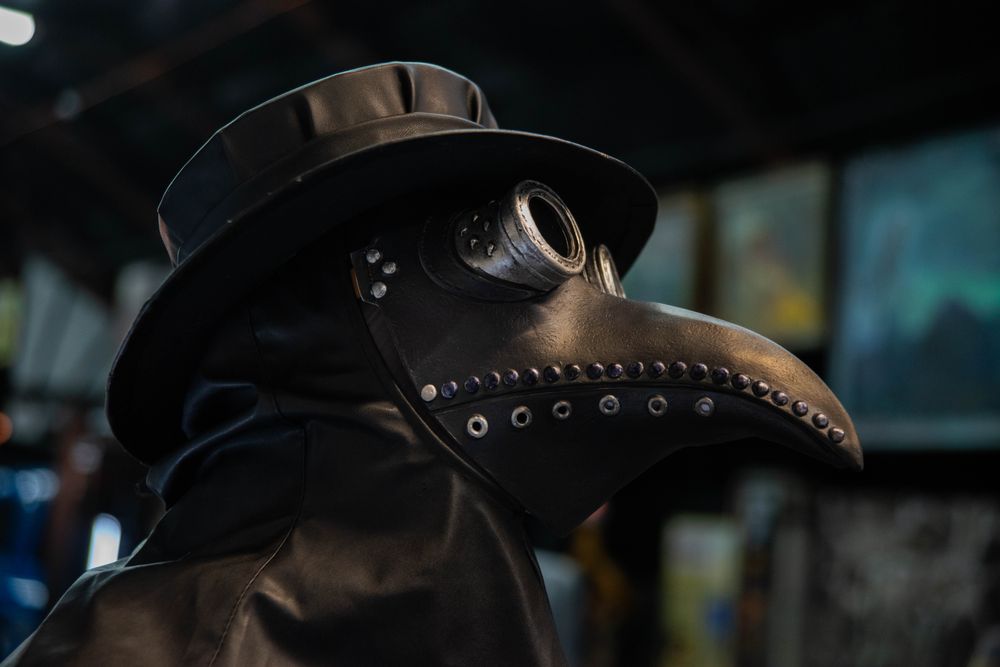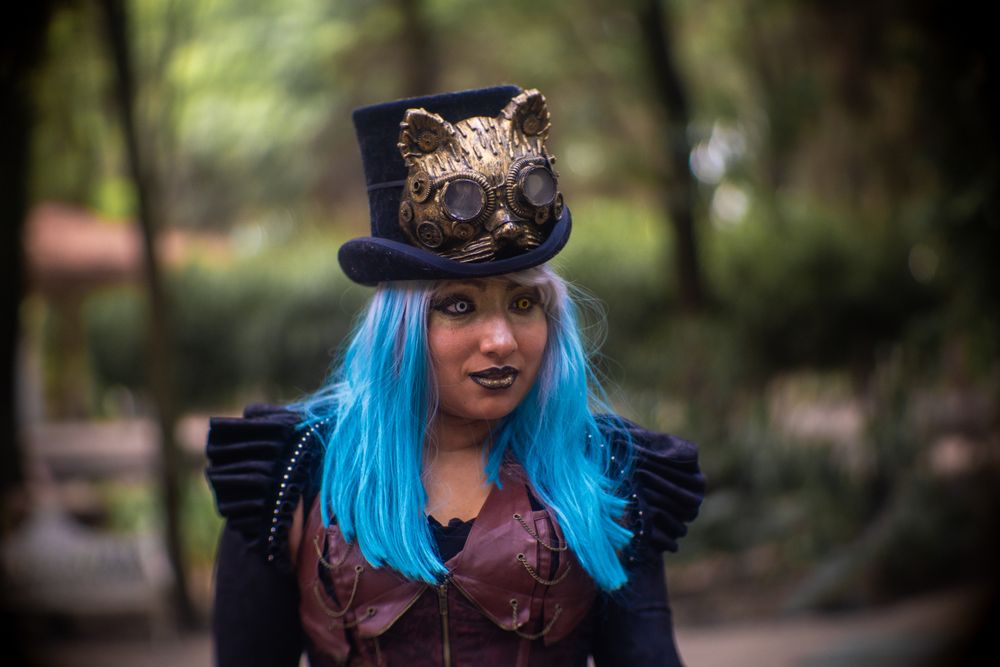
A steampunk hat sits at the top of every photograph and is the first thing people notice across a room. It also carries more of the steampunk character than any other single piece, because it is where the goggles, gears and gauges usually go. Steampunk hats range from tall top hats to tiny ones pinned at an angle, from bowlers to riding hats with veils, and each one says something about the person underneath it.
This guide starts with the steampunk top hat and the real history behind it, then the other hats that suit the style, and steampunk womens hats in particular. It goes on to decorating a hat, measuring your head for the right size, keeping a hat on through a long day, and making or dressing up a plain one. For how a hat fits into a whole outfit, see our guides to women's steampunk outfits and men's steampunk outfits.
The top hat, and how it became steampunk
The top hat is a tall hat with a flat top and a narrow brim. It is the most Victorian hat there is, and so the steampunk top hat is the most recognised hat in the whole style.
Where the top hat came from
Gentlemen began to give up the three-cornered hat, the tricorne, for the top hat at the end of the eighteenth century. The first silk top hat in England is credited to George Dunnage, a hatter from Middlesex, in 1793. The invention of the top hat is often credited to a haberdasher called John Hetherington, but that story is treated as mistaken.
Early top hats were made of felted beaver fur. Through the late eighteenth and early nineteenth centuries, beaver was slowly replaced by hatter's plush, a soft silk weave with a long nap, and that silk plush has not been in general production since the 1950s. Within about thirty years the top hat was worn by all classes, workmen included. When Prince Albert began wearing one in 1850, its place as the hat of respectable town life was settled.
The 1840s and 1850s saw the top hat at its most extreme, with ever higher crowns and narrow brims. Straight-sided ones were called stovepipes, and Abraham Lincoln made the stovepipe famous in the United States. There was even a top hat that folded flat: around 1840, in France, Antoine Gibus's design for a top hat with springs inside that let it collapse proved so popular that such hats were called gibus. They were also called opera hats, because they could be stored flat under a seat at the opera. The top hat stayed the standard formal outdoor hat for upper-class men until the First World War, and by the end of the Second World War it had become a comparative rarity.
The hatters, and the Hatter
Felt hats had a dark side in their making. Mad hatter disease, also called erethism, is chronic mercury poisoning. Hatters used a mercury compound in a step called carroting, when fur was matted into felt, and breathed in mercury vapour, often in poorly ventilated rooms. It caused irritability, extreme shyness and trembling hands, and in severe cases much worse. By the turn of the twentieth century it had become rare among British hatters.
Lewis Carroll's Hatter in Alice's Adventures in Wonderland (1865) is often linked with that illness, but the link is disputed, and Carroll never called the character the Mad Hatter. The top hat he wears, with a ticket in the band reading "In this style 10/6", comes from John Tenniel's drawings for the first edition rather than from Carroll's words. The ticket gives a price in old British money, ten shillings and sixpence. A ticket like it, tucked into the band of a steampunk top hat, is an easy nod to the book.
Why steampunk took the top hat
On a Victorian gentleman the top hat was plain black silk. On a steampunk it is given a job to do: goggles on the brim, a gauge on the band, a leather strap with a buckle, a small cog where a ribbon would once have been. Steampunk top hats are usually felt or leather rather than silk, and both take decoration well. They come full height, cut down to a shorter crown, or tapered towards the top. A tall hat suits a gentleman, an inventor or a ringmaster; a shorter one is easier to wear all day and suits an engineer or an aviator. Our guide to steampunk, gothic and Victorian styles shows the same top hat worn all three ways.
Bowlers, mini top hats and riding hats
The top hat is not the only choice. Three other hats come up again and again at steampunk gatherings, and each suits a different kind of character.
The bowler
The bowler is a hard felt hat with a rounded crown and a narrow, rolled brim. The London hat-makers Thomas and William Bowler designed it in 1849 for a customer who wanted a close-fitting, low-crowned hat to protect gamekeepers, whose top hats kept being knocked off by low branches as they rode. Americans call it a derby. In the 1850s the upper class kept to their top hats while working men wore bowlers. In steampunk the bowler suits an engineer, a detective, a railwayman or a frontier character. A pair of goggles sits well round its crown, and a narrow leather band with a small buckle is often all the decoration it needs.
Mini top hats
A mini top hat is a small top hat, far smaller than a full one, clipped, pinned or tied to the head at an angle rather than worn over it. It is mostly a modern costume piece, but it has Victorian ancestors. In the 1870s women wore tiny, heavily decorated hats, sometimes fastened almost upright on the head, and the 1880s brought a women's hat inspired by the top hat, called the flowerpot hat. A mini top hat sits on top of an elaborate hairstyle without flattening it, carries decoration easily, such as a tiny pair of goggles, a short veil or a feather, and is light enough to forget about by the afternoon.
Riding hats
Since the Victorian era, women's riding habits, the clothes women wore on horseback, have often been worn with a top hat and a veil, the hat often in the most formal men's style of the day. A riding hat of this kind, a short or medium top hat with a length of net or chiffon round the crown and falling behind, is one of the most elegant hats a steampunk woman can wear, and it suits a lady adventurer or a gentlewoman of the skies. Men can wear one too: reinforced top hats of a heavier kind were used for riding and hunting.
Other hats
Explorers wear the pith helmet and detectives the deerstalker, and a leather flying cap suits an aviator. Our guide to men's outfits covers those, and all of them suit women just as well.
Hats for women
Steampunk hats for women draw on a wider range of Victorian headwear than men's, because women's hats changed far more over Queen Victoria's reign, from 1837 to 1901. Hats mattered to a respectable appearance for both men and women, and going out with nothing on the head was simply not done.
Bonnets
In the 1840s women's headwear was dominated by bonnets, many of them poke bonnets with deep, rounded brims. Some bonnets made between about 1817 and 1845 had a peak so deep that the wearer had to turn her head to see to the side. Bonnets shrank at the end of the 1860s, and in the early 1870s they moved to a perched position on the head. A small bonnet trimmed with lace, ribbon and a little brass suits a quieter steampunk character, such as a governess, a lady scientist or a traveller.
Small hats of the 1870s
In the 1870s fashion moved to tiny, over-decorated hats, sometimes fastened almost upright on the head and worn with the large hairstyles of that decade. From then on, hats rather than bonnets were the headwear of choice for the rest of the Victorian age. They are the ancestors of the small decorated hats steampunk women pin to one side of the head, which suit a lady adventurer, an aviatrix or anyone with long hair to show off. Our guide to steampunk make-up and hair explains the hairstyles that go underneath.
The 1880s and 1890s
The 1880s brought the flowerpot hat, inspired by the top hat. Late Victorian hats were covered in silk flowers, ribbons and, above all, exotic feathers, and some carried whole stuffed birds. In the 1890s the boater, a flat straw hat, became popular with women. A boater with a leather band and a pair of goggles makes an unusual summer hat for a steampunk woman.

Feathers, and the women who objected
The fashion for feathers had a cost. Between 1870 and 1920 more than 20,000 tonnes of feathers were imported into Britain for the fashion trade, the V&A says, threatening up to 61 species of bird, egrets in particular. In February 1889 Emily Williamson of Didsbury, Manchester, started the Society for the Protection of Birds to campaign against it. It received a Royal Charter in 1904 and became the RSPB, and its campaign led to a ban on importing plumage in 1921. A steampunk hat can still carry a feather, and it is a piece of history worth knowing when you pick one.
Women in top hats
Steampunk women wear full top hats, bowlers and flying caps as readily as men do. With long hair pinned up, measure over the hair as it will be worn, so the hat has room for it.
Decorating a hat: goggles, gears, feathers and bands
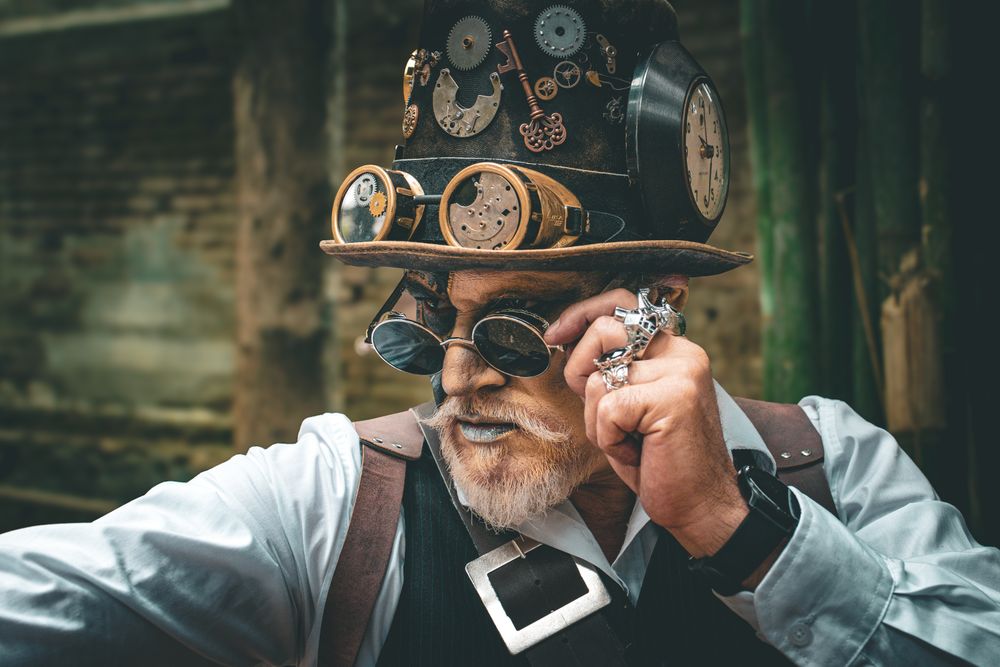
Decoration is what turns a plain hat into a steampunk one. The rule that works best is to give the hat a purpose: decide what your character does, then add only what that person would carry or wear for the job.
Goggles
Goggles are the classic decoration, worn on the front of the brim or round the crown just above it, with the strap pulled snug round the hat. Choose goggles that suit the character: plain round ones for an inventor, flying goggles for an aviator, heavier welder's goggles for an engineer. Our guide to steampunk goggles explains the kinds and how to fix them.
Gears and gauges
Gears, cogs and small gauges look best grouped in one place, usually on one side of the band, as if they were part of a mechanism, rather than scattered all over the hat. A single gauge on the band can suggest that the hat measures something: the pressure, the altitude, the time. Light card or foam gears painted brass weigh far less than real metal ones, which matters on a tall hat.
Feathers
One or two feathers tucked behind the band at the side, sweeping back, give movement and height. Dark feathers, or ones in brown and gold, suit most steampunk colours. A big plume suits a lady adventurer or a ringmaster; a single short feather suits almost anyone.
Bands, buckles and straps
A hat band is the strip that runs round the crown just above the brim. Swapping a plain ribbon for a leather strap with a brass buckle is the quickest way to make any hat steampunk, and the band also hides the glue and stitches of everything else. A chain, a row of rivets, or a band of brocade fabric all work too.
Veils, lace and flowers
A short veil of net over the eyes, a band of lace or a fabric flower softens a hat and suits many women's characters. A black veil and dark roses move a hat towards the gothic side of steampunk.
How much is enough
Three kinds of decoration is a good limit for one hat, such as goggles, a band with a buckle and a feather. More than that and the hat starts to look like a display stand rather than something a person would wear. Heavy decoration also pulls a hat off balance, so spread the weight between the front, the sides and the back.
Sizes, and how to measure your head
A hat that does not fit is the most common hat problem at any gathering. Too small and it perches, gives you a headache and blows away. Too large and it slides down over the eyebrows.
How to measure
Hat size is the measurement round the head about one centimetre above the ears. To measure:
- Use a soft tape measure, or a piece of string marked with a pen and then laid against a ruler.
- Run it across the middle of the forehead, about a finger's width above the eyebrows, over the tops of the ears and round the fullest part of the back of the head.
- Keep it level and firm, but not tight.
- Measure with your hair as you will wear it under the hat, and measure two or three times.
- Write the result down in centimetres.
Reading a size
Hats are sized in centimetres, in letters such as small, medium and large, or in numbers such as 7 or 7 and an eighth. Letter sizes mean different measurements to different makers. The American number is the head's measurement in centimetres divided by eight, so a 56 centimetre head is an American size 7. British numbers are close to the American ones, but size charts disagree about exactly how they match, so the measurement in centimetres, checked against each maker's own chart, is the figure to trust.
Between sizes
If you fall between two sizes, choose the larger, because a hat that is slightly big can be made smaller and one that is too small cannot be made bigger. A strip of foam or folded felt tucked behind the band inside the hat takes up the extra room.
Mini hats and children
Mini top hats do not need to fit the head at all, because they sit on it rather than round it, which makes them a good choice when you cannot try a hat on first. For children, choose a hat with a little room, because heads grow, and make sure it stays on without a tight strap under the chin.
Keeping a hat on all day
Steampunk gatherings often mean a long day on your feet, partly outdoors, with wind, crowds, low doorways and a great deal of turning to look at things. A hat that will not stay on spoils all of it.
Hatpins
Victorian women had an answer. Hatpins became far more popular in the 1880s, when women's headwear moved from bonnets to hats, and they stayed a standard accessory until the 1910s. Some cities in the United States even limited their length by law around 1910; Chicago's limit was half an inch beyond the crown of the hat. A hatpin passes through the hat, through the hair underneath, and out of the hat again, so it works only with enough hair to hold it. Cover the point with a protector, keep it well away from the scalp, and take extra care in crowds.
Combs, clips and elastic
Small hats stay on best with hair combs or hair clips sewn inside, which grip the hair. A thin elastic that runs from one side of the hat round the back of the head, under the hair, holds a mini top hat or a small riding hat firmly and almost invisibly. Bonnets and some small hats tie with ribbons under the chin, which is the most secure way of all.
Full-size hats
A full top hat or bowler stays on because it fits, so the measuring above matters most. In wind, hold it by the brim, or carry it rather than chase it. Indoors, take a tall hat off before doorways and low beams, and when you sit in a crowded room, so it is not knocked off.
Heat and comfort
Felt and leather hats are warm, and a hat that was welcome on a cold morning can be heavy work by mid-afternoon. Take it off for a few minutes when you rest, drink plenty of water, and find some shade. A heavily decorated hat pulls on the neck as the hours pass, which is one more reason to keep decoration light. For when and where people gather, see our guide to UK events.
Making or dressing up a plain hat
Many of the best steampunk hats started life as an ordinary hat from a cupboard or a charity shop. Our guide to a steampunk costume on a budget explains how to find one.
Dressing up a plain hat
- Change the band. Remove the old ribbon and fit a leather strap with a buckle, or a band of brocade fabric.
- Add goggles. Run the strap round the crown and stitch it in place at the back.
- Add a mechanism. Group a few gears, a small gauge and a rivet or two on one side, glued or stitched on, with the band hiding the fixings.
- Age it. A plain black hat can be dusted lightly with brown or bronze along the edges of the brim, so it looks worn rather than new.
- Add a feather or veil at the side.
Making a top hat from card and fabric
A top hat is three shapes: a tube for the crown, a circle for the top, and a ring for the brim. Measure your head, cut a strip of thin card a little longer than that measurement and as tall as you want the crown, and tape it into a tube. Cut a circle of card for the top and fix it on with tabs. Cut a brim as a ring whose inner circle matches the tube, with tabs cut round the inside edge to fold up and glue inside the crown. Cover the whole hat in felt, faux leather or dark fabric, with glue spread thinly, then add a band to hide the join at the base of the crown. A mini top hat is made the same way at a smaller size, fixed to a hair comb, a clip or a thin headband.
Safety while making
- Craft knives. The Health and Safety Executive's advice on hand knives recommends knives with retractable blades where possible, and names cutting away from the body, and the dangers of blunt knives, among the things every user should be taught. Cut on a board, and change blades often.
- Glue and spray paint. Solvent glues and paints give off fumes that can cause headaches, nausea and dizziness, and the Health and Safety Executive says ventilation is always needed when they are used. Work outdoors or with the windows open.
- Hot glue. A glue gun is quick for fixing decorations, but hot glue sticks to skin. Press pieces together with a tool rather than your fingers.
A home-made hat is never quite finished. Most steampunks add something each time they wear one, and that is part of the pleasure.