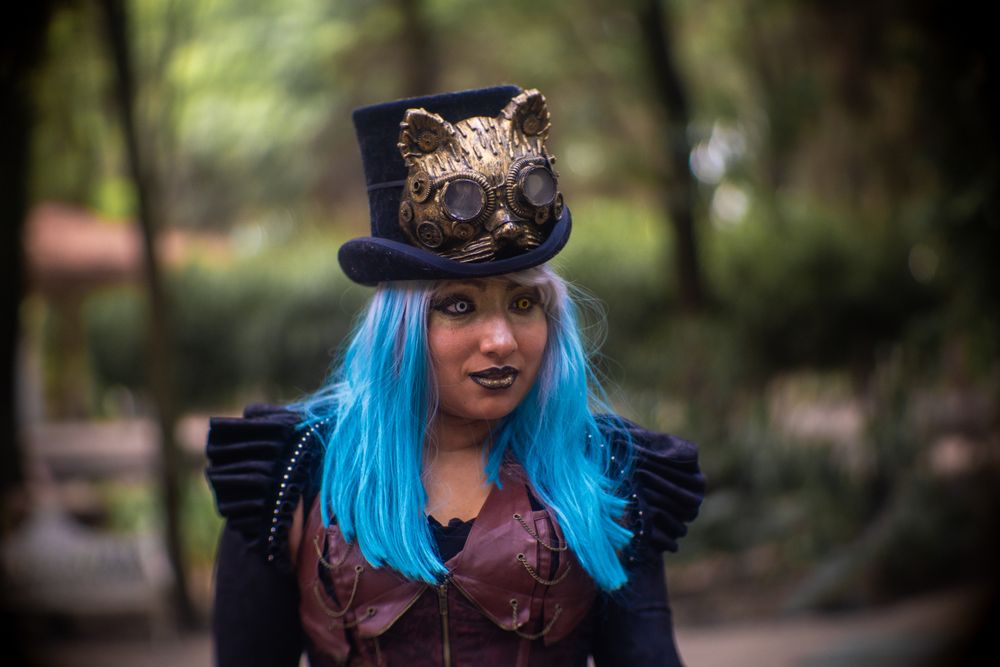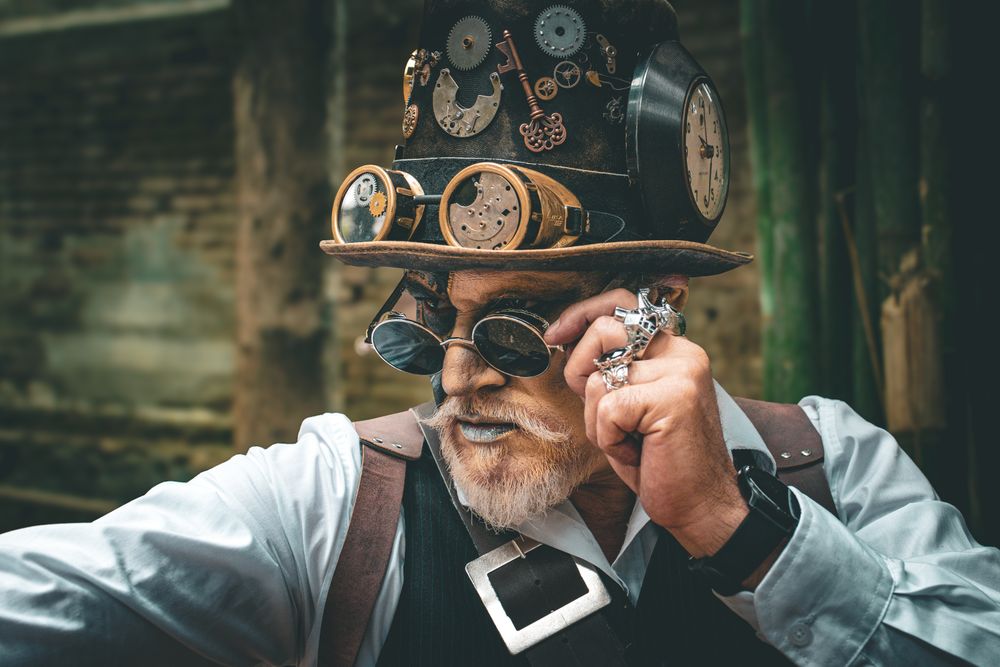
Steampunk fashion is a way of dressing that takes the clothes of the Victorian age and adds the machinery of a future that never happened. A steampunk outfit might be a frock coat and waistcoat with a pair of brass goggles on the hat, or a long skirt and blouse with a leather corset worn on the outside and a pocket watch on a chain. The clothes say 1880; the brass, leather and gears say that this is an 1880 where airships fill the sky and every gentleman inventor has a workshop.
There is no official uniform. Steampunk clothes, steampunk attire and steampunk garb all mean the same thing, and people mix old and new, bought and home-made, as they please. But the outfits that look best tend to follow the same few ideas, and this guide sets them out in the order you would use them: the Victorian clothes underneath, the workings on top, the pieces from head to foot, colours and fabrics, characters to dress as, where the clothes come from, the common mistakes, and finally a first outfit.
Start with Victorian clothes
Steampunk is set in a version of the nineteenth century, usually the reign of Queen Victoria, which ran from 1837 to 1901. So the base of almost every outfit is a set of clothes shaped like the clothes of that time. Get the base right and the rest is easy. Get it wrong, with a modern T-shirt and jeans under a pair of goggles, and no amount of brass will save it.
For a gentleman's look
The Victorian gentleman wore a white shirt with a high collar, a tie or cravat, a waistcoat, trousers, and a coat over the top. In the 1840s that coat was a close-fitting frock coat reaching to the calf; later it shortened to the knee, and by the 1870s matching three-piece suits of jacket, waistcoat and trousers were growing popular. On his head he wore a top hat for formal dress, or for more casual wear a bowler, the round, hard hat designed in London in 1849 for gamekeepers on horseback. All of these shapes work as steampunk bases, and a waistcoat on its own does more than any other single piece to make an outfit look Victorian.
For a lady's look
The Victorian lady wore a blouse or bodice with a high neck and long sleeves, a long skirt reaching to the ground, and a corset beneath. The shape of the skirt depended on the decade: held out wide by a crinoline frame in the 1850s and 1860s, gathered at the back over a bustle in the 1870s and 1880s, and falling in a plain A-line in the 1890s, when the sleeves grew into great puffs at the shoulder. For steampunk, any of these will do. The 1890s shape, a plain A-line skirt with no frame beneath, is the easiest to find and the easiest to move in.
Women's steampunk dress is not limited to skirts. Trousers, breeches and divided skirts all appear, and so do outfits borrowed from the gentleman's wardrobe. Our guides to women's steampunk outfits and men's steampunk outfits go into each in detail.
Add the workings: brass, leather and gears
Victorian clothes on their own are a costume from a period drama. What makes them steampunk is the machine age added on top. The rule of thumb is that the workings are left on show. A Victorian hid the structure of her clothes, the corset, the bustle, the hooks and laces. Steampunk brings the structure out where it can be seen, and adds the tools and instruments of an inventor or traveller.
The usual workings are:
- Brass and copper, in buckles, buttons, clasps, gauges, cogs and fittings. Warm metals are the signature of steampunk; silver tends to look gothic instead.
- Leather, in belts, straps, harnesses, holsters, pouches, cuffs and corsets. Brown and tan leather look most at home; black works for a darker look.
- Gears and clockwork, as brooches, hat decorations, cufflinks or patterns, and above all as a pocket watch on a chain.
- Instruments: goggles, a compass, a spyglass, a map case, a pair of tinted glasses, a small toolkit. These tell people what your character does.
The skill is in restraint. One hat with goggles, one belt with a pouch or two, a watch chain and a pair of leather cuffs is plenty. A costume covered from head to foot in glued-on cogs stops looking like a person and starts looking like a craft table. Our guide to the steampunk aesthetic explains why these particular details came to mean steampunk.
The pieces, from head to foot
Here is a whole steampunk outfit, one piece at a time, starting at the top. You do not need all of them: pick a few, and let each one earn its place.
Hats
The top hat is the most recognised steampunk hat, worn tall or cut down, plain or decorated with goggles, gauges and cogs. The bowler is its everyday cousin. A pith helmet, the light sun helmet worn by Victorian soldiers and travellers in hot countries, suits an explorer; sun helmets made of pith first appeared in India in the 1840s. Women wear all of these, including small top hats pinned at an angle, as well as riding hats and hats trimmed with feathers. An aviator's leather cap with flaps over the ears suits a pilot.
Goggles and glasses
Goggles are the single best-known piece of steampunk, worn over the eyes or, more often, pushed up on the hat brim. Real goggles became a necessity for pilots in the years after the first aeroplane flight of 1903, as faster aircraft meant stronger wind in the face, and drivers of early open cars wore them against dust. Round glasses with tinted lenses in amber, red or smoke are an easier choice to wear all day. A monocle suits a gentleman scientist. Our guide to steampunk goggles covers the different kinds.
Shirts and blouses
A white or cream shirt with long sleeves is the base for a gentleman. A collarless or band-collar shirt looks rougher and more working, which suits an engineer or airship crew. For a lady, a high-necked blouse with lace or pin-tucks at the front, long sleeves and perhaps a little puff at the shoulder. Plain cotton or linen in white, cream or pale grey goes with everything.
Waistcoats and corsets
The waistcoat is the most useful single piece in steampunk, for men and women alike: it shapes the body, gives a place for a watch chain, and makes even a plain shirt look Victorian. The corset is its equivalent in women's steampunk, usually worn on the outside over a blouse, in leather, brocade or a strong cotton, often with buckles or straps instead of hidden lacing. A corset should never be laced so tight that breathing or moving is hard, and if you feel faint, take it off. Our guide to corsets and waistcoats explains how to choose and wear both.
Coats and jackets
The long frock coat is the classic, cut to the knee and fitted at the waist. A tailcoat, cut away at the front, looks more formal. A long, loose coat in heavy cotton or canvas suits a traveller or sky pirate. For women, a short, fitted jacket worn over the corset, or a riding jacket, shows off the waist. A military-style jacket with braid and brass buttons suits an airship officer.
Trousers, skirts and bustles
Trousers should be straight and high at the waist, in wool, tweed or heavy cotton, and braces look better with them than a modern belt. Breeches tucked into tall boots suit an aviator or explorer. Long skirts can be plain, layered, or pulled up at the sides with ties to show a petticoat underneath. A bustle, real or suggested with a gathered overskirt at the back, gives a skirt the unmistakable Victorian silhouette.
Belts, holsters and pouches
A wide leather belt with a few pouches is the quickest way to turn an outfit into a working character. Pouches hold tools, a compass or the small things you need during a day out, such as a phone, keys and money. A leather harness or holster across the chest suits an explorer or adventurer. Keep the number down: two or three pouches look purposeful, ten look like a builder's tool belt.
Gloves and gauntlets
Leather gloves, fingerless gloves for an engineer, lace gloves for a lady, or a single gauntlet with metal plates over the fingers. A gauntlet makes a strong statement, so one is usually enough.
Boots
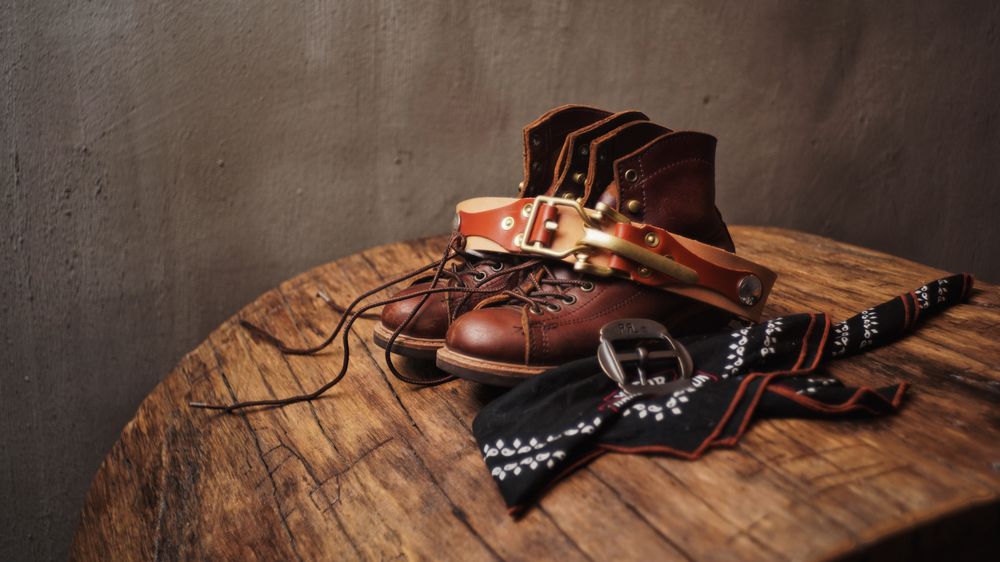
Boots finish the outfit, and they matter more than people think, because they are what you stand in all day. Brown or black leather boots reaching above the ankle, laced or buckled, suit almost every character. Riding boots suit an aviator. Above all, they should be comfortable enough to walk in for hours.
Colours and fabrics that work
Colours
Steampunk colours come from its materials. The core is brown in every shade from tan to chocolate, with cream, rust, burgundy, bottle green, navy, grey and black, and brass, copper and bronze for the metal. These are warm, slightly worn colours, the colours of a workshop, a library or a ship's cabin. A good approach is to choose one main colour for the large pieces, such as a brown coat and trousers, one or two accent colours for the waistcoat or corset, and then let the metal bring the whole thing together.
Bright modern colours, such as neon pink or electric blue, look out of place, as do shiny synthetic blacks. If you want something brighter, take your lead from the Victorians themselves, who loved the strong purples, greens and reds of the new dyes; a deep purple or emerald waistcoat sits well against brown.
Fabrics
Natural fabrics look most convincing because they are what the Victorians had: wool, tweed, linen, cotton, velvet, brocade and silk, with leather for the working parts. They also breathe, which matters at an all-day event. Tweed and wool suit coats and trousers, linen and cotton suit shirts and blouses, and brocade or velvet suit a waistcoat or corset with a touch of luxury. Faux leather is a fair choice for belts and straps if you would rather not wear leather, though the cheapest kinds crack and look plasticky in photographs. Shiny satin and thin polyester are the fabrics that most often give a costume away as cheap.
Wear and weathering
New clothes can look too new. Steampunk characters have been places, so a little wear helps: a softened leather belt, brass with a slightly dulled finish, a coat that has been worn before. Leave the hard work to time if you can. Clothes that are worn often soon gain the lived-in look.
Characters to dress as: the explorer, the inventor, the aviator, the lady adventurer
The quickest way to make a steampunk outfit hang together is to decide who you are. A character gives every piece a reason, and saves you from adding things at random.
The explorer
The explorer has just come back from somewhere hot and far away. Think of a pith helmet, a khaki or tan linen jacket, a shirt with the sleeves rolled, breeches and tall boots, with a leather harness carrying a compass, a spyglass and a map case. Real Victorian travellers make good models. Mary Kingsley, who travelled in West Africa in the 1890s, kept to her long skirts and wrote in her book Travels in West Africa (1897) that when she fell into a spiked game pit it was her skirt that saved her, praising the blessing of a good thick skirt.
The inventor
The inventor works in a cluttered workshop and has the tools to prove it. Waistcoat and shirt sleeves, perhaps a leather apron, goggles pushed up on the forehead, fingerless gloves, and a belt of small tools and pouches. A pocket watch, a magnifying lens on a chain, and a strange home-made gadget complete the look. The Time Traveller in H. G. Wells's The Time Machine (1895), a Victorian scientist who builds his own machine, is the model here, and so is Captain Nemo, the designer as well as the captain of Jules Verne's submarine, the Nautilus.
The aviator
The aviator commands or crews an airship. A leather flying cap and goggles, a short leather or canvas jacket, a scarf, breeches and tall boots, with a harness or a belt carrying a few instruments. An airship captain might add a military-style coat with brass buttons and a peaked cap. Airships, real and imagined, are the world these characters belong to.
The lady adventurer
The lady adventurer is dressed for society but ready for anything. A fitted jacket over a corset, a skirt that can be looped up for walking, a small top hat with goggles on the brim, gloves, and something practical hidden among the lace, such as a pouch, a compass or a parasol. The Victorian traveller Isabella Bird, the first woman elected to the Royal Geographical Society, in 1892, rode through the Rocky Mountains in what she called her mountain dress: a half-fitting jacket, a skirt to the ankles and full trousers gathered over her boots.
Buying, thrifting, altering or making
Steampunk clothes can come from almost anywhere, and most good outfits mix several sources. There is no need to buy a complete costume. Many people would say a costume put together from pieces looks better than one bought in a bag.
Buying new
Specialist steampunk and costume sellers make whole outfits and single pieces, and historical clothing makers sell Victorian-style shirts, waistcoats, skirts and coats. If you buy new, look at the fabric and the stitching before the decoration: a good plain waistcoat will serve for years, while a cheaply made one covered in printed cogs will not.
Thrifting
Charity shops and second-hand clothes are the steampunk's best friend. Waistcoats from old suits, long wool skirts, high-necked blouses, tweed jackets, leather belts and boots turn up all the time, and they already have the softened, lived-in look new clothes lack. A men's dinner jacket or a long dark coat from a charity shop can become a frock coat with very little work.
Altering
Small changes do a lot. Swap plastic buttons for brass ones. Add a strap and buckle to a jacket. Take up a skirt at the sides with ties. Fix goggles and a small gauge to a plain hat. Dye a pale shirt a tea colour for an aged look.
Making
Many steampunks make their own hats, goggles, gauntlets and gadgets, and some make whole outfits. The making is part of the fun for many people. Props such as ray guns or mechanical arms are a craft of their own; costume weapons and props at events must follow each event's own rules, so read them before you go. Our guide to a steampunk costume on a budget goes through all of these step by step.
Mistakes that make a costume look cheap
A few things give away a costume more than any others. Most of them are easy to avoid.
- Too many cogs. Gears glued all over a hat, a corset and a coat at once look like decoration for its own sake. One or two, placed where a mechanism might really be, look far better.
- Shiny synthetic fabrics. Thin, shiny satin and polyester look cheap under lights and in photographs. Matt fabrics with a bit of weight look more real.
- Brand-new everything. A whole outfit straight out of the packet looks like a costume. Mix in something worn.
- Goggles that do nothing. Goggles with no lenses, plastic that is obviously plastic, or goggles on a character with no reason for them. If you wear goggles, know why your character has them.
- Modern shoes. Trainers under a frock coat spoil the whole effect. Plain dark boots, even modern ones, are far better.
- Visible modern things. A phone in a hand, a plastic bag, a baseball cap. Keep a pouch or a small leather bag for the modern things you need.
- No base. Goggles and a waistcoat over a T-shirt and jeans. Start with the Victorian clothes, then add the workings.
Putting together your first outfit
Here is a simple order of work for a first steampunk outfit that will look right at a gathering, a party or a day out.
1. Choose your character
Explorer, inventor, aviator, lady adventurer, airship captain or society figure. Write down in one line what they do, and keep it in mind for every choice that follows.
2. Build the Victorian base
A shirt or blouse, a waistcoat or corset, trousers or a long skirt. Plain, natural fabrics in neutral colours. If you own nothing suitable, this is where the charity shops come in.
3. Add one coat or jacket
A frock coat, a long travelling coat or a fitted jacket. This is the largest piece, so it sets the main colour.
4. Add the hat and the eyes
A top hat, bowler, pith helmet or flying cap, with goggles on the brim or tinted round glasses. This is the part people notice first, and the part they remember.
5. Add the workings, with restraint
A leather belt with one or two pouches, a pocket watch on a chain, one brass piece of jewellery. Stop there and look in the mirror before adding anything else.
6. Finish with boots and gloves
Comfortable boots you can walk in all day, and gloves or a gauntlet if your character would wear them.
7. Wear it before the day
Spend an hour at home in the whole outfit, sitting, standing and walking. Anything that pinches, slips or falls off will be ten times worse after six hours. If you are wearing a corset, check that you can breathe deeply and bend comfortably in it.
Then go somewhere and wear it. When you are ready, our guide to what to wear to your first steampunk event covers the day itself, and for gatherings across the country, see our guide to UK events.