Most people recognise steampunk style before they can say what it is. A brass clock with its gears open to view, a leather corset with buckles, a lamp made from copper pipes: each one says steampunk at a glance. This guide explains why. It breaks the steampunk aesthetic into its parts, the colours, the materials, the shapes and the details, and then shows how those parts come together on a person, in a room and on screen.
The word aesthetic simply means the look and feel of something, the set of choices that makes a style hang together. The steampunk aesthetic is unusually consistent, which is why it is so easy to spot and so satisfying to copy.
The colours: brass, copper, leather and dark wood
The steampunk palette is taken almost entirely from the materials of a Victorian workshop. Very little of it is painted on. The colours are what metal, leather and wood look like when they have been used for years.
Brass and copper
Brass is the colour most people think of first. It is an alloy, a mixture of metals, made from copper and zinc, and it has a warm yellow-gold shine. Copper is redder and darker. Bronze, made from copper and tin, sits between them. All three change with age: brass darkens, and copper can grow a green-blue coating where it meets damp air. That aged look is welcome in steampunk. A gauge that is slightly tarnished looks as if it has been in service; a perfectly polished one can look new from the shop.
Leather and dark wood
Brown leather supplies the large areas of colour, in belts, straps, corsets, holsters, boots and hat bands. Dark wood, such as walnut, mahogany or oak stained deep brown, plays the same part in a room, in the frames of furniture and the cases of clocks and instruments.
The supporting colours
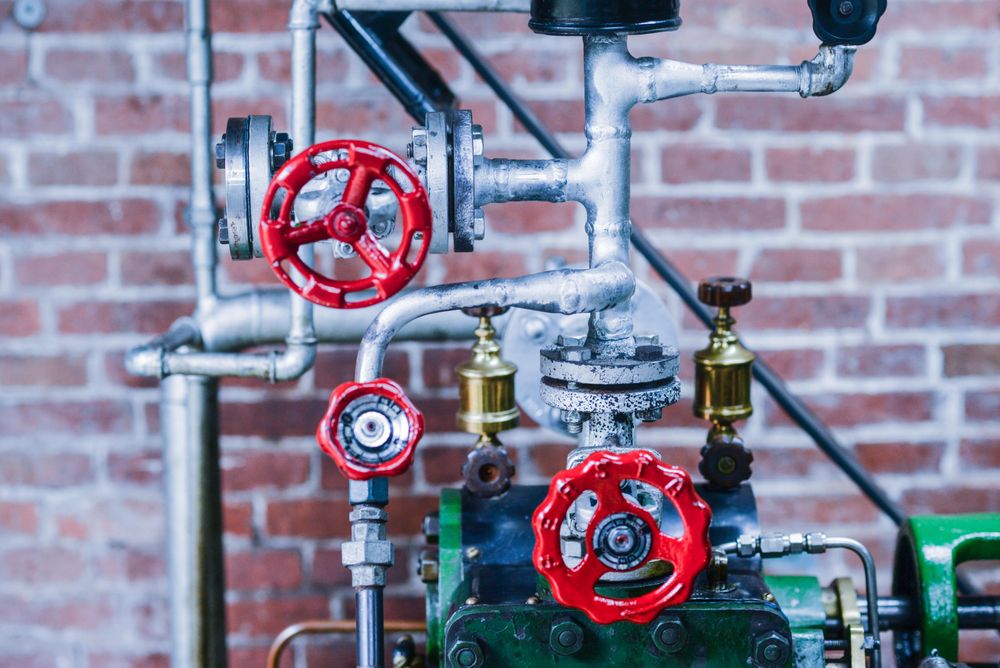
Around those, steampunk uses the deep colours of Victorian interiors and clothing: burgundy, bottle green, navy, plum, charcoal grey, cream and black. Brighter colours appear in small amounts, such as red or amber lenses in a pair of round glasses, or the red of a valve wheel. A good rule is that the metal should be the brightest thing you see.
How the colours are used together
Most steampunk outfits and rooms work on the same proportions. A large area of one deep or neutral colour, such as brown, charcoal or cream, makes the ground. A second colour, often leather brown or a Victorian shade like burgundy, covers the next largest area. Metal is used last and in small amounts, so that each brass buckle or copper fitting catches the eye. Black can be used, and often is, but an outfit that is almost all black with silver metal tends to read as gothic rather than steampunk. Swapping the silver for brass and adding one warm brown is usually enough to move it back.
The materials, and why the workings are always on show
Steampunk is built from materials that existed in the nineteenth century: brass, copper, iron, steel, wood, leather, glass, wool, cotton, lace and velvet. What it leaves out matters as much. There is no visible plastic, no smooth white casing, no touch screen and no hidden electronics. When modern parts are used, and they often are, they are covered with something older.
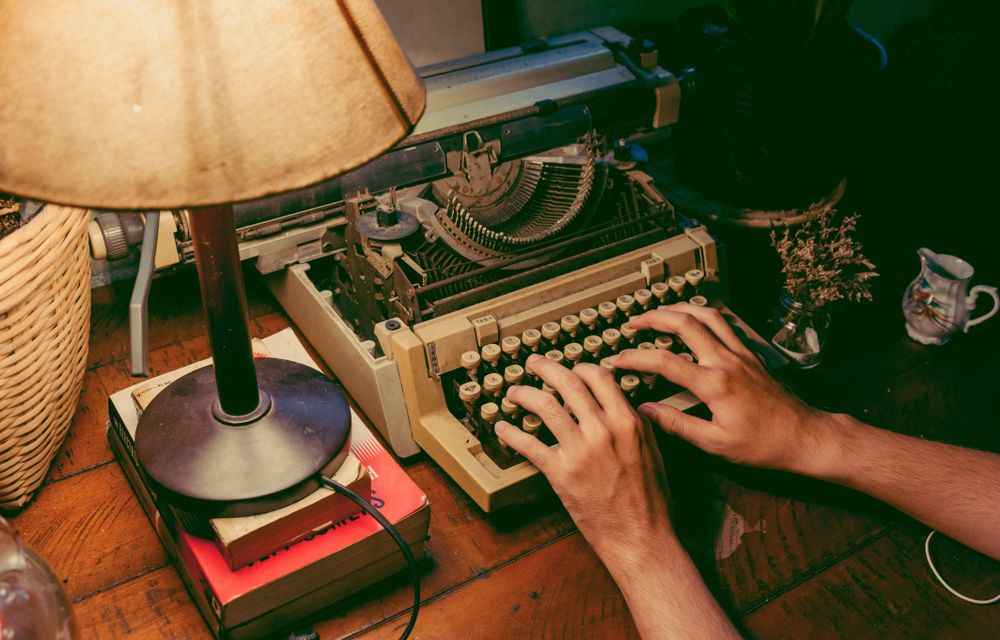
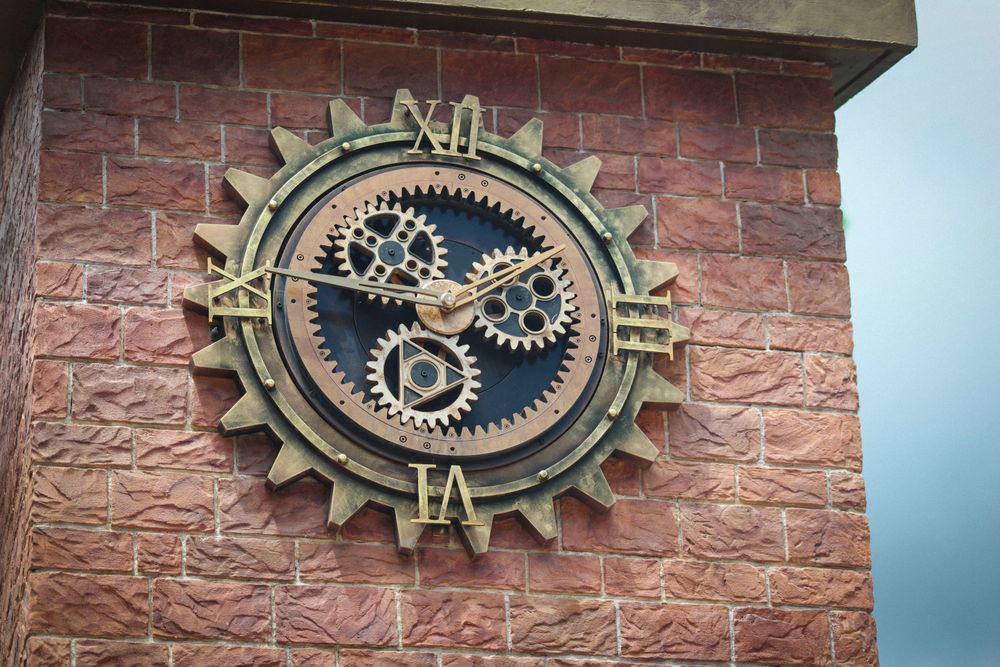
The most important rule of the steampunk aesthetic is that the workings are on show. In modern design a machine hides its parts inside a case. In steampunk the parts are the decoration. A clock has its gears exposed; a lamp shows its bulb, its wires and its valve; a pair of goggles has visible screws and adjustable lenses. The pleasure is in being able to see, or at least imagine, how a thing works.
That idea comes straight from the books that inspired the style. In The Time Machine (1895), H. G. Wells describes his inventor's machine as made of nickel, ivory and rock crystal, with a brass rail: a thing you could see and touch, not a sealed box. Jules Verne's Nautilus runs on electricity, yet in the book it is still a vessel of handles, valves and instruments. Steampunk keeps that hands-on feeling. Even when a steampunk machine is pure fantasy, it should look as though it could be taken apart with a spanner.
Fabrics
Clothes follow the same idea. The fabrics that suit steampunk are the natural ones a Victorian tailor or dressmaker would recognise: wool and tweed for coats and trousers, cotton and linen for shirts and blouses, velvet and brocade for waistcoats and evening wear, and lace at collars and cuffs. Heavy fabrics hang well and hold the shapes of the period. Shiny synthetic fabrics catch the light in the wrong way and are the first thing to give a cheap outfit away.
Real and imitation
Not every piece needs to be what it appears to be. Many of the best steampunk objects are made from card, foam, resin or wood and then painted to look like aged metal. Leather-look fabrics are widely used for corsets and belts. What matters is that the finished surface looks like a nineteenth-century material, with the weight, the colour and the signs of wear that the real thing would have.
Shapes borrowed from the 1800s
The shapes of steampunk come from the reign of Queen Victoria, 1837 to 1901, and they are what turn a pile of brass and leather into something recognisably of its period.
Shapes in clothes
For women's clothes, the strongest shapes are the fitted bodice and the full skirt. The V&A, which holds one of the great collections of Victorian dress, dates the steel-hooped cage crinoline to 1856 and its fall from fashion to about 1868. The bustle, which pushed the fullness of the skirt to the back, arrived in the 1870s, came back in an exaggerated form around 1883 and was gone by the end of that decade. Steampunk borrows freely from all of these, often shortening the skirt or gathering it up at the front to show boots underneath. For men, the shapes are the frock coat, the tailcoat, the waistcoat, the high collar and the top hat.
Hats deserve a word of their own, because they do so much of the work. The tall top hat is the most recognised, followed by the rounded bowler and the small hats, often only a few inches high, that are pinned at an angle on top of the head. Boots are the other end of the outfit: lace-up or buttoned, ankle or knee high, usually in brown or black leather, and always looking as if they could walk a long way. Between the two, the line of a fitted waist, whether made by a waistcoat, a corset or a belted coat, is what makes an outfit look of its period.
Shapes in buildings and objects
Victorian engineering supplies the rest. The Crystal Palace, built of iron and glass for the Great Exhibition in London in 1851, showed what those materials could do on a grand scale. St Pancras station in London pairs a vast single-span iron train shed, opened in 1868, with a Gothic red-brick hotel by George Gilbert Scott in front of it. Arched iron frames, round porthole windows, domed glass, riveted plates, spoked wheels and the rounded body of a steam boiler all appear again and again in steampunk design.
Gears, gauges, rivets and pipes: the details that say steampunk
If the colours and shapes set the scene, the small mechanical details are what tell you at once that you are looking at steampunk. These are the ones that appear most often.
- Gears and cogs. The best known symbol of the style. They look best when they seem to mesh with each other or drive something, rather than being scattered like sequins. Our guide to cogs, gears and machines explains how real gear trains work.
- Gauges and dials. Round faces with needles, as if measuring pressure, speed or something imaginary. A single gauge on a hat or a belt instantly suggests a machine.
- Rivets. Rows of round-headed metal pins, like those on a boiler or an iron bridge. They make a surface look built rather than moulded.
- Pipes and valves. Copper or iron tubes, often with wheel valves, elbows and joints. They suggest steam and pressure moving through the object.
- Springs, screws and levers. Small working parts that suggest something can be adjusted, wound up or switched over.
- Lenses. Goggles, monocles, magnifying glasses and spyglasses, often in brass mounts with several lenses that swing in and out. Our guide to steampunk goggles covers the most recognised piece of all.
- Clock faces and pocket watches. Time, measured by hand-wound machinery, is never far from steampunk.
- Glowing bulbs. Bare filament bulbs, often in cages or glass jars. Electric light arrived in the Victorian age; the Savoy Theatre in London, opened in 1881, is described as the first public building in the world lit entirely by electricity, with Joseph Swan's incandescent lamps.
One or two of these details are often enough. Steampunk can be very busy, but the strongest pieces usually choose a few details and make them look as though they belong.
The test for any detail is whether it seems to have a job. A pipe that runs from a pouch on the belt to a gauge on the shoulder suggests a breathing apparatus or a pressure system, even if it does nothing at all. A gear placed where a hinge would be suggests a joint. A lens on a hinged arm suggests close work. Details that connect to each other tell a story about how the thing works, and that story is what makes steampunk more than decoration.
The look on a person, in a room and on screen
The same aesthetic works at every scale. Here is how it shows itself in the three places you are most likely to meet it.
On a person
A steampunk outfit is built in layers. The base is a set of Victorian or Victorian-looking clothes: a shirt or blouse, a waistcoat or corset, trousers, breeches or a long skirt, and boots. Over that go the working pieces: a coat, a belt with pouches or holsters, a hat, goggles or round glasses, gloves or a gauntlet, and something that ticks, such as a pocket watch. The finished outfit usually suggests a job, so that the wearer looks like an explorer, a pilot, an engineer or a scientist. A corset, if you wear one, should never be laced so tightly that breathing or moving is hard, and if you feel faint, take it off. Our guide to steampunk fashion goes through every piece from head to foot.
The job is what decides the accessories. An explorer carries a compass, a map case and a water bottle in a leather holder. An engineer wears heavy gloves, a tool roll and goggles pushed up onto the forehead. An aviator has a flying cap or a hat with goggles, a scarf and a short jacket. A scientist has a lens, a notebook and perhaps a mysterious device in a brass case. Choosing the job first means that every piece has a reason to be there, and the outfit holds together as one person rather than a collection of parts.
In a room
In a home, steampunk style means exposed brick and pipework, warm low light from bare bulbs, dark wood, leather chairs, old maps and globes, brass instruments and clocks of every size. Industrial objects are reused as furniture and lamps. Our guide to decorating a room in steampunk style shows how to bring it into a house, lighting included, without turning it into a museum.
On screen
Films and games make the aesthetic move. Airships drift over smoky cities, inventors work in crowded workshops, steam trains and submarines are drawn in loving detail. Hayao Miyazaki's Castle in the Sky (1986) is full of flying machines with flapping wings and spinning propellers. Martin Scorsese's Hugo (2011) turns a Paris railway station into a world of clock mechanisms, with a clockwork figure at the centre of its story. Katsuhiro Otomo's Steamboy (2004) is set in an alternate nineteenth-century Britain, moving from Manchester to London, and builds its climax around a vast steam-powered fortress. Our guide to the best steampunk films names more.
Screen steampunk tends to be bigger and bolder than anything a person could wear or a house could hold. That is useful to know. A film can afford a whole city of brass, but in an outfit or a room the same look usually works best in smaller doses, with the base kept simple and a few strong pieces doing the talking.
When it tips into fancy dress, and how to keep it from doing so
Every style has a point where it stops looking convincing and starts looking like a costume from a party shop. Steampunk reaches that point in some familiar ways, and each has a simple remedy.
Too many gears
Cogs glued over every surface look like decoration rather than machinery. Use fewer, and place them where a mechanism might really sit: at a joint, on a hat band, beside a gauge.
Everything brand new
Bright, shiny, identical pieces look bought rather than lived in. Steampunk looks best a little worn. Leather that has been creased, brass that has darkened slightly and fabric that has softened all make an outfit look as though it has a history.
Plastic that shows
Thin, shiny plastic is the quickest way to break the spell. Where a part is plastic, paint it to look like metal and add wear to the edges, or swap it for something heavier.
No story
An outfit or a room without a character behind it often looks like a collection of props. Decide who would own these things and what they use them for, and the choices become easier. An airship pilot needs goggles and gloves; a scientist needs a lens and a notebook; neither needs a dozen gears.
Ignoring the base
The Victorian base matters more than the add-ons. A good waistcoat, a well-fitted coat or a long skirt that moves properly will carry very little decoration and still look right. A weak base cannot be rescued by goggles.
The wrong scale
A tiny gear on a huge coat disappears, and a huge gauge on a small hat looks like a joke. Match the size of each detail to the piece it sits on, and keep the largest pieces near the centre of the body or the room, where the eye goes first.
Props that get in the way
Ray guns, swords, canes and large backpacks can finish an outfit, but they can also make it hard to sit, walk through a door or stand in a crowd. Carry only what you can manage all day. At a gathering, costume weapons and props follow the event's own rules, so check those before you go; our guide to making steampunk props safely covers how to build them so they are light and harmless.
A checklist for recognising it
If you are trying to decide whether something is steampunk, run through these questions. The more you can answer yes, the more firmly it belongs to the style.
- Is it built from, or made to look like, nineteenth-century materials: brass, copper, iron, leather, wood, glass?
- Are the colours warm metal, brown and deep Victorian shades, with the metal as the brightest thing?
- Are the workings on show, or at least suggested: gears, gauges, rivets, pipes, springs, lenses?
- Do the shapes come from the 1800s: frock coats, corsets, bustles, top hats, iron arches, round portholes?
- Is there a sense of invention, something that could not have existed in real Victorian life?
- Does it seem to belong to someone with a job: an explorer, an engineer, an aviator, a scientist?
- Does it look used rather than new from the shop?
Something that answers yes to the first four is steampunk in look. Something that answers yes to all seven is steampunk in spirit as well.
The checklist works in the other direction too. If you are putting together an outfit or a room and it does not feel right, go down the list and see which question gets a no. Most often it is the third or the fifth: the workings are hidden, or there is nothing invented about it. Adding one working detail, or one impossible object, is usually the change that makes the difference.
It also helps to remember what the checklist does not ask. It does not ask whether something is expensive, whether it is historically accurate or whether it matches what anyone else is wearing. Steampunk is a style built on imagination, and two very different outfits can both pass every question.
For the wider picture of what the style is and where it came from, start with our guide to what steampunk is. Many of the arches, towers and pointed windows that steampunk borrows come from the building style explained in our guide to Gothic Revival architecture.