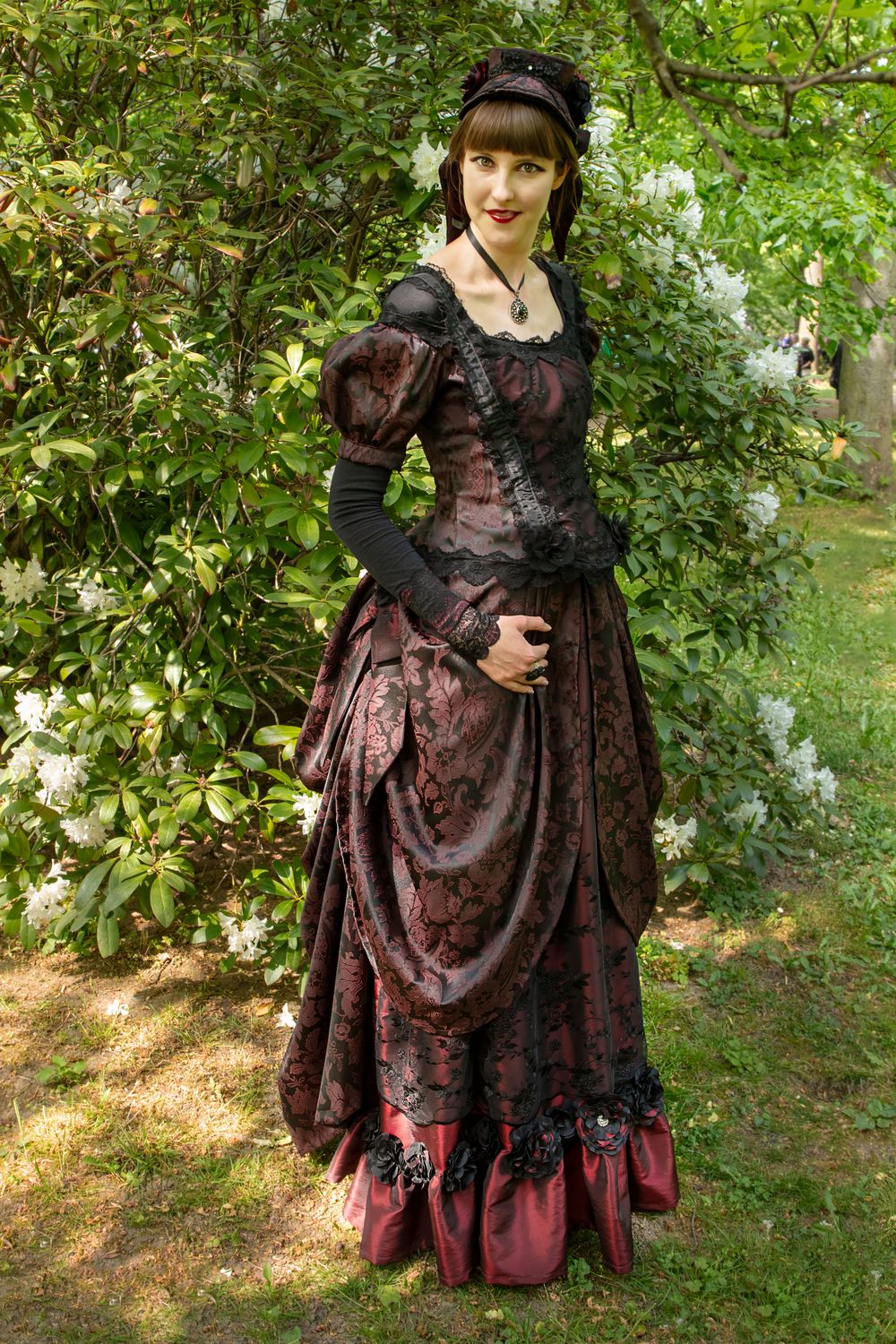
A Victorian mourning dress was the clothing of grief. When someone died, the women of the family put on black, plain and dull at first, and wore it for months or years, lightening it slowly in stages as time passed. The men wore black too, the household's servants were put into black, and the family's letters went out on paper edged in black. Queen Victoria herself wore mourning for almost forty years after the death of her husband, and her long grief made the customs of mourning stricter and more visible than ever before.
This guide explains Victorian mourning dress with care, because behind every surviving black dress was a real loss. It looks at why the Victorians mourned so publicly, at the Queen's widowhood, at the stages of mourning as the sources describe them, at crape, jet and black silk, at mourning jewellery and the art of hair work, at men, children and servants, and at how the custom came to an end. Where the sources disagree about the rules, it says so, because the rules themselves were never fixed. Our guide to Victorian fashion for women places mourning among the other clothes of the reign.
Why the Victorians mourned so publicly
Death was close to every Victorian family. The V&A notes that death was highly visible in Victorian culture, and that people were encouraged to show their grief openly rather than hide it. Mourning dress was the way they did so. It told everyone who met a family that it had suffered a loss.
Respect and respectability
Mourning was also a matter of what was proper. The V&A, describing a crape shawl in its collection, says that under Queen Victoria correct mourning dress was a sign of social respectability, and more so after the death of Prince Albert in 1861. Wikipedia's account of the custom notes that putting on ordinary clothes too soon could be seen as disrespect to the dead. People in deep mourning were expected to stay away from parties and other social events.
Mourning before Victoria
The custom was old. The habit of wearing plain black for mourning goes back at least to ancient Rome. In Britain, the death of Princess Charlotte in childbirth in 1817 plunged the whole country into mourning, the V&A records, and set the standard for mourning dress for years afterwards. The court issued guidelines through the Lord Chamberlain, a senior officer of the royal household. The death of the Duke of Wellington in 1852 brought another wave of national mourning.
Not everyone agreed
Mourning cost money, and not everyone thought it helped. In 1873 Charles Voysey wrote that it only added gloom to families who were already grieving. Mourning clothes could be bought new, or made by dyeing ordinary clothes black, as Wikipedia's account of mourning records.
Queen Victoria's forty years in black
Prince Albert died on 14 December 1861, aged 42; the illness was diagnosed at the time as typhoid fever. The royal family's own account of the Queen says she was deeply attached to her husband, who was also her closest adviser, and that she sank into depression after he died. For the rest of her reign she wore black.
The widow of Windsor
For years Victoria rarely appeared in public. She stayed mostly at Windsor Castle, at Osborne House on the Isle of Wight and at Balmoral in Scotland, and she seldom came to London, which earned her the name the widow of Windsor. She kept up her official work in private, reading her papers and seeing her ministers, but she was widely criticised for hiding herself away, and her seclusion fed calls for a republic. She was persuaded to open Parliament in person in 1866 and 1867, and only slowly returned to a fuller public life.
Her mourning and the country's
The Queen's grief set the tone for the nation. Formal mourning reached its height during her reign, and her long widowhood made prolonged, visible mourning the expected thing. The V&A has a handkerchief that belonged to her, of fine linen with black silk embroidery and her monogram in one corner, and notes that she extended her mourning far beyond the usual periods, as only a queen could. The Met's Costume Institute, in a century-long survey of mourning dress from 1815 to 1915, showed mourning gowns worn by Queen Victoria and by her daughter-in-law, Queen Alexandra.
Memorials to Albert
Victoria commissioned memorials to her husband. The best known is the Albert Memorial in Kensington Gardens, built between 1864 and 1876 to the designs of George Gilbert Scott in the Gothic style our guide to Gothic Revival architecture describes. She also built the Royal Mausoleum at Frogmore, near Windsor, where he was laid to rest.
A white funeral
Victoria died at Osborne House on 22 January 1901, aged 81. In instructions written in 1897 she asked for a military funeral and for white rather than black: a white pall over her coffin and no black drapes. She was dressed in a white dress and her wedding veil. Her funeral was held at St George's Chapel, Windsor, on 2 February 1901, and she was buried beside Albert at Frogmore. Above the mausoleum door are words of hers saying that she would rest with him at last.
The stages of mourning
Mourning was worn in stages, starting with the heaviest, plainest black and growing lighter over time. How long each stage lasted depended on how close the dead person had been, and the rules were set out in etiquette books and ladies' magazines that did not always agree. What follows is the pattern the museum sources describe, not a single rule that everyone kept.
Deep or first mourning
A widow began in deep mourning, also called full or first mourning. The V&A's notes give it as a year in one place and as a year and a day in another. She wore matt black with no shine, trimmed with crape, with no ornament and no jewellery, and a long black crape veil. The whole outfit was known as her widow's weeds, from an old English word for a garment. Some advice said she should use only black handkerchiefs, while other advice allowed white ones with a black border.
Second mourning
After the first year, the V&A explains, a widow could add some trimming and simple jewellery to her black, and the black border on her handkerchiefs grew narrower as mourning eased.
Half mourning
The last stage was half mourning, when soft colours were allowed: grey, lilac, mauve and lavender, and white trimmings. The V&A has a pale grey silk satin dress with leg-of-mutton sleeves and a deep lace peplum, made in 1894 as a half-mourning day dress and worn that August as a wedding dress by a bride who had recently lost her mother. Life went on, and mourning made room for it. In the 1820s, the V&A notes, shiny black silks and velvets were thought too bright for the first stages and were allowed only in the final one.
How long it lasted
The sources give a range rather than a rule. Wikipedia's account says a widow was expected to mourn for two years in all and not to go into society for the first twelve months, that special clothes could be worn for up to four years, and that some widows wore them for life. For a brother or sister, six months is the figure it gives. Mourning for a parent, a child or a more distant relation each had its own length, and the V&A sums up the principle: the closer the relationship, the deeper the mourning.
Crape, jet and black silk
Mourning had its own materials, chosen because they did not shine. Shine meant celebration; dullness meant grief.
Crape
Crape was the fabric of deep mourning. The V&A describes it as a crimped fabric, often of worsted and silk, with a dull, crinkled surface. The finest was woven by hand in Italy and worn by royalty and the aristocracy; in Britain, machines copied it with an embossed pattern and made it in great quantities for a wider market. The V&A's example was probably made in Norfolk or Essex, it was also called Norwich crape, and the museum names three firms that dominated British mourning crape, among them Samuel Courtauld's. The historian Lou Taylor, in her book Mourning Dress, saw crape as the material that best sums up the middle-class Victorian widow. The V&A has a dress of about 1900 in black wool with chevrons of crape around the hem, the trimming that marked the wearer's stage of mourning.
Very little crape survives. It was fragile, and many people thought it unlucky to keep crape in the house once mourning was over, so few pieces were kept. The Courtauld family's textile business, the V&A notes, made much of its money from black mourning crape, which the Queen's long mourning had made so popular.
Black silk and wool
Under the crape, mourning dresses were made in dull black fabrics: wool, or silk with a lustreless finish. The V&A has a mourning dress of 1845 to 1850 in lustreless black silk satin, trimmed with black braid, its bodice ending in a long point at the front in the fashion of the day. Mourning dresses followed the fashionable shapes of their day: the V&A's crape-trimmed dress of about 1900 has the A-line skirt typical of the early 1900s. The Met's survey traced the move over the century from crape to corded silks, and later the arrival of grey and mauve.
The mourning warehouses
So much black was needed, so quickly, that shops grew up to supply it. Jay's London General Mourning Warehouse opened on Regent Street in 1841 and sold everything needed for funerals and mourning. Peter Robinson's mourning warehouse, also on Regent Street, was nicknamed Black Peter Robinson's. The V&A has a length of its black dress silk from about 1890, still in its printed wrapper, sold to be made up by the customer's own dressmaker, and notes that its assistants advised customers on the right degree of mourning.
Jet
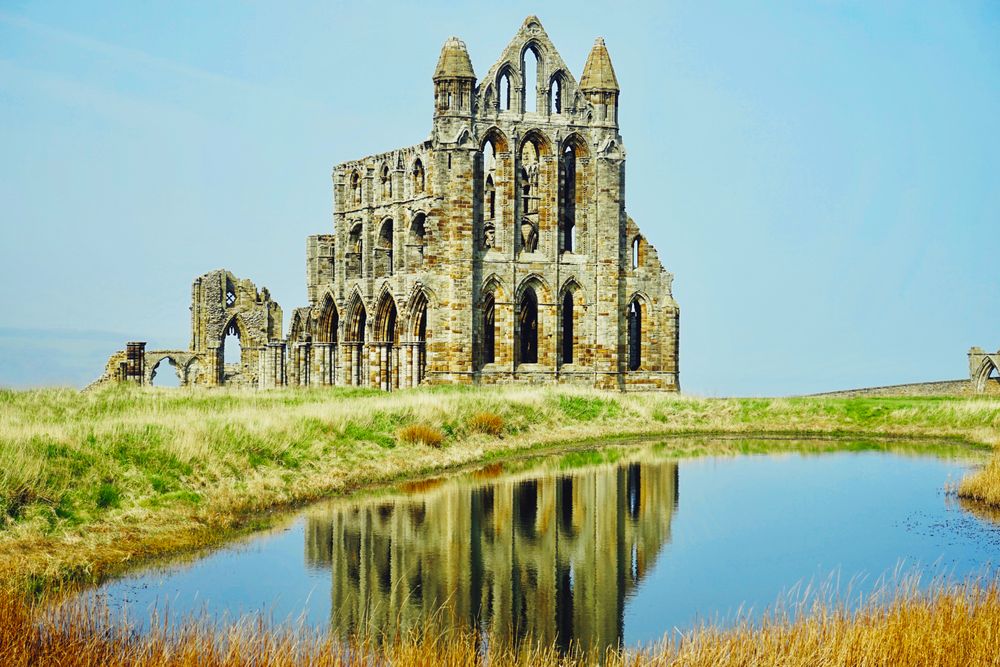
Jet, a black stone formed from fossilised wood, was the jewel of mourning. Whitby Museum says the Lord Chamberlain's office laid down that the ornament worn with mourning should be jet, and that after Prince Albert's death the Queen wore jet with her mourning for the rest of her life. At the height of the trade there were over 200 jet workshops in Whitby employing about 1,500 people. English Heritage notes Whitby's long association with jet, used in mourning jewellery. Wearing polished jewellery in full mourning was thought a serious mistake. Our guide to steampunk jewellery tells the story of Whitby jet and its imitations, and our guide to the Whitby steampunk weekend describes the town today.
Mourning jewellery and hair work
Mourning jewellery was worn to remember a particular person. Its popularity rose quickly in the second half of the nineteenth century, and industry made it cheap enough for many families.
Rings, lockets and brooches
Mourning rings were an old custom; people sometimes left money in their wills for rings to be made and given to mourners. Lockets and brooches held a photograph or a keepsake. Some carried symbols with their own meanings: cypress and yew for death, violets and forget-me-nots for remembrance.
Hair work
The most personal mourning jewellery was made from the hair of the person who had died. Hair lasts a very long time, which made it a fitting material for remembrance. Early pieces held a single lock behind glass. By the end of the century hair was braided into bracelets and necklaces, woven into patterns, and arranged into small mourning pictures such as willow trees.
The V&A notes that hair artists, who specialised in turning locks of hair into jewellery, worked throughout the Victorian period. Their printed catalogues let customers choose a design, with quiet assurances that a family's locks would not be muddled or swapped for someone else's hair. Among its examples is a London brooch of about 1842 by A. Forrer: brown hair shaped into a bow, bound with gold wire and finished with gold tassels, engraved with the dates of a sixteen-year-old who had died that year. Another is an English bracelet of 1846 in enamelled gold and plaited hair, with a small padlock hanging from it, inscribed in memory of the person it remembers. The V&A records that Queen Victoria herself both wore and gave jewellery set with hair.
Hair work at home
Not all hair work was done by professionals. Instruction books taught it as a home craft, among them Mark Campbell's Self-Instructor in the Art of Hair Work, published in New York in 1867, and mid-Victorian guides made it popular well beyond the rich. Not all of it was about death, either: the V&A notes that some hair jewellery was given as a token of love or friendship between the living.
If you own or find a piece of old hair work, remember that it holds part of a real person who was loved. Handle it gently, and ask a museum or a conservator before cleaning or repairing it.
Men, children and servants in mourning
Mourning was for the whole household, not only for widows. The V&A notes that when someone died, the whole household went into black, including children and servants.
Men
For a man, mourning meant a black frock coat with black trousers and waistcoat, and a black band round his hat. Our guide to Victorian men's fashion describes the frock coat and the hats of the period. Wikipedia's account of the custom says that a plain black armband on its own was thought proper only for men in uniform, who could not change their clothes.
Children
Children were dressed in black too. The V&A's note on Peter Robinson's mourning warehouse is plain that the whole household, children included, went into black when someone died, and the shop's assistants advised families on what each person should wear.
Servants
The servants of a household went into mourning when someone in the family died. Wikipedia's account notes that servants wore black armbands after a death in the house.
Letters and stationery
Mourning reached the writing desk too. The National Archives notes that black-edged stationery was commonly used to send news of a death, and that mourning envelopes appear often among the designs registered in the period; one, in 1864, showed a mourning cross when its flap was folded down. A black-edged letter told its reader the news before it was opened.
How the custom ended
Victorian mourning did not end on a single day. It faded over about half a century, for several reasons at once.
The last years of the reign
The trades that supplied mourning were already in decline before the Queen died. Whitby Museum says the jet industry peaked around 1870 and then collapsed, hurt by poor-quality Spanish jet, first recorded in 1874, until the fashion for mourning had passed. The Courtauld business, the V&A notes, found its future in 1904 when it bought the British rights to make artificial silk. Victoria herself had asked for white, not black, at her own funeral.
After 1901
In the Edwardian years, from 1901 to 1910, clothes became more practical, but mourning dress was still strictly laid down. The rules then relaxed little by little, until dark colours worn for up to a year after a death in the family were thought enough.
The First World War
The First World War brought the change to a head. Wikipedia's account of mourning jewellery says the war marked the end of showy mourning, and that mourning jewellery largely disappeared with it. Many people still wear black to a funeral today, but the years of crape and veils had gone.
Mourning dress and steampunk
The black of Victorian mourning lives on in gothic fashion and in the darker side of steampunk: a black bustle skirt, a veil on a small hat, a jet brooch. Our guide to steampunk, gothic and Victorian explains where those styles meet.
A costume that follows the real stages reads as more thoughtful than one in plain black. Deep mourning means matt fabrics with no shine and no jewellery; a later stage allows a little trimming and a single brooch of jet or black glass; half mourning brings in grey, lilac or mauve, with white lace at the collar. Our guide to women's steampunk outfits shows how to build the rest of the outfit around pieces like these. If you borrow the look, it is worth remembering what it meant. These were the clothes of real grief, worn by people who had lost someone they loved, and the respect they asked for then is still due to them now.