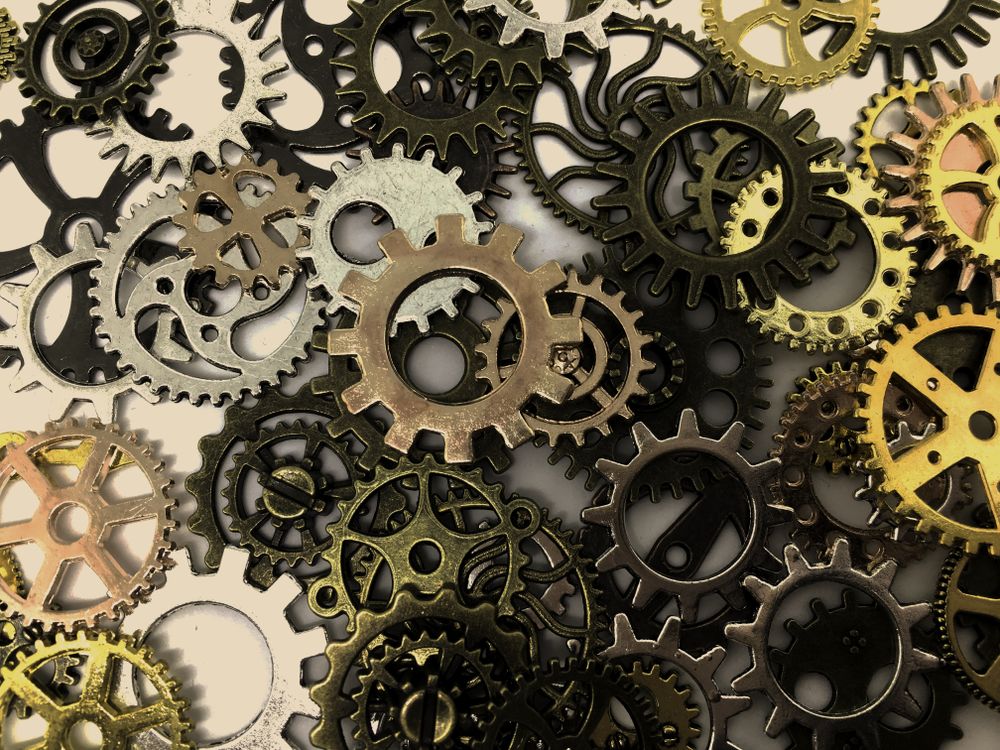
A steampunk robot is a mechanical person built as a Victorian might have built one: a boiler for a body, a pressure gauge for a face, gears at the joints and a key in the back. Alongside the robots come the creatures, steampunk animals of riveted brass, clockwork insects, mechanical spiders, cats, owls, dragons and skulls. They are some of the most popular subjects in steampunk art, and among the most satisfying things to make.
This guide explains the real clockwork creatures, called automatons, that came first, then steampunk robots, mechanical animals, clockwork insects and spiders, and dragons, cats and other creatures. It gives a method for making a small mechanical creature at home safely, and ends with the films and books where such creatures appear.
Automatons: the real clockwork creatures
An automaton is a machine that moves by itself, usually made to look like a person or an animal. The word comes from Ancient Greek and means acting of one's own will; the plural is automata or automatons. Long before steampunk imagined clockwork creatures, craftsmen in the eighteenth and nineteenth centuries were building real ones, and several can still be seen working.
The Silver Swan
The Silver Swan at the Bowes Museum in Barnard Castle, County Durham, was made in 1773 in the London workshop of James Cox, a jeweller and goldsmith who worked as much as a showman as a craftsman. John Joseph Merlin, who worked for Cox, designed the mechanism of its head and neck. The swan is life-size and has about 2,000 moving parts, among them 113 rings in its neck and 139 crystal rods that make the water it sits on. Three clockwork mechanisms drive it: one for the head and neck, one for the music, and one for the pool, in which small silver fish appear to swim. It preens and seems to feed. It was shown at the Paris International Exhibition of 1867, and John Bowes bought it in 1873.
The Jaquet-Droz automata
Three of the most famous automata ever made were built in Switzerland between 1768 and 1774 by the watchmaker Pierre Jaquet-Droz, his son Henri-Louis and Jean-Frédéric Leschot, partly to bring in customers for their watches. Each is a doll. The Musician, a young woman, plays a real organ built for her by pressing its keys, and her chest rises and falls as if she were breathing. The Draughtsman, a small boy, draws four pictures, among them a dog, and blows the dust off his pencil. The Writer, the most complicated, dips a goose feather in ink and writes a text of up to forty letters, chosen one by one on a wheel inside him, while his eyes follow the words. All three still work. The Neuchâtel History and Archaeology Society bought them in 1906, and they are in the Musée d'Art et d'Histoire in Neuchâtel.
Maillardet's automaton
The Swiss maker Henri Maillardet, who worked in London making clocks and other mechanisms, built a doll that draws and writes, believed to date from about 1800. Its memory is held in brass discs called cams, whose uneven edges are followed by steel fingers that move the hand through levers and rods. It produces four drawings and three poems, two in French and one in English. It arrived at the Franklin Institute in Philadelphia, in November 1928, as a ruined machine, and when it was repaired it wrote a line saying it had been made by Maillardet's automaton, which told the museum who had made it.
Tipu's Tiger
One of the best-known objects in the V&A in London is a wooden tiger, almost life-size, mauling a European soldier who lies on his back. It was made in Mysore, in India, in the 1780s or 1790s, for Tipu Sultan, the ruler of Mysore from 1782 to 1799. Hidden behind a flap in the tiger's side is an organ. Turning a handle plays it, raises and lowers the soldier's arm, and makes sounds meant to imitate his dying cries. After Tipu was killed in 1799 and British forces took his capital, Seringapatam, the tiger was shipped to London. It was first shown at the East India Company's museum and later moved to the South Kensington Museum, which became the V&A, where it has been on display almost ever since.
Vaucanson, and the golden age
In France, Jacques de Vaucanson built a mechanical flute player in 1737 that could play twelve tunes, and a gilded copper duck that seemed to eat grain and digest it. It was a trick: when the magician Jean-Eugène Robert-Houdin examined the duck in 1844, he found that the droppings were prepared beforehand and kept in a second container. The years from 1860 to 1910 are often called the golden age of automata, when small family workshops in Paris sent thousands of clockwork figures and mechanical singing birds all over the world. Those Victorian toys, with their keys, springs and painted faces, are the real ancestors of the steampunk creature.
Steampunk robots
Where the word robot came from
The word robot is younger than steampunk's Victorian setting. It was introduced in R.U.R., a play by the Czech writer Karel Čapek written in 1920 and first performed in January 1921. Čapek said the true inventor of the word was his brother Josef. In Czech, robota means forced labour. Oddly, the robots in the play are not machines at all but artificial people made from synthetic living matter. The metal robot came later.
Mechanical men before the word
Victorian writers imagined mechanical men long before anyone called them robots. The Steam Man of the Prairies by Edward S. Ellis, a cheap American adventure story of a kind called a dime novel, published in August 1868, has a teenage inventor, Johnny Brainerd, who builds a huge steam-powered man that pulls him in a carriage across the prairies. In L. Frank Baum's Ozma of Oz (1907), Dorothy finds Tik-Tok, a round mechanical man of polished copper driven by clockwork, with separate windings for thinking, speaking and moving, none of which he can wind himself. When one runs down, he stops thinking, falls silent or freezes. Tik-Tok is often called one of the first robots in modern stories, though the word did not yet exist.
Designing a steampunk robot
The difference between a steampunk robot and a modern one is what it runs on and what it is made of. A modern robot is smooth and sealed; a steampunk robot shows its workings. Some ways to make the idea clear:
- A body that is a machine. A boiler, a barrel, a stove or a diving helmet makes a body; a chimney or a whistle on top shows where the steam goes.
- A face that is an instrument. A pressure gauge, a clock face, a pair of goggles or a grille from an old radio makes a face with character.
- Joints you can see. Hinges, ball joints, pistons and gears at the shoulders, elbows and knees show how it moves.
- A way to power it. A winding key in the back, a furnace door in the chest, a coal scuttle on the side.
- Riveted plates. Rows of rivets along the seams make the body look built rather than moulded.
Give the robot a job, too. A butler, a postman, a soldier, a gardener or a deep-sea diver each suggests a shape, and the job makes it a character rather than a heap of parts. Our guide to how to draw steampunk shows how to draw the gears, pipes and gauges that make one up.
Mechanical animals
A steampunk animal is a real animal rebuilt as a machine, and the trick is to keep what makes it recognisable while replacing what it is made of. Look first at the animal's outline, the way it stands and moves, and the one or two features everyone knows it by: an owl's round face and big eyes, an elephant's trunk and ears, a horse's long legs and neck. Keep those, and turn everything else into metal.
Turning an animal into a machine
- Plates instead of fur or feathers. Overlapping metal plates, like the scales of armour, follow the shape of the body. Feathers become thin brass leaves, each with a rivet at the base.
- Gears at the joints. Shoulders, hips and the neck are where a mechanical animal would bend, so that is where the gears, hinges and pistons go.
- Glass or lenses for eyes. A camera lens, a watch glass, a bead or a jeweller's loupe gives a mechanical eye that catches the light.
- Something open. A panel left off, a cage of ribs or a glass dome over the chest shows the clockwork inside, which is the heart of the style.
Which animals work best
Birds are the classic choice, because the Victorians themselves made mechanical singing birds and the Silver Swan. Owls suit the scholarly side of the style, and ravens the darker, gothic side. Horses fit the age of the carriage. Elephants, octopuses and whales suit the explorer and the submarine. Fish suit Captain Nemo. Choose an animal that belongs to the story your character is telling.
Clockwork insects and spiders
Clockwork insects are perhaps the most popular steampunk creatures of all, because insects already look like small machines. Their bodies are made of hard sections joined together, their legs bend at clear joints, and their wings are thin and veined like metal foil. An insect is also small enough to make from the parts of a single old watch.
Beetles, dragonflies and bees
A beetle is the easiest to start with: a domed, rounded back that can be a watch case or a button, a small head, and six legs. A dragonfly is long and thin, with four clear wings, which can be cut from thin sheet metal, clear plastic or the glass from an old watch. A bee is round and striped, and can be built from a few rings of brass with a pair of small wings. Real insects have six legs and their bodies are in three parts, head, thorax and abdomen, so getting those right makes a mechanical one more convincing.
Spiders
Spiders have eight legs and two body parts, and their long, jointed legs make them look mechanical even in life. A small spider is a good brooch or hat decoration. On a large scale, a mechanical spider is a classic steampunk villain's machine: in the film Wild Wild West (1999), directed by Barry Sonnenfeld, the villain Dr Loveless takes control of a giant mechanical spider that he uses as his ultimate weapon.
Using old watch parts safely
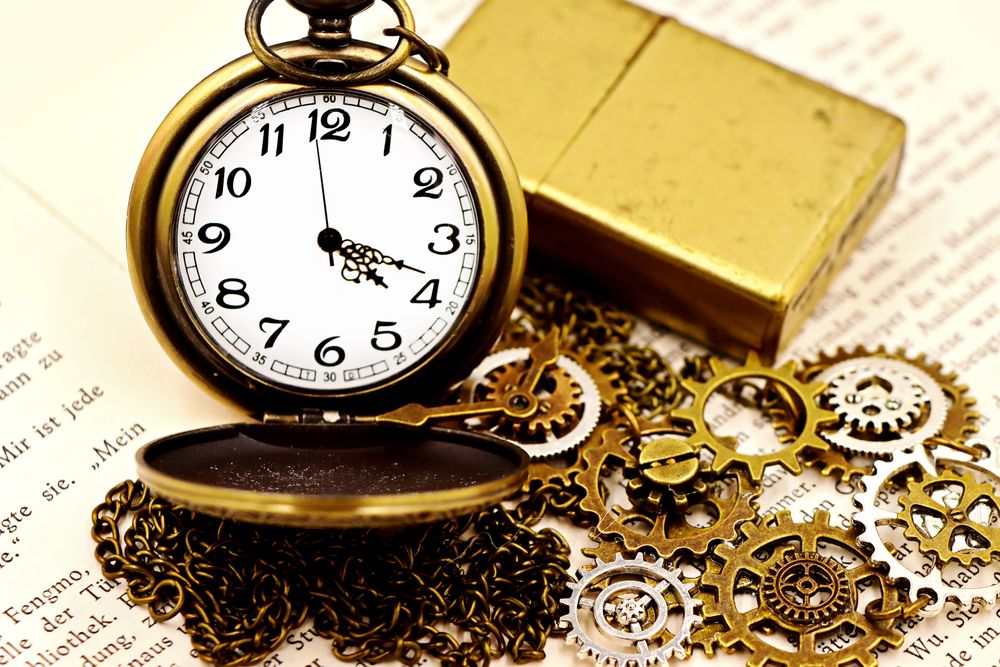
Old watch movements, the works inside, are the usual source of parts for small insects, with their tiny gears, springs and jewels. Never take apart a watch or clock with luminous numbers or hands made before the 1970s. The paint on those may contain radium, which has a half-life of about 1,600 years. An old dial left intact is usually little risk, but taking one apart can free flakes of paint that can be breathed in or swallowed. Our guide to watches and pocket watches says the same about old watches.
Dragons, cats and other creatures
Dragons
A mechanical dragon is a fantasy creature rebuilt by an engineer, and it suits steampunk because a dragon already breathes fire, which is what a steam engine runs on. Give it a furnace in its chest, a chimney or exhaust pipes along its spine, plates for scales, wings made of a frame of rods with canvas or leather stretched between them, like the wings of early flying machines, and a pressure gauge somewhere on its neck. The jaw can be a hinge, the teeth a row of bolts.
Cats
A mechanical cat is about posture: the arched back, the curled tail and the alert ears. Build the tail from a chain of small rings or a coiled spring, so it curls naturally, and the ears from two triangles of sheet metal. Eyes of green or amber glass catch the light as a real cat's do. A cat can be friendly, sitting on a pile of books, or sinister: in the animated film 9 (2009), directed by Shane Acker and produced with Tim Burton and Timur Bekmambetov, a cat-like machine called the Cat Beast hunts the film's small rag-doll heroes.
Skulls
Skulls appear often in steampunk art and decoration, usually with a gear set into the forehead, a goggle over one eye, or a jaw on a visible hinge. They belong to the darker side of the style, close to the gothic, and they echo memento mori jewellery, made since the Middle Ages, which used skulls and skeletons as reminders of death. A mechanical skull is also a good way to practise: it is one rounded shape with a few clear features, and every gear you add has an obvious place to go.
Others
Octopuses, with their eight arms, look wonderful built from flexible metal tubing. Seahorses, snails and crabs, with their spiralled or plated shells, already look half mechanical. Any creature with a hard shell, clear joints or a spiral is a good subject.
Making a small mechanical creature
A small creature for a shelf, a hat or a brooch can be made in an afternoon. This method makes a beetle, and the same steps work for most small creatures.
What you need
- A base for the body: a large button, an old watch case without a luminous dial, a bottle cap or a shaped piece of card.
- Small gears, watch parts or flat washers for decoration.
- Thin wire for legs and antennae, copper or brass coloured.
- Strong glue made for metal, and a pair of small pliers.
- Paint for ageing, dark brown and black, with a little metallic paint.
Step by step
- Plan it. Lay the pieces out on a sheet of paper and move them about until you like the shape. Draw round them so you can put them back in order.
- Build the body. Glue the head, a small button or gear, to the front of the body. Let it set before going on.
- Add the legs. Cut six equal lengths of wire. Bend each into a leg with two joints, and glue three under each side of the body, pointing slightly forward, sideways and back.
- Decorate the back. Glue small gears on top, overlapping, with the largest in the middle. A pair of wings cut from thin sheet metal or clear plastic can go on top of them.
- Age it. Brush dark paint into the hollows and wipe it off the raised parts, so the creature looks handled for years. A touch of metallic paint on the edges catches the light.
- Finish it. Add antennae from two short pieces of wire, and a brooch pin or a small magnet underneath if it is to be worn or stuck to something metal.
Working safely
Glues and paints give off vapours as they dry, and solvent vapours can cause headaches and dizziness; the Health and Safety Executive says ventilation is always needed when solvents are used, so work with the windows open. Cut wire and sheet metal with care and protect your eyes, because small pieces fly. Use a sharp craft knife on a cutting board, cutting away from your body: the Health and Safety Executive names cutting away from the body, and the dangers of blunt knives, among the things anyone using a hand knife should be taught.
Keep small parts away from young children. Gears, beads and watch parts are exactly the size a small child puts in their mouth, so keep them in a closed box and clear the table when you finish. Two things need particular care. The government's product safety office warns that a button battery, the small flat round battery in watches and in anything that lights up, reacts with saliva to make caustic soda, and if one sticks in a child's food pipe it can burn a hole and cause bleeding that can kill. Small, powerful magnets, if more than one is swallowed, can pull together through the gut and cut off its blood supply. If you think a child has swallowed either, take them straight to A&E, even if there are no symptoms, take the packaging with you, and do not let them eat or drink or make them sick. Our guide to making steampunk props safely covers tools and the workshop in more detail.
Where these creatures appear in films and books
Automatons on screen and on the page
The best-known story about an automaton is Brian Selznick's The Invention of Hugo Cabret (2007), a book told in words and hundreds of pictures, which won the Caldecott Medal in 2008. Selznick was inspired by seeing Maillardet's automaton repaired at the Franklin Institute. Martin Scorsese made it into the film Hugo (2011), set in a Paris railway station in 1931, in which a boy and his father work to repair a broken mechanical man built to draw; the film won five Academy Awards. Philip Pullman's short novel Clockwork (1996), set in a German town in the old days, tells of an apprentice clockmaker and a deadly mechanical knight.
Robots in animation
Hayao Miyazaki's Castle in the Sky (1986) has robots from the floating city of Laputa, which first appear as fearsome guardians and are later found peacefully tending the city's gardens. In Disney's Treasure Planet (2002) the hero meets B.E.N., a robot who has lost his memory, voiced by Martin Short and based on Ben Gunn in Treasure Island, while John Silver is a cyborg with a mechanical arm. Miyazaki's Howl's Moving Castle (2004), from Diana Wynne Jones's novel of 1986, has a castle that walks on mechanical bird-like legs. Our guide to animated steampunk films and series describes them all.
Creatures in other stories
In Philip Reeve's novel Mortal Engines (2001), whole cities move on wheels and hunt each other, and among its characters is Shrike, a Stalker, an ancient cyborg. Bryan Talbot's comic Grandville (2009) is peopled mostly by animals and has steam-powered vehicles and automatons. And in the Halloween costume ideas in our guide to steampunk for Halloween, a clockwork doll or a mechanical animal worn on the shoulder is one of the easiest ways to wear a creature yourself. For the gears and machines that make all of these creatures move, see our guide to cogs, gears and machines, and for more films, the best steampunk films.