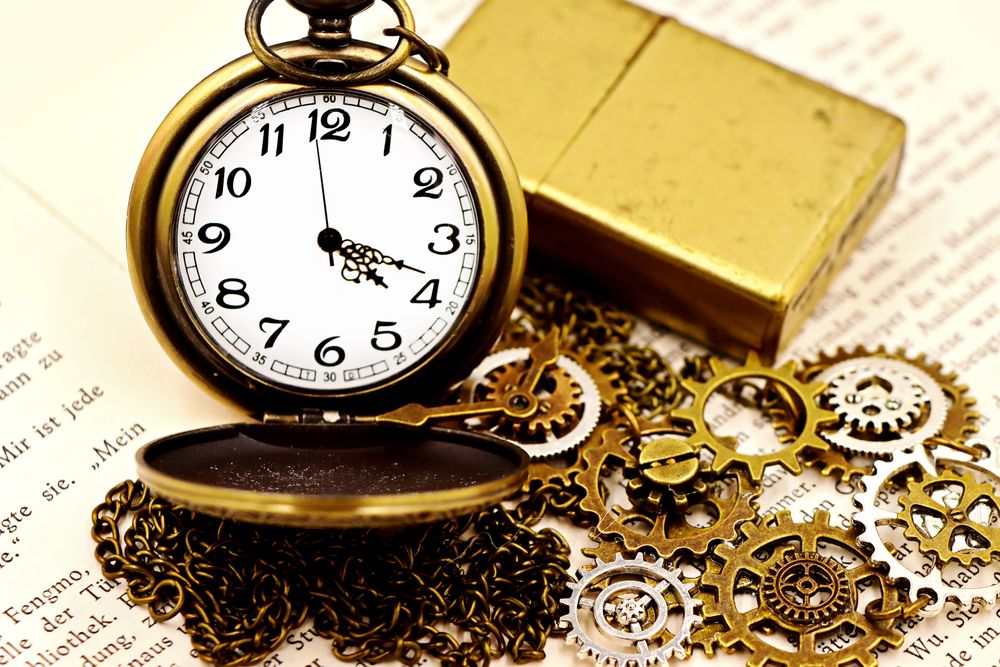
A steampunk watch is the one accessory that belongs to the Victorian age exactly as it was. A pocket watch on a chain, tucked into a waistcoat, is what a nineteenth-century gentleman, railwayman or engineer really carried, and it is also a small machine with its workings inside, which is the whole idea of steampunk in the palm of a hand. A pocket watch steampunk outfits wear can be a real antique, a modern mechanical watch, or a costume piece that only looks the part.
This guide explains the watch's place in Victorian life, the two main kinds of case, the chains and fobs that go with them and how to wear one, skeleton watches that show their workings, where the wristwatch fits in, how clockwork runs and how to keep it running, and how to look after an old watch, including the one real hazard some old watches carry. It names no makers to buy from.
The pocket watch in Victorian life
Before Victoria
Watches small enough to carry were first made in the sixteenth century, and the earliest had only an hour hand; the minute hand appeared in the late seventeenth century. Two British advances made the Victorian watch possible. By 1755 the London watchmaker Thomas Mudge had invented the lever escapement, the part that lets the watch's power out a step at a time; in 1770 George III bought a gold watch by Mudge that used it, as a present for Queen Charlotte, and it is still in the Royal Collection. Six years later Mudge was made watchmaker to the king. Lever watches became common after about 1820, and the same design is still used in most mechanical watches today.
The other advance was at sea. In 1714 Parliament offered a reward for a way of finding a ship's longitude, and the clockmaker John Harrison set out to build a portable timekeeper accurate to within three seconds a day. His fourth, known as H4 and completed in 1759, looked like a very large pocket watch, with a dial about ten centimetres across, and it weighs about one and a half kilograms. It ticks five times a second. It is now in the collection of Royal Museums Greenwich.
Railway time
For most Victorians, the watch mattered because of the railways. Early in the nineteenth century every town kept its own time by the sun, so local time in Plymouth was about sixteen and a half minutes behind Greenwich. At first different railway lines ran on different times, which made timetables a muddle. In 1847 the Railway Clearing House, the body that regulated the railways, recommended that every station keep Greenwich time, and in 1880 Greenwich Mean Time became the legal time in Great Britain.
Royal Museums Greenwich describes a gold watch made in 1847 by Benjamin Lewis Vulliamy with two minute hands: a gilt one for Greenwich time and a blued steel one for local time, so that a traveller from Liverpool could see both, with Liverpool running twelve minutes behind. A watch like that makes a perfect prop for a steampunk railway engineer or traveller. Our guide to steampunk trains, cars and machines has more on the engines themselves.
Watches for more people
Until the third quarter of the nineteenth century most pocket watches were wound and set with a small key. Winding by turning the knob on top, called the crown, was invented in the 1840s and spread over the following decades. In 1857 an American factory began making watches from interchangeable parts, which made them cheaper to build and to mend.
Open-face and hunter cases
A pocket watch case comes in one of two main forms, and the choice says something about the character carrying it.
The open-face watch
An open-face watch has no metal cover over the glass, so the dial is always on show. The ring at the top, called the pendant, where the chain is fixed, is usually at twelve o'clock. Open-face watches were the working watch of the railways. On 19 April 1891 a train crash at Kipton, Ohio, was blamed on an engineer's watch that had stopped for four minutes, and American railways then set strict standards for their watches; after 1908 those standards required them to be open-faced with the winding crown at twelve. For a steampunk engineer, a railwayman or a ship's officer, an open-face watch is the practical choice.
The hunter
A hunter has a hinged metal lid on a spring that closes over the dial and the glass. The name comes from England, where men who rode to hounds found they could open the watch and read it with one hand. It is also called a savonette, from the French word for soap. The lid protects the glass, and it makes a satisfying moment out of checking the time, which is why the hunter is the gentleman's watch in steampunk: the inventor, the officer, the aristocrat.
The half-hunter
A half-hunter, or demi-hunter, has a small glass window or a hole in its lid, so the time can be read without opening it. It suits a detective or a doctor, someone who checks the time often and quickly.
Case metals
Old cases are found in gold, silver, gilt metal and steel. Gold suits a wealthy character, silver a professional man, and plain steel or gunmetal a working one. For a darker, gothic outfit, a blackened case looks right, and a brass case goes with almost every steampunk colour.
Chains, fobs and how to wear one
The albert
In British English the chain that fastens a pocket watch to a waistcoat is called an albert, a nineteenth-century word named after Prince Albert, Queen Victoria's husband. The watch sits in a front pocket of the waistcoat, the chain runs across to a buttonhole, sometimes an extra one made in line with the pockets, and a bar on the end of the chain goes through the buttonhole, so that the watch cannot slip away if it is dropped or pulled.
Fobs
The word fob has two meanings that both belong here. A fob is a small pocket just below the waistline of a pair of trousers, made for a watch. It is also a short chain or ribbon hanging from that pocket, and the small medallion or charm on the end of it. Watch chains were often hung with small decorative pendants, which also came to be called fobs. The word may come from an old German word for a pocket. In steampunk a fob is the place for a personal touch: a small compass, a key, a seal, a locket or a single brass gear.
Watches for women
Victorian women seldom had pockets in their dresses before the 1850s. Many hung their useful things from a chatelaine, a decorative clasp worn at the waist with a row of short chains for scissors, thimbles, keys and watches. The word was used for it in a fashion magazine in April 1828, and in the nineteenth century chatelaines were worn by many housekeepers. The V&A has a cut-steel chatelaine made in England around 1850, with penknives, scissors, keys and a thimble case among its parts. A chatelaine with a small watch on one chain, worn at the belt of a corset or a skirt, is a steampunk lady's answer to the albert. Our guide to steampunk jewellery has more.
How to wear one
- Put the watch in one of the lower front pockets of your waistcoat.
- Pass the bar on the other end of the chain through a buttonhole near the middle of the waistcoat, so the chain hangs across the front in a gentle curve.
- Adjust it so the curve sits above the bottom edge of the waistcoat, rather than dangling below it.
- If you have no waistcoat, clip the chain to a belt loop or a brace button and keep the watch in a trouser pocket.
- Hang one fob on the chain, or none. Several start to look like a key ring.
Our guide to steampunk corsets and waistcoats explains how to choose the waistcoat the watch lives in.
Skeleton watches: the workings on show
A skeleton watch is a mechanical watch whose moving parts can be seen, through the front, the back, or both. To make one, a watchmaker trims away every piece of metal the movement does not need from its plates, bridges and wheels, leaving a delicate frame that is often engraved by hand. The French clockmaker André-Charles Caron is credited with making the first skeleton watch in the 1760s. They took so much work that few were made in the eighteenth and nineteenth centuries.
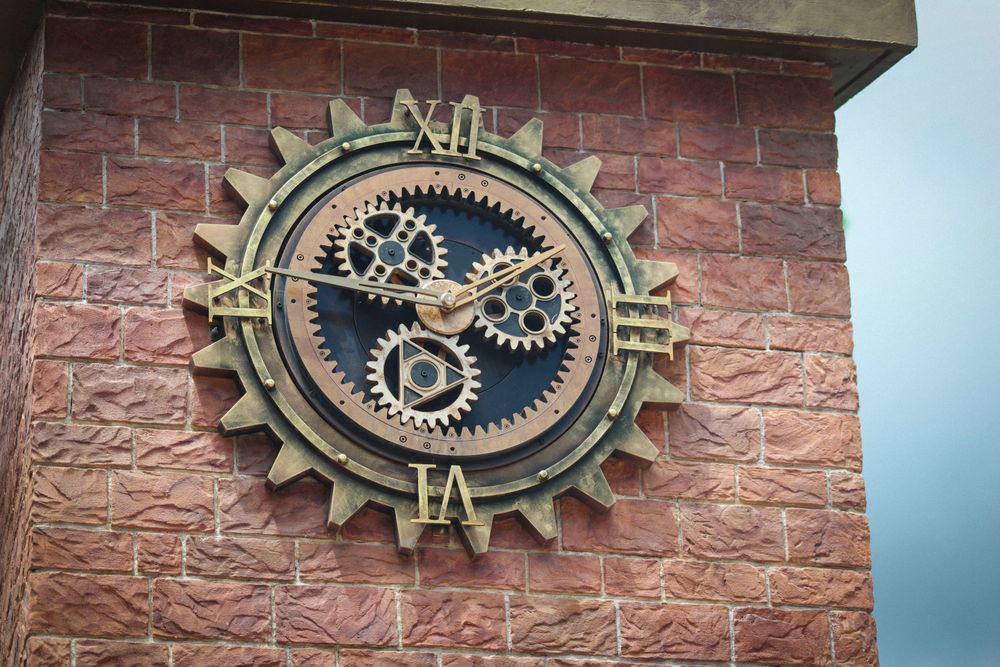
No kind of watch suits steampunk better, because steampunk is the style that puts the workings on show. A skeleton watch lets you see the wheels turn and the balance swing back and forth, and it looks like a tiny version of the machinery the style is built on. A simpler version is the open-heart watch, which has a small window, usually round, cut into the dial to show the balance wheel moving, sometimes called the watch's beating heart.
Real workings and painted ones
Some watches sold as steampunk watches are skeleton or open-heart watches with a real mechanical movement inside. Others are battery-powered watches with gears printed on the dial or fixed behind it for decoration, which do not move. Both can look good on an outfit. If you want the real thing, look for a watch that ticks, whose balance wheel you can see swinging, and which needs winding. Our guide to cogs, gears and machines explains what each of the parts you can see is doing.
Wristwatches in steampunk
A wristwatch is not out of place in a steampunk outfit, because the wristwatch is older than many people think. The oldest one that survives, then called a bracelet watch, was made in 1806 and given to Joséphine de Beauharnais, the wife of Napoleon. For about the first hundred years wristwatches were made almost only for women, while men kept to pocket watches.
Men's wristwatches came in later in the nineteenth century, and soldiers were among the first to wear them. During the First Boer War of 1880 to 1881, the need to coordinate the movements of troops made wristwatches common among officers. The British War Office began issuing wristwatches to fighting men from 1917, and by the end of the First World War almost all enlisted men wore one. After the war wristwatches gradually replaced pocket watches, partly because officers in the field had found a watch on the wrist far easier to reach than one in a pocket. Watches of that time, part pocket watch and part wristwatch, are called trench watches.
Wearing one in steampunk
For a woman, a small watch on a bracelet at the wrist has a real Victorian history. For a man, a watch on a wide leather cuff suits an aviator, an officer or an engineer, the kind of character who needs both hands free. A watch set into a leather gauntlet, or a watch worn on the outside of a glove, looks like equipment. If your everyday watch is very modern, a plain leather cuff fastened over it hides it for the day. The quartz watch, which went on sale on 25 December 1969, belongs to a different age altogether, but on a steampunk wrist nobody will know.
Clockwork, and keeping it running
A mechanical watch is a machine with five main parts, and knowing what each does makes it easier to look after.
How it works
- The mainspring, a spiral ribbon of spring steel, stores the power when the watch is wound.
- The wheel train, a row of gears, carries that power through the watch and counts the swings of the balance into seconds, minutes and hours.
- The escapement lets the wheels move on one small step at each swing of the balance. It makes the ticking sound.
- The balance wheel swings back and forth, kept in time by a fine spiral spring called the balance spring or hairspring. This pair is the part that keeps time. Most watch balances swing at between five and ten beats a second, so Harrison's H4, at five ticks a second, already beat at the pace of a modern watch.
- The jewels, tiny bearings of synthetic ruby or sapphire, reduce friction where the parts turn, which helps accuracy and makes the watch last.
Winding
Most watches wound by the crown run for between a day and a half and three days on a full wind, so the simple habit is to wind once a day, at the same time each day, in the morning. Turn the crown gently until you feel it stiffen, and then stop; never force it. An old key-wound watch is wound with a small key, and needs a key of exactly the right size.
Setting the time
Pocket watches are set in different ways, and forcing the wrong one can break it. On many, you pull the crown out a little and turn it. On a lever-set watch, a design American railways made compulsory because it stops the time being changed by accident, you open the glass and the ring round it, pull out a small lever at the edge of the dial, turn the crown, and then push the lever back. On a pin-set watch, you press a small pin next to the winding stem before turning the crown. If you are not sure which kind you have, ask a watchmaker before you try. For the bigger clockwork that suits a steampunk room, see our guide to steampunk clocks.
Looking after an old watch
Servicing
Every mechanical watch eventually needs cleaning, oiling and adjusting by a skilled watchmaker, because its oils dry out and its parts wear. An old watch that has not been looked after for years may run for a while and then stop. If you buy or inherit one, have it looked at before you wear it often, and do not open the movement yourself: the parts are tiny, the springs are strong, and some old watches carry a hidden hazard.
Radium dials
Soon after radium was discovered in 1898 it was mixed into paint that glowed in the dark, and from 1914 radium paint was widely used on the numbers and hands of watches and clocks. It was replaced by other materials in the 1970s. The radium used has a half-life of about 1,600 years, so an old radium dial is still radioactive today. Many no longer glow, but that is because the glowing material in the paint has broken down, not because the radium has gone.
An intact radium watch kept in good condition is usually considered a low risk. The danger comes from taking one apart, because flakes of the old paint can be breathed in or swallowed. In a study published by the University of Northampton in 2018, a collection of thirty radium-dial watches from the 1920s to the 1960s, kept in a small room the size of a boxroom, raised the level of radon, a radioactive gas given off as radium decays, to more than a hundred times the level the UK recommends. So:
- never open the case of a watch or clock with a luminous dial made before the 1970s, or scrape at its numbers;
- never take its gears for a costume, as our guide to a steampunk costume on a budget also says;
- do not keep a large collection of old luminous watches in a small closed room;
- if the glass of such a watch breaks, do not handle the paint, and take it to a watchmaker.
Reading the case
A gold or silver case made in Britain may carry hallmarks, and they can tell you a good deal about the watch. The Goldsmiths' Company explains that a hallmark includes a sponsor's mark, usually initials in a shield, for the maker or the person who sent the piece to be marked; a town mark for the assay office that tested it, which in London is a leopard's head; a standard mark for the type of metal; and a date letter, which can be looked up in each office's published tables, since before 1975 every office used its own sequence. Silver-plated cases can carry stamps that only look like hallmarks, so a mark is worth checking.
Everyday care
Keep an old watch dry, because it was not made to stand up to water or damp. Wind it gently, keep it in a soft pouch or a pocket on its own rather than loose in a bag with keys, and open a hunter's lid gently rather than prising at the edge. Wipe the chain and the case with a soft, dry cloth after wearing, since sweat and rain dull silver and brass, and store the watch with its chain coiled loosely beside it rather than wound tightly round it, so the links and the pendant are not strained. Treated that way, a Victorian watch can keep time for another hundred years, and our guide to men's steampunk outfits shows how to make it the finishing touch.