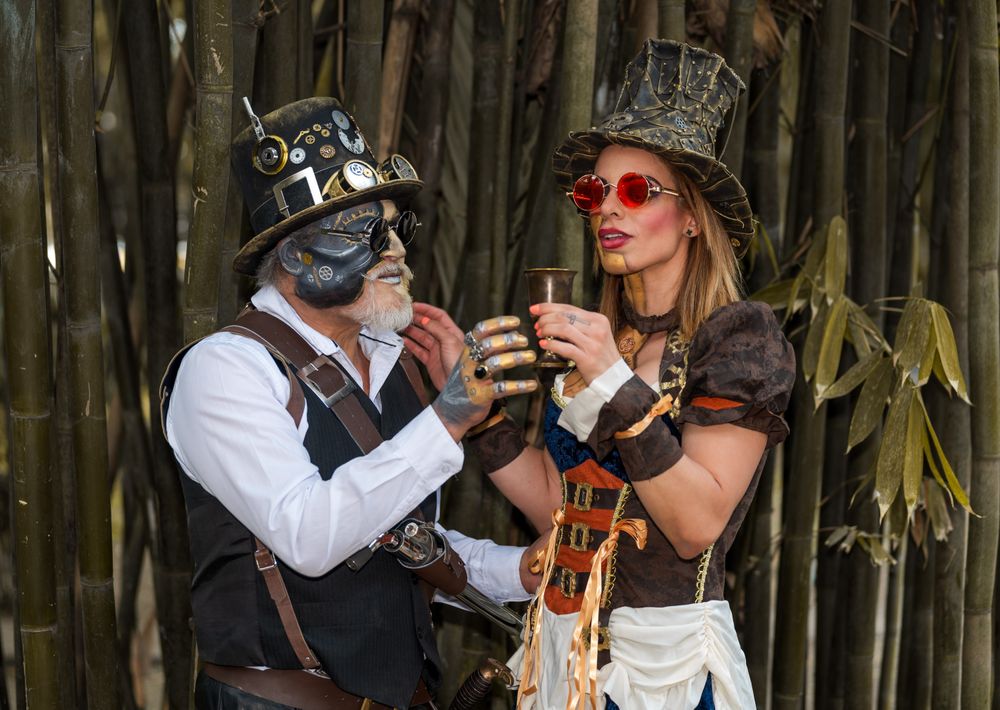
Steampunk for Halloween is a natural fit. A steampunk outfit is already a costume with a story, built from the dark coats, top hats and long skirts of the Victorian age, and that age was also the great age of the gothic horror story. Add a little darkness and a few strange instruments, and a steampunk outfit becomes a mad scientist, a vampire hunter, a clockwork creature or a doctor in a beaked mask. Halloween costumes in the steampunk style also have one great advantage over most: they are not thrown away on 1 November, because the same clothes can be worn all year.
This guide explains why the style suits the night, then takes the darker side of steampunk, the plague doctor, and the mad scientists, clockwork creatures and vampire hunters in turn. It covers make-up that looks like brass and machinery, the safety points for children's costumes, and a quick steampunk Halloween outfit for anyone who has left it late.
Why steampunk works for Halloween
Halloween falls on 31 October, the eve of All Hallows' Day, also called All Saints' Day. The name comes from the Lowland Scots form of All Hallows' Eve. Dressing up for it is older than many people think. Guising, going from door to door in disguise and usually reciting verses in return for food, is recorded from at least the sixteenth century in Ireland, Scotland, the Isle of Man and Wales. By the late nineteenth century dressing up at Halloween was common in Scotland and Ireland, though costumes did not spread to England until the twentieth century. So while Victoria was on the throne, people in parts of Britain were already putting on disguises on Halloween night.
The Victorian age also gave us many of the stories Halloween still draws on. Mary Shelley's Frankenstein came a little earlier, in 1818, but Robert Louis Stevenson's Strange Case of Dr Jekyll and Mr Hyde was published in London in January 1886, and Bram Stoker's Dracula in 1897. These are stories of science that goes wrong, of men who meddle with what they should not, and of hunters who fight back with knowledge and kit. That is very close to steampunk's own territory of inventors, laboratories and strange machines.
There is a practical reason too. Steampunk already looks good by candlelight and lamplight, in dark colours with the gleam of brass. It works for a party, a night out or a walk round the houses, and it can be as frightening or as friendly as you choose.
Dark steampunk: the gothic side
Ordinary steampunk is warm: brown leather, bright brass, cream linen and the faded khaki of a travelling coat. Its heroes are explorers and inventors, and its mood is adventure. The gothic side of steampunk, sometimes called goth steampunk or steamgoth, keeps the machinery and changes the mood, and it makes a ready-made steampunk Halloween outfit.
The colours
Dark steampunk starts from black and stays close to it. Its accents are deep red, wine, purple and bottle green. Its metal is darkened: gunmetal, blackened brass, old iron and pewter, rather than bright gold. Goggles have smoked or red lenses. Lace appears at the throat and wrists, and a veil or a black feather may hang from a top hat.
The pieces
For a man, a black frock coat or a long black greatcoat, a dark waistcoat, a high collar and a black cravat, with a pocket watch in a dark case. For a woman, a black corset worn over a black or deep red blouse, a long layered skirt, a small black top hat with smoked goggles and a veil, and black lace gloves. For anyone, a long black coat crossed with leather straps, and a single brass gauge darkened with paint. Our guide to steampunk, gothic and Victorian explains where the three styles meet, and the black of the Victorian mourner, which gothic borrows, is covered in our guide to Victorian mourning dress.
The characters
The gothic side suggests darker stories than the airship and the expedition. Picture a Victorian ghost hunter with a brass instrument for detecting spirits, an undertaker who mends clockwork figures in his spare time, a spirit medium with a mechanical crystal ball, or a laboratory assistant who has seen too much. Each needs only the dark base and two or three props to tell the story.
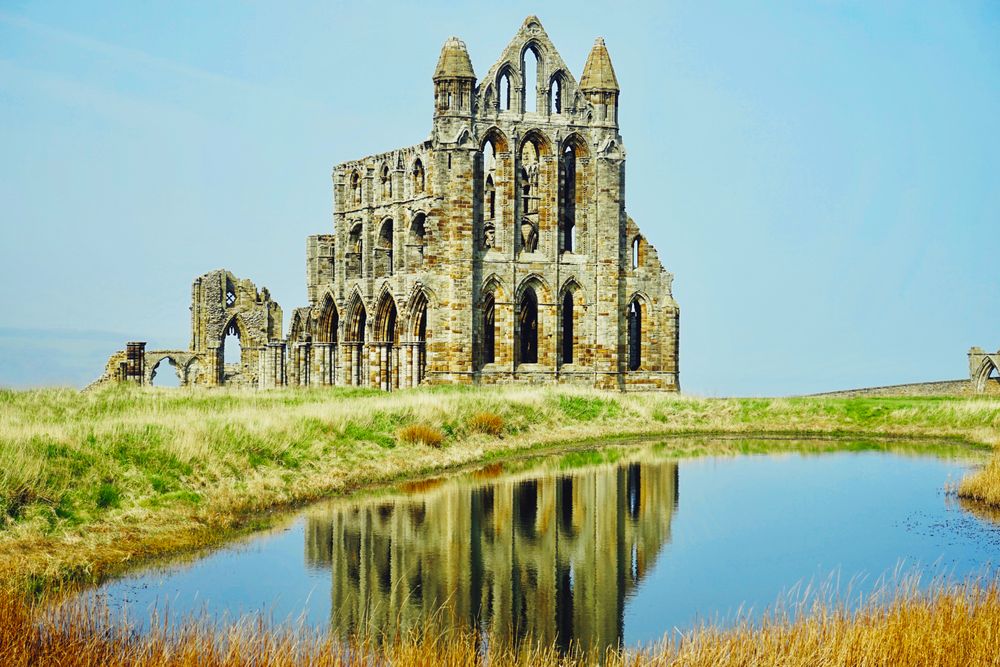
Dracula itself has a British setting that suits dark steampunk well. Stoker stayed in Whitby, on the Yorkshire coast, in the summer of 1890, and in the town's library he read about a fifteenth-century prince known as Dracula. In the novel a ship runs aground below Whitby's East Cliff, and one of the characters' diaries describes the ruined abbey on the cliff above.
The plague doctor
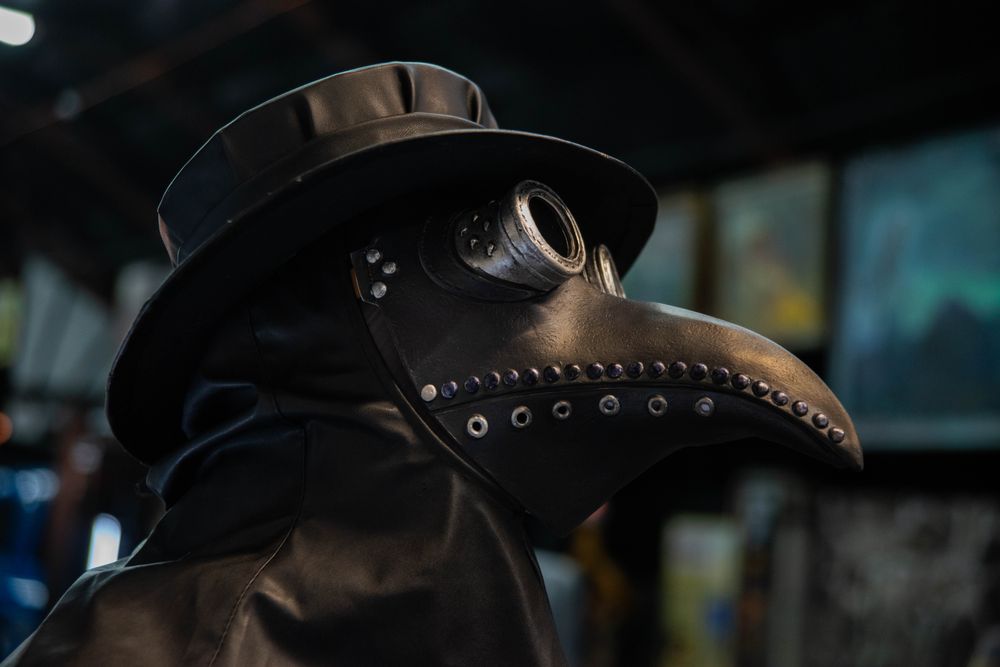
The plague doctor, with a long-beaked mask and a wide-brimmed hat, is one of the most popular steampunk Halloween costumes, even though it is not Victorian at all. The real costume belongs to the seventeenth century, and there is no evidence that it was worn at the time of the Black Death, centuries before.
Where it comes from
The costume is credited to Charles de Lorme, physician to King Louis XIII of France, who wrote about it during an outbreak of plague in 1619, though historians warn that his account should be treated with caution. An engraving of about 1656 by Paul Fürst shows a plague doctor of Rome in the full outfit. The beak held strongly scented things such as dried flowers, herbs, spices and a sponge soaked in vinegar, because doctors then believed that disease was carried by bad air and that sweet smells could guard against it. The rest of the outfit was a long robe of waxed linen, gloves, boots, a wide leather hat and a cane, used to examine patients without touching them. A white version of the beaked mask later became one of the masks of the Carnival of Venice.
Making it steampunk
The plague doctor already looks like steampunk: leather, a strange mask with glass eyes, a dark coat and a hat. To push it further, give the beak brass rivets or a riveted metal band, turn the eyepieces into goggle lenses with brass rims, and add a small gauge or a filter canister on one side, as if the mask were a Victorian breathing machine. A long black coat with leather straps, a belt of small glass bottles and a black top hat in place of the wide hat all move the costume into the 1800s. Our guide to steampunk masks and the plague doctor goes into the mask in detail.
Wearing one safely
A beaked mask narrows your view and can be hot to wear. Make sure you can see clearly to the sides and at your feet, especially on stairs and in the dark, and that the mask lets you breathe easily. Push it up onto the top of the head when you are walking through crowds or crossing roads. For children, the Chartered Trading Standards Institute's advice is to wear face paint instead of a mask, so they can see where they are going.
Mad scientists, clockwork creatures and vampire hunters
These three characters suit steampunk better than almost any other Halloween costume, because each one is about a person and their machines, or their kit.
The mad scientist
The mad scientist begins with Victor Frankenstein, the young scientist in Mary Shelley's novel, first published without her name in London on 1 January 1818. He studies at the University of Ingolstadt and brings a creature to life from parts gathered from dissecting rooms and slaughterhouses. The novel does not say exactly how he does it; the idea of bringing him to life with electricity owes much to the early films, above all James Whale's Frankenstein of 1931, with Boris Karloff as the creature. Dr Jekyll, Stevenson's respectable London doctor who makes a potion to separate the evil in himself and becomes Mr Hyde, is the other great model.
A steampunk mad scientist wears a Victorian gentleman's base, a shirt, waistcoat and dark trousers or skirt, with a long coat or a leather apron over the top. Goggles go on the forehead. Hair can be wild, and a little grey powder at the temples adds years. The props tell the story: a belt of small bottles filled with coloured water, a brass instrument with wires and dials, rubber gloves to the elbow, and a notebook of diagrams. Stains on the apron, done with tea or paint, suggest experiments gone wrong. For a gentler version, the Time Traveller in H. G. Wells's The Time Machine (1895), a Victorian scientist with a machine of his own, is a scientist who is curious rather than mad.
Clockwork creatures
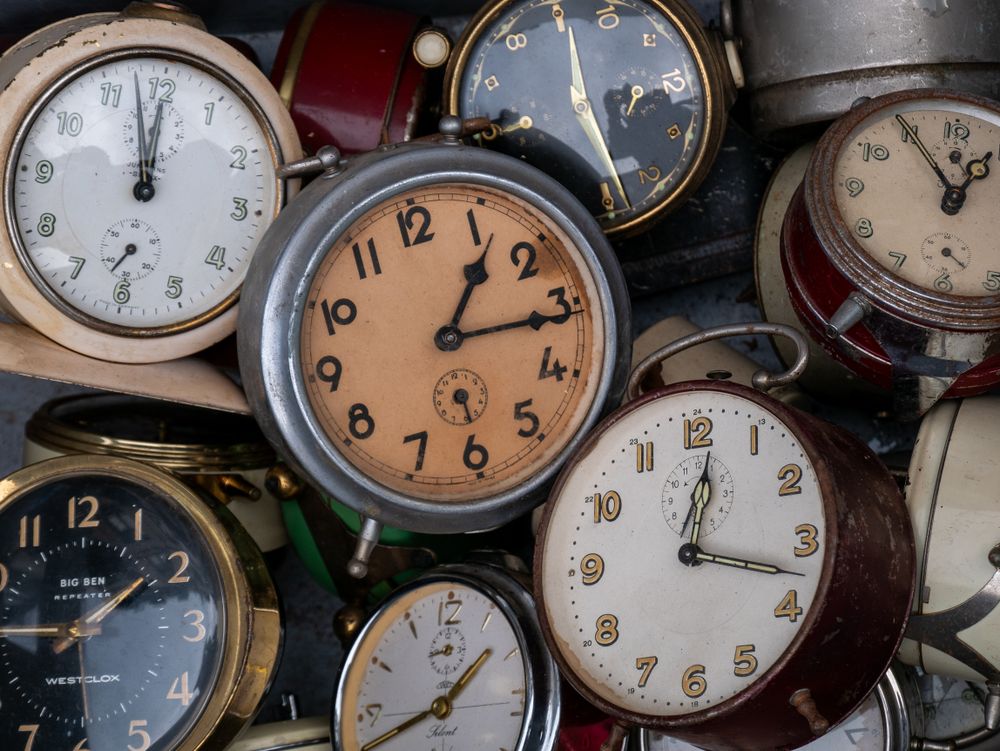
Clockwork figures that move by themselves, called automata, were made long before steampunk. One of the most famous is the Silver Swan at the Bowes Museum in Barnard Castle, County Durham, made in the London workshop of James Cox in the 1770s, with a mechanism by John Joseph Merlin. Clockwork drives its preening, a pool of moving glass rods and silver fish, and its music. A clockwork creature makes a striking Halloween costume because it is both beautiful and uncanny.
For a clockwork doll or automaton, wear Victorian clothes, a dress or a suit, with a large key fixed to the back as if for winding. Paint fine lines at the joints of the face and hands with make-up, so the face looks like porcelain or metal plates fitted together. Move stiffly, stop suddenly, and start again. A clockwork animal, such as a brass owl or a mechanical spider, can be made from card and paint and worn on the shoulder. Our guide to steampunk robots, animals and insects has more ideas.
The vampire hunter
The vampire hunter comes from Dracula. Abraham Van Helsing, the Dutch doctor from Amsterdam who leads the fight against the Count, arrives as an expert in rare diseases and stays as a hunter. In the novel he uses garlic, a crucifix, communion wafers, and a wooden stake and hammer. A steampunk vampire hunter is the same character with more equipment. Wear a long dark coat, a waistcoat and a wide-brimmed hat or a top hat, with a leather harness carrying small bottles, a wooden stake and a brass lantern. Goggles with red lenses suggest seeing in the dark. A case of instruments, opened to show stakes, bottles and a silver cross, makes a fine prop for a party.
Keep props blunt and light. A wooden stake should have a rounded end, and anything that looks like a weapon follows the rules of the event or venue. Our guide to making steampunk props safely explains how to make props that look real but cannot hurt anyone.
Make-up that looks like brass and machinery
Make-up turns a steampunk outfit into a steampunk Halloween costume faster than anything else. A few simple ideas work well.
Metallic skin
Gold, bronze or copper make-up brushed along the cheekbones, the brow and the bridge of the nose catches the light like polished metal. For a fuller look, cover one side of the face with a metallic colour and darken the edges with brown or black, as if the skin were turning to brass.
Rivets, plates and seams
Thin dark lines drawn along the jaw, the forehead or the cheek look like the seams between metal plates. Small dots of dark make-up with a highlight of gold beside each one look like rivets. Together they turn a face into a mask of fitted metal, which suits an automaton, a clockwork creature or a person part-way through becoming a machine.
Gears and workings
Gears can be painted onto the skin with a fine brush, in gold with dark shading, as if a window had opened onto clockwork beneath. A cracked-porcelain look, with fine lines across a pale face and a painted cog showing through the cracks, suits a clockwork doll. Very small, flat, light gears of card or foam can be fixed to the skin, but only with an adhesive sold for use on skin.
Safety with make-up
Use only make-up and face paint made for skin. Never use craft paint, acrylic paint, metallic spray or glue on the face. Try any new product on a small patch of skin, such as the inside of the arm, a day before, and do not use it if the skin reacts. Keep paint and glitter away from the eyes, and take it all off before going to sleep. Our guide to steampunk make-up and hair covers more looks for every day of the year.
Costumes for children
Children love steampunk costumes: a small inventor in goggles and a waistcoat, an aviator with a scarf and a leather cap, an explorer with a compass and a map. A child's costume needs more thought about safety than an adult's, because children run, trip and go near candles and pumpkin lanterns without thinking.
Bought costumes
In the UK, children's fancy dress costumes count as toys rather than clothing, so they are tested under toy safety rules and do not have to meet the same standards as ordinary clothes. London Fire Brigade advises looking for a UKCA or CE mark on the packaging, and for a UK manufacturer's or importer's name and address. Some costumes that meet the rules carry the warning "Keep away from fire"; London Fire Brigade warns that a costume labelled as highly flammable is not one that meets them. Be careful buying online. In 2024 the Office for Product Safety and Standards tested 128 Halloween costumes for children under seven, bought from online marketplaces, and more than eight in ten failed basic safety tests. Twenty-eight failed the flammability test, and 61 of the 74 costumes tested for cords and drawstrings failed that test. The office points out that it chose the costumes it tested, so the results are not a national estimate, but its advice is to buy from trusted sources.
Home-made costumes
A home-made costume is not automatically safer. London Fire Brigade warns that cotton, netting, felt and synthetic fabrics can all be highly flammable. Whatever the costume, keep children well away from candles, tea lights, bonfires and fireworks. Battery candles or glow sticks are safer than real flames in a pumpkin lantern. Ordinary clothes worn under the costume give an extra layer, and every child should know to stop, drop and roll, covering the face with the hands, if clothing ever catches fire.
Nothing to trip on, nothing to catch
- Hems above the ankle. A long skirt or coat should stop well clear of the ground, so a child cannot tread on it, especially on stairs and steps.
- No long cords at the neck. Cords and drawstrings round the head and neck can catch and strangle, which is why the safety tests check them. Goggle straps should be elastic, and a cape should fasten with a hook or a snap that comes undone if pulled.
- Clear sight. Goggles should sit on the hat or forehead rather than over the eyes, and face paint is better than a mask.
- Be seen in the dark. A strip of reflective tape on a coat or a bag, or a glow stick, keeps a child visible on a dark street.
No small parts for the very young
Gears, rivets, beads and buttons glued onto a costume can come off, and a very young child may put them in their mouth. The toy safety rules require toys that might be dangerous for children under 36 months to carry a warning that they are not suitable for that age, with the reason. For a toddler, leave small decorations off altogether and paint the gears on instead, or use large, soft pieces that are sewn firmly in place.
Three ideas for children
The little inventor: a white shirt, a waistcoat, trousers tucked into wellies or boots, goggles on a cap, and a cardboard gadget with painted gears. The aviator: a jumper, a scarf, a leather-look cap with goggles on the brow and a pair of cardboard wings. The explorer: a pale shirt, shorts or a skirt over leggings, a sun hat, a toy compass and a map in a tube. All three work with clothes most children already own.
A quick costume for the night
If it is the afternoon of 31 October and there is nothing ready, a steampunk Halloween outfit can still come together in an hour or two from ordinary clothes.
Start with black
Black trousers or a long black skirt, a white or black shirt or blouse, and a dark waistcoat if you have one. Add any long dark coat. Black boots or plain dark shoes.
Add the steampunk
Any hat with a brim, with a pair of goggles on it. If you have no goggles, two jar lids painted gold and joined by a strip of card will do from a distance. A belt over the waistcoat or coat with a pouch, and a chain from the waistcoat pocket, even without a watch on the end. A brooch, a key on a ribbon or a few card gears painted gold.
Choose who you are
- The mad scientist: wild hair, goggles on the forehead, an apron, rubber gloves and a bottle of coloured water.
- The vampire hunter: a long coat, a wide hat, a wooden spoon handle for a stake, and a crucifix or a string of garlic.
- The clockwork figure: metallic make-up, painted seams and rivets, a cardboard key on the back, and very stiff movements.
- The ghost hunter: a long coat, a lantern, and a home-made brass instrument with a dial.
Finish with make-up
A little gold on the cheekbones, a little shadow under the eyes, and darker lips suit almost any of these. Then look in the mirror, decide which character you are, and add one prop that says so. For a fuller version next year, our guide to a steampunk costume on a budget shows how to build one slowly and cheaply, and our complete guide to steampunk fashion explains the style from head to foot.