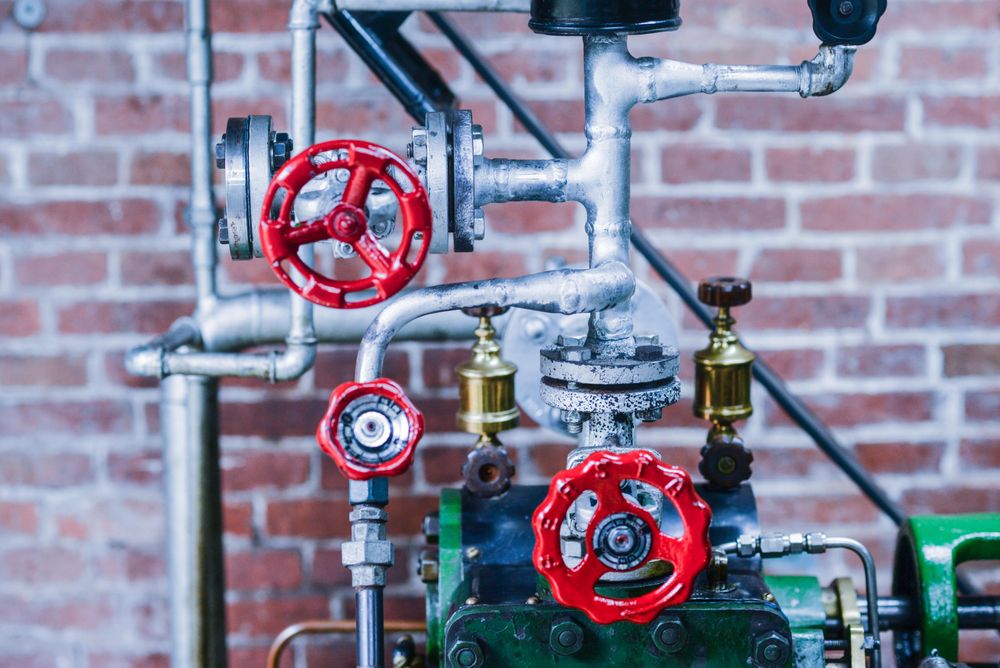
Cogs and gears are the badge of steampunk. A steampunk cog turns up on hats, brooches, clocks, lamps, wallpaper and drawings, and a single gear is often enough to say steampunk on its own. Behind the badge is real machinery: steampunk machines imagine the clocks, mills, pumping engines, locomotives and calculating engines of the 1800s, pushed a little further than they ever really went.
This guide is about the real thing: how gears, clockwork and steam engines work, in plain words, how to use real gears safely, and where to see working machines in Britain. Knowing how the parts fit together is what makes a gear on a hat look like part of a machine rather than a sticker. Our guide to the steampunk aesthetic explains why the workings are always left on show.
How a gear works
A wheel with teeth
A gear is a wheel with teeth round its edge, fixed to a shaft, that passes a turning movement on to another gear or to another part of a machine. It is also called a gearwheel, a toothed wheel or a cog. Strictly, a cog is one tooth on the wheel, a word that comes down from Middle English, though it is used for the whole wheel as well. Two gears whose teeth fit together are said to mesh, and a run of gears meshing one after another is called a gear train.
Turning the other way
When two gears side by side mesh, they turn in opposite directions: if one turns clockwise, the other turns anticlockwise. The Greek philosopher Aristotle noted this in about 330 BC. Put a third gear between them and the last gear turns the same way as the first, which is how a machine is made to turn each part in the direction it needs. The exception is a gear that sits inside a larger ring of teeth, on a parallel shaft: then both turn the same way.
Speed and force
The second thing gears do is change speed and force. The gear ratio compares the number of teeth on one gear with the number on the other. Suppose a small gear with 10 teeth drives a large gear with 40. Each turn of the small gear moves 10 teeth past the point where they meet, which takes the large gear only a quarter of the way round, so the small gear has to turn four times for every single turn of the large one. What is lost in speed is gained in force: the large gear turns more slowly, but with about four times the turning force, less a little lost to friction. Turn the arrangement round, with the large gear driving the small one, and the small one spins four times as fast with less force.
That trade between speed and force is the point of most gearing. A winch uses it so that a person turning a handle can lift a load far heavier than they could pick up. A steampunk machine is more convincing if you can say which gear drives which, and why one is bigger than the other.
Far older than steam
Gears are far older than the steam age. The earliest surviving gears come from China in the fourth century BC, among them a bronze ratchet gear dated to between 475 and 221 BC. The Antikythera mechanism, dated to about 150 to 100 BC, holds the earliest surviving gears in Europe; it worked out the positions of the heavenly bodies and predicted eclipses. For centuries large gears in mills were made of wood, until cast iron and then steel took over.
Spur, bevel, worm and other gears
Gears come in a handful of basic kinds, each made for a different job and each with a shape you can learn to recognise.
Spur gears
The spur gear is the simplest and the commonest: a flat wheel with straight teeth cut across its edge, meshing with another on a parallel shaft. Almost every gear in a steampunk picture is a spur gear. It is simple to make and pushes nothing sideways along its shaft. Its weakness is noise at high speed.
Helical and herringbone gears
A helical gear has its teeth set at an angle across the edge, so each tooth comes into mesh gradually instead of all at once. Helical gears run more smoothly and quietly than spur gears, but the slanting teeth push the gear along its shaft as well as round it. A double helical gear, often called a herringbone gear for its two rows of teeth slanting opposite ways like the bones of a fish, cancels that push.
Bevel gears
Bevel gears are shaped like slices of a cone. They are used where two shafts meet at an angle, most often a right angle, so that a turning movement can be carried round a corner.
Worm gears
A worm is a shaft with a thread like a screw, meshing with a gear beside it called the worm wheel. Worm gearing slows a movement enormously, with ratios from about 10 to 1 up to 500 to 1. Because the worm slides against the wheel as it turns, it loses more power to friction than other gears, and when the thread is shallow the wheel often cannot turn the worm backwards, so the gear locks itself in place. That makes it useful for anything that must not run back when the handle is let go. The worm gear was invented in the Indian subcontinent in the thirteenth or fourteenth century, for roller cotton gins.
Rack and pinion
A rack is a straight bar with teeth along it, and a pinion is the small gear that meshes with it. Turn the pinion and the rack slides in a straight line. It turns a round-and-round movement into a straight one, and it is used in the steering of cars.
Epicyclic gears
In epicyclic gearing, one or more gears travel round another as well as turning on their own shafts, like planets round the sun, which is why they are also called planetary gears. They pack a big change of speed into a small space, and they are found in differentials and automatic gearboxes. One of the most famous examples drove James Watt's steam engines, as the next section explains.
Cogs in Victorian machines
The mill and the line shaft
In a Victorian mill, one engine drove a whole building full of machines. The engine might be a steam engine, a water wheel or a turbine, and its power went out along a line shaft: a long turning shaft, usually hung from the ceiling, with belts and pulleys carrying the power down to each machine. Line shafts were in use from the 1700s and were most widely used in the nineteenth century. After about 1900, electric motors small enough to fit to each machine became available, and by the middle of the twentieth century most line shafts had been taken out. Gears did the heavy work wherever the power had to change speed or direction, between the engine and the shafts and inside the machines themselves.
Sun and planet
Early steam engines pumped water, with a rod that moved up and down. To drive the machines in a mill, an engine has to turn a wheel instead. In 1781 James Watt introduced the sun and planet gear, which turned the back-and-forth motion of his engines into a turning one: a gear on the end of the rod travelled round a gear on the main shaft, like a planet round the sun. William Murdoch is credited with suggesting it.
The governor
Many old engines carry a pair of heavy balls spinning on a spindle above them. This is the centrifugal governor, which keeps an engine running at a steady speed. As the engine speeds up, the spinning balls swing outward and upward, and their movement pulls a linkage that narrows the valve letting steam in. As the engine slows, the balls drop and the valve opens again. The idea had already been used to regulate windmills and water wheels, and in 1788 James Watt adapted it for steam engines.
The calculating engine
The most famous Victorian machine never built in its own century is Charles Babbage's. He designed his Difference Engine No. 2 between 1847 and 1849 to calculate tables of numbers and print them, using only addition and subtraction. It is turned by a hand crank, not by steam. The Science Museum finished the calculating section in 1991 and added the printing mechanism in 2002.
Rods, wheels and the locomotive
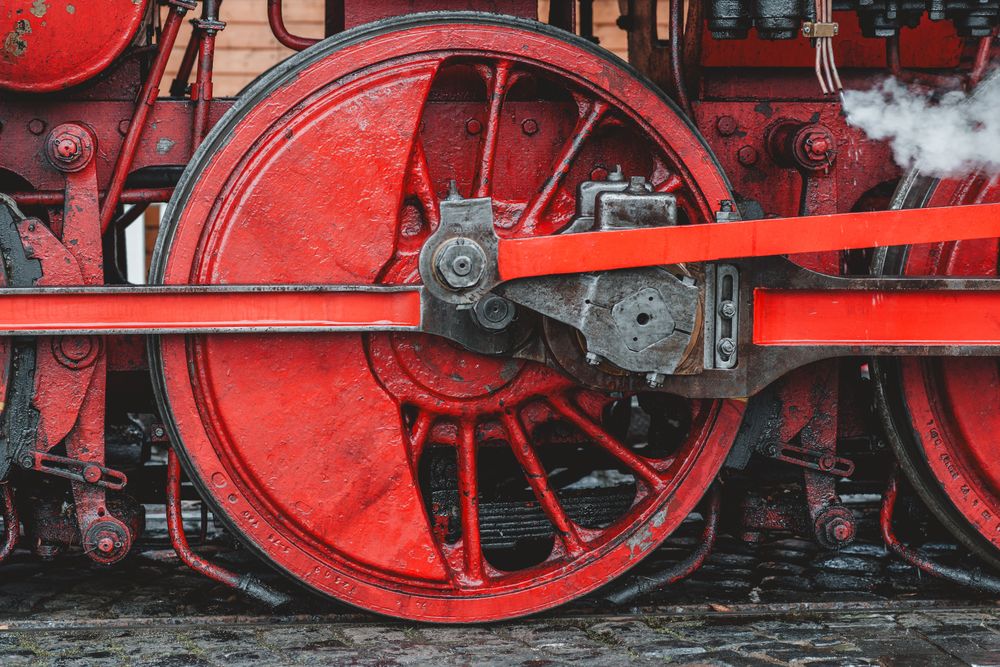
A steam locomotive shows its machinery more plainly than anything else. Its pistons drive the wheels through connecting rods, and coupling rods pass the drive on to the other driving wheels. Stephenson's Rocket, designed by Robert Stephenson and built in 1829, was the clear winner of the trials held at Rainhill that year: it was the only entrant to complete them, averaging 12 miles an hour with a top speed of 30, and it won a prize of £500 and a contract from the Liverpool & Manchester Railway. Our guide to steampunk trains, cars and machines follows the locomotive into steampunk.
Clockwork: springs, escapements and wheels
The power: weights and springs
Every clock needs something to drive it. The first mechanical clocks were driven by a falling weight on a cord. Spring-driven clocks appeared in Europe in the fifteenth century, and the oldest surviving one, known as the Burgunderuhr, dates from about 1430. The spring, called a mainspring, is a long ribbon of springy metal, usually spring steel, coiled into a spiral; winding it coils it tighter and stores energy, and as it unwinds it turns the wheels.
A spring pulls hard when fully wound and weakly when nearly run down. Clockmakers evened that out with the fusee, a cone-shaped pulley joined to the spring's barrel by a chain, the standard answer until the nineteenth century.
The escapement
Left to itself, a wound spring would spin a clock's gears round in seconds. The escapement is the part that stops it. It holds the gear train and lets it move on by one small, fixed step at a time, and at each step it gives the swinging part of the clock a tiny push to keep it going. The catch and release of the escapement is what makes the tick.
The verge escapement, the first, dates from thirteenth-century Europe, and it was the invention that made the mechanical clock possible. The iron clock in Salisbury Cathedral, which has no dial and strikes only the hours, is a well-preserved example of that earliest kind. It is usually dated to about 1386, though the date is disputed, and it is often said to be the oldest working clock in the world, though other clocks make the same claim. It was restored to working order in 1956.
The pendulum and the balance wheel
The swinging part sets the clock's pace. The Dutch scientist Christiaan Huygens invented the pendulum clock on 25 December 1656. Before the pendulum, clocks kept time to about 15 minutes a day; with it, to about 15 seconds. The anchor escapement, which let the pendulum swing through a much smaller arc, followed soon after; it is usually credited to Robert Hooke, though William Clement also claimed it.
A pocket watch cannot use a pendulum, because it moves about. It uses a balance wheel instead, a small wheel that swings to and fro, controlled by a fine coiled hairspring called the balance spring. Robert Hooke and Christiaan Huygens both have a claim to the balance spring, which came in the mid-1670s, and it improved watches from errors of perhaps several hours a day to about 10 minutes. In the 1750s Thomas Mudge invented the lever escapement, which has been used in the great majority of watches since the nineteenth century.
The wheels to the hands
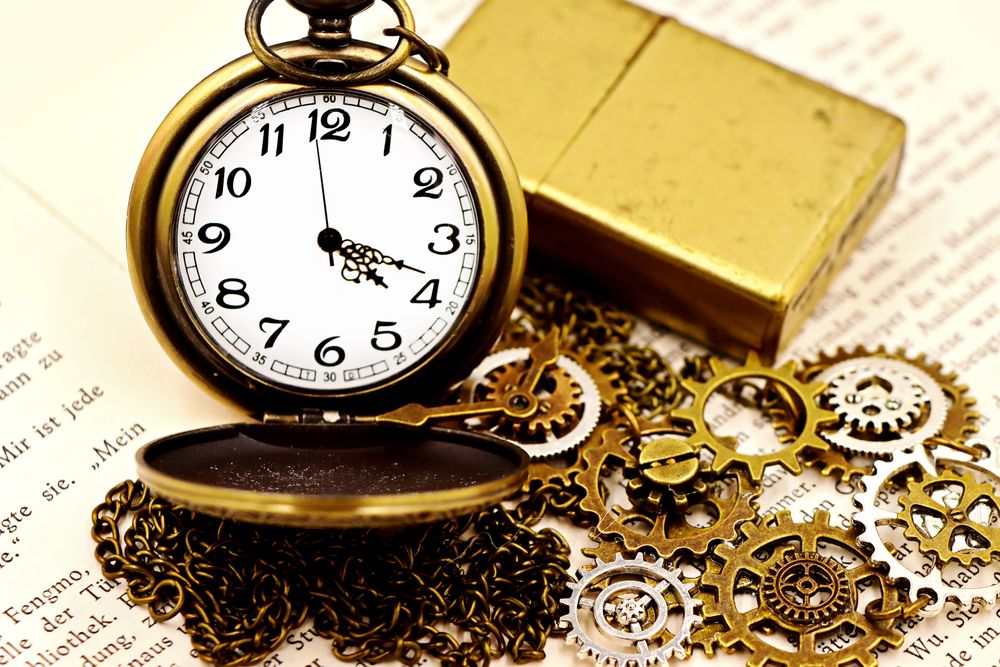
Between the spring and the hands runs the gear train, each wheel turning the next. At the dial, a small set of gears makes the minute hand go round twelve times for each single turn of the hour hand. Our guides to steampunk clocks and to watches and pocket watches show how those workings became part of the look.
Steam engines in plain words
What a steam engine is
A steam engine is an engine that turns heat into movement using steam. A fire burns fuel, usually coal, to boil water in a boiler, kept separate from the engine itself. The steam, under pressure, is let into a cylinder, where it pushes a piston, a close-fitting disc, along the cylinder and back. A connecting rod and a crank then turn that back-and-forth movement into a turning one, which can drive a wheel, a pump or a line shaft.
Newcomen's engine
In 1698 Thomas Savery built the first commercial steam-powered device, a water pump, though its boilers were prone to explode. The first engine to give continuous power to a machine was Thomas Newcomen's atmospheric engine, first put up near Dudley in 1712 and used mainly for pumping water. It worked in an unexpected way. Steam filled a cylinder standing upright, and was then cooled so that it condensed back into water, leaving a partial vacuum. The pressure of the air outside then pushed the piston down, and the piston rocked a great beam that worked the pump. That is why it is called an atmospheric engine: the air did the pushing.
Watt's improvements
Newcomen's engine wasted heat, because the cylinder was cooled with water on every stroke and then had to be heated again. In 1765 James Watt hit on the answer while repairing a model of one: a separate condenser, a second, always cold chamber where the steam was drawn off and condensed, so that the main cylinder could stay hot. It used about half as much coal for the same work. Watt took out his patent in 1769, went into partnership with Matthew Boulton in 1775, and the fully developed engine went into commercial production in 1776.
High-pressure steam
Around 1800 to 1802 Richard Trevithick introduced engines working at high pressure, far more powerful for their size and small enough to carry on wheels, which opened the way to the locomotive.
The boiler, the gauge and the safety valve
Steam under pressure is dangerous, and early boilers could burst. Engines came to carry pressure gauges and glass tubes showing the water level, and every locomotive boiler has a safety valve, which opens by itself when the pressure reaches its limit and lets steam out until it falls.
Using real gears in costume and decor
Where real gears come from
Real gears come from broken clocks, old watches, wind-up toys, kitchen gadgets and machinery. Small brass and steel gears are lovely on a hat band, a brooch or a picture frame, and a large iron gear makes a striking piece on a shelf or a wall. Our guide to steampunk jewellery covers small parts in detail, and our guide to a costume on a budget shows how to cut convincing gears from card and foam instead.
Leave luminous dials alone
One warning comes before any other. Watch and clock dials with luminous numbers or hands made during most of the twentieth century may be painted with radium, a radioactive metal, and the radium used has a half-life of about 1,600 years, so it is still radioactive now. An intact dial in good condition is usually little risk, but taking one apart can free flakes of paint that can be breathed in or swallowed. Never take apart a clock or watch with a luminous dial; take gears only from ones without.
Springs can still be dangerous
A clock or watch may still hold a wound mainspring, and even a spring that has been let down holds some tension. Taken apart without the right precautions, a mainspring can release suddenly and cause a serious injury. If a clock still has its spring in place, leave the dismantling to a clock repairer, or choose a different source of gears.
Weight and sharp edges
Brass and iron gears are heavier than they look, and the teeth can be sharp. File rough edges smooth, and wear real eye protection while you drill, file or cut metal: the Health and Safety Executive names dust and flying fragments among the hazards to the eyes, and lists safety spectacles, goggles and face shields among the protection to choose from.
Making gears look like a machine
A heap of gears glued on at random looks like decoration. Gears that mesh, with teeth of the same size, each on its own shaft or pin, with a large one driving a small one, look like a mechanism, even if nothing turns. Our guide to how to draw steampunk explains how to lay out meshing gears on paper first.
Where to see working machines in Britain
The best way to understand gears and engines is to watch them move. Museums of science, industry, water supply and railways keep engines, clocks and machines in their permanent collections, and several run them. Which engines are running, and on which days, changes through the year, so check each museum's own website before you go.
The Science Museum, London
The Energy Hall at the Science Museum, which is free, holds some of the most important engines in the world, among them what the museum describes as the oldest surviving and unaltered atmospheric engine, Old Bess, the oldest surviving engine by James Watt, rotative engines by Watt, a mill engine from Burnley, high-pressure engines of the kind Richard Trevithick pioneered, and a steam turbine by Charles Parsons.
The Science and Industry Museum, Manchester
The Power Hall in Manchester reopened in October 2025 as a free working gallery holding one of the UK's largest collections of historic working engines. Its steam engines are run on steam from a new electric boiler, among them the Durn Mill engine, which once powered weaving machinery at a mill near Rochdale.
Thinktank, Birmingham
Birmingham's science museum, Thinktank, holds the Smethwick Engine, built in 1779 to a design by the firm of Boulton & Watt, which the museum describes as the oldest working steam engine in the world. It pumped water back up a flight of canal locks at Smethwick.
The London Museum of Water & Steam
The London Museum of Water & Steam, at the former Kew Bridge Waterworks in Brentford, tells the story of London's water supply and of the great pumping engines that served it, and it describes itself as home to the world's largest collection of stationary steam engines.
The National Railway Museum, York
The National Railway Museum in York, which is free, is the place for locomotives, and the Science Museum Group's record for Stephenson's Rocket lists it in the museum's Great Hall. As with any single object, it is worth checking that it is on show before a long journey.
Take a sketchbook. Watching a governor rise as an engine speeds up teaches more than any picture. Our guide to steampunk robots, animals and insects shows how the same parts become clockwork creatures.