Steampunk decor turns a room into somewhere an inventor might live: a study lined with books and instruments, a workshop with brass on the walls, a parlour where a map of an imaginary airship route hangs above the fireplace. Decorating steampunk style does not mean filling a room with gears. It means starting with a Victorian room, warm, dark and full of things worth looking at, and then letting some of its machinery show.
This guide works through a room in the order a decorator would: the walls, including steampunk wallpaper and exposed brick, then the floors, pipes and gauges, light, furniture and the Victorian study, pictures and collections, and finally how to make a steampunk room, or a whole steampunk house, on a small budget. It names no shops, paints or brands. Our guide to the steampunk aesthetic explains the colours and materials the style is built on.
Start with the walls: colour, brick and wood
Colour
The walls set everything else, so start there. Steampunk rooms look best in deep, warm colours that make brass, copper and wood glow: dark green, deep red, navy, chocolate brown, charcoal, or a dark mustard. Pale walls are not wrong, but they turn brass a little yellow and make dark furniture look heavy. If a whole room in a dark colour feels too much, paint one wall dark behind the fireplace or the bookcase, and keep the others a warm off-white.
The Victorian three-part wall
One Victorian idea is worth borrowing directly. The V&A notes that by the late 1860s it had become fashionable to divide a wall into three bands, and that by 1880 it was very fashionable: the dado at the bottom, the filling in the middle, and the frieze, a deep band at the top under the ceiling. The museum holds a wallpaper panel of 1877, designed by Bruce James Talbert, printed in exactly those three parts. A dado rail, the moulding that runs round the room between the bottom band and the middle one, is usually fixed at about 910 millimetres, roughly the height of a chair back, which it was meant to protect.
A steampunk room can use the same plan: a dark painted or panelled dado, a patterned or plain filling above it, and a frieze of maps, gears or a stencilled pattern at the top. It breaks a tall wall into pieces, and it gives a room an instantly Victorian feel.
Steampunk wallpaper
Wallpaper was one of the great Victorian passions. In the 1860s, the V&A says, fashionable taste favoured very lifelike, showy flowers. William Morris went another way: his first wallpaper design, Trellis, a rose trellis with birds drawn by Philip Webb, is dated by the museum to November 1862, and it went on sale in 1864. Nearly all his early papers were printed by hand from carved woodblocks, and he went on to design more than fifty. A dark Morris-style pattern of leaves and birds suits a steampunk room as well as any gear.
Steampunk wallpaper itself comes in a few kinds: patterns of gears and cogs, old engineering drawings, maps, airships, or plain papers that look like aged leather, pressed tin or riveted metal sheet. One wall is usually enough; a whole room papered in gears can feel like being inside a clock. For designs on screen rather than on a wall, see our guide to steampunk wallpaper, backgrounds and fonts.
One historical warning. Some Victorian wallpapers were coloured with poisonous pigments. The V&A has a mid-nineteenth-century paper from Cranford House in Middlesex that was found to be printed with Scheele's green, a copper and arsenic green whose use was given up later in the century. If you find very old wallpaper under later layers in an old house, do not scrape or sand it to keep as a souvenir.
Brick and wood
Exposed brick is the other great steampunk wall, because it looks like a factory, a railway arch or an engine house. In an old house the brick may already be there under the plaster, but taking plaster off is messy, dusty work that is best left to a builder. Brick slips, thin slices of brick stuck to the wall, and good brick-effect papers give much the same look with far less trouble. Wood panelling, real or made from boards and mouldings, gives the look of a library or a ship's cabin, and painted dark it makes a strong backdrop for brass.
Floors and rugs
Floorboards
If your home has wooden floorboards, sanded, stained dark and waxed they make a good floor for a steampunk room. Dark boards with a rug in the middle are the simplest Victorian floor there is. Laminate or vinyl planks in a dark wood colour give the same effect over a concrete floor.
Encaustic and patterned tiles
Patterned tiles are another Victorian floor. Inlaid tiles of two or more colours, called encaustic tiles, were first popular in medieval churches, and in the nineteenth century, during the Gothic Revival, they were mass-produced and made available to everyone. They were laid most often in churches, and even the ones made for homes often copied church designs. A floor of black, red and cream tiles in a geometric pattern suits a steampunk hall or kitchen perfectly, and modern tiles in the same patterns are easy to find.
Linoleum
Linoleum is a Victorian invention. Frederick Walton noticed a skin of hardened linseed oil on a tin of paint in 1855, was granted a patent for his process on 27 January 1860, and set up his company at Staines, near London, in 1864. It was made mainly of hardened linseed oil, pine resin and cork dust on a backing of hessian or canvas, and in the late nineteenth century it was popular for hallways and passages. Patterned lino in a tile or parquet design is a cheap and genuinely period floor.
Rugs
A rug does more for a steampunk floor than anything else. Look for rugs with rich, patterned designs in red, blue, gold and brown, in the style of old Persian or Turkish carpets, or a worn leather or hide rug for a study. A rug with some wear shows age, which suits the style. Lay it so that the furniture stands at least partly on it, and use a non-slip underlay on a wooden or tiled floor.
Pipes, gauges and metal on show
Decorative pipework
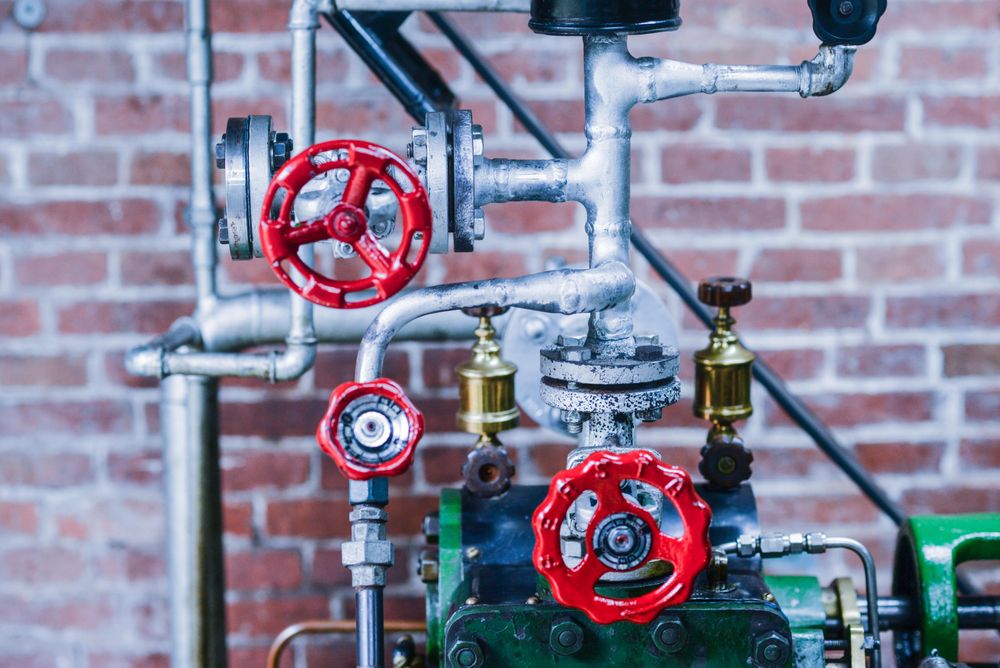
Pipes are the most recognisable steampunk decoration of all. Copper pipe, black iron pipe and their fittings, with red valve wheels and brass gauges added, can be fixed along a wall, round a doorway or across a ceiling as pure decoration, carrying nothing. Copper pipe is light and easy to cut; iron pipe is heavy and needs strong fixings. Clips made for pipes hold them to the wall, and gauges, taps and valve wheels can be screwed on with nothing behind them.
Real pipes and gas fittings
Real pipes are a different matter. Many homes have water pipes, heating pipes and gas pipes on show already, and it is tempting to dress them up. Painting a cold water pipe or a radiator pipe is one thing; altering any real pipe is another, and gas is the one never to touch. The Health and Safety Executive says that anyone employed to work on gas appliances in a home must be a Gas Safe registered engineer, and that moving and reinstalling an appliance counts as gas work that must be done by one. So never alter, move, box in or hang anything from a gas pipe or a gas meter yourself; if you want it changed, use a Gas Safe registered engineer.
Keep decorative pipes clearly separate from real ones, so that nobody in future mistakes one for the other, and never cover air bricks, vents or the flue of a gas appliance with decoration. If you ever smell gas, the HSE's advice is to call the gas emergency freephone number, 0800 111 999, open the doors and windows, and turn off the gas at the meter if you know where the control is.
Drilling into walls
Fixing pipes, shelves and gauges to a wall means drilling, and drilling means thinking about what is behind the plaster. Electrical Safety First warns that a common mistake is drilling, nailing or screwing into cables hidden in walls. Cables buried in walls are installed running straight up, down or across from switches, sockets and other fittings, so avoid those lines, and a cable detector can help you trace buried cables before you start. Water and heating pipes can also run inside walls and under floors, so take the same care near radiators and taps.
Metal in small doses
Brass and copper look richest in small, well-placed amounts: a row of gauges above a desk, a ship's porthole mirror, a set of brass hooks by the door, a riveted metal panel behind a shelf. A room covered in metal starts to look like a boiler room. A good rule is that the metal should look as if it does something, even when it does not. A gauge that seems to measure the pressure in the pipe beside it is a detail; a gauge stuck on a cupboard door for no reason is clutter.
Light and lamps
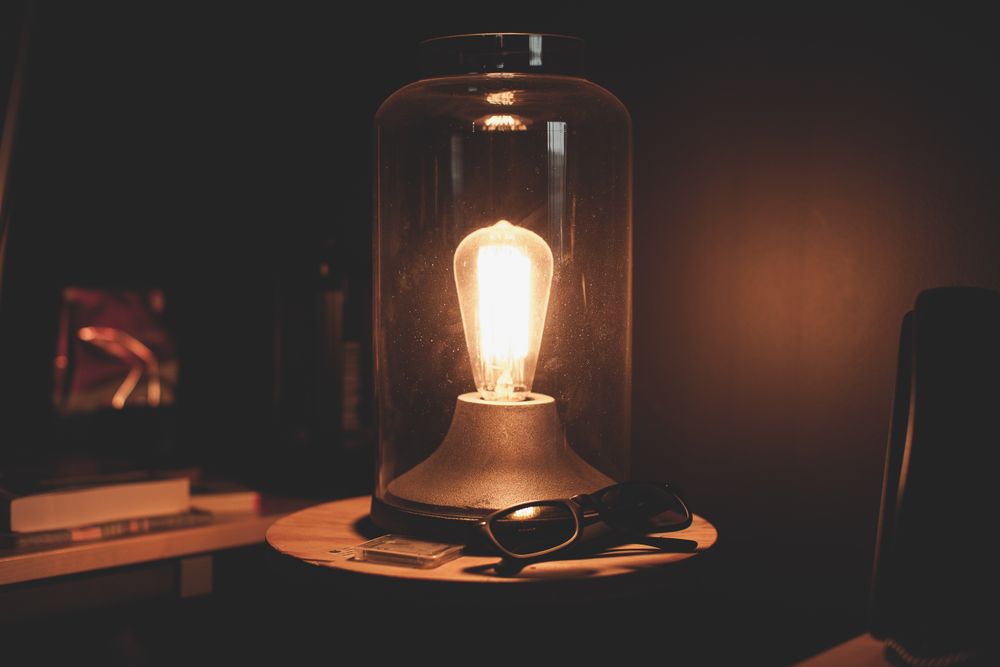
Light changes a steampunk room more than anything else in it, and it has its own guide. In short, a steampunk room wants several warm lights at different heights rather than one bright light in the middle of the ceiling: a wall light either side of the fireplace, a floor lamp by a chair, a desk lamp, a jar lamp on a shelf. Warm white bulbs make brass, wood and leather glow, and dimmers let the same room work for reading and for a quiet evening.
Light on the walls
Point some of the light at the walls rather than into the room. A wall light washing down a brick wall, a picture light over a map, or a lamp beside a skeleton clock throws texture and shadow across the surfaces you have worked on, and that is where a steampunk room comes alive. Leave some corners in shadow, too. A Victorian room was never evenly lit, and the darkness between the pools of light is part of the look.
Candles and safety
Candles look right in a steampunk room, but never leave one burning in an empty room or near curtains, paper or anything hanging. Battery candles are a safer choice on high shelves and anywhere near children or pets. Our guide to steampunk lamps and lighting covers the lamps themselves, the bulbs, and the safe way to wire or make a lamp.
Furniture and the Victorian study
A Victorian room was a full room
Victorian rooms were full. In the Victorian age a bare room was thought to be in poor taste, so every surface was filled with objects that showed the owner's interests and hopes, and the parlour, where guests were received, was the showcase of the house. A steampunk room keeps that fullness but chooses the objects: instruments, books, maps, clocks and curiosities, the belongings of someone who invents and explores.
The Victorian study
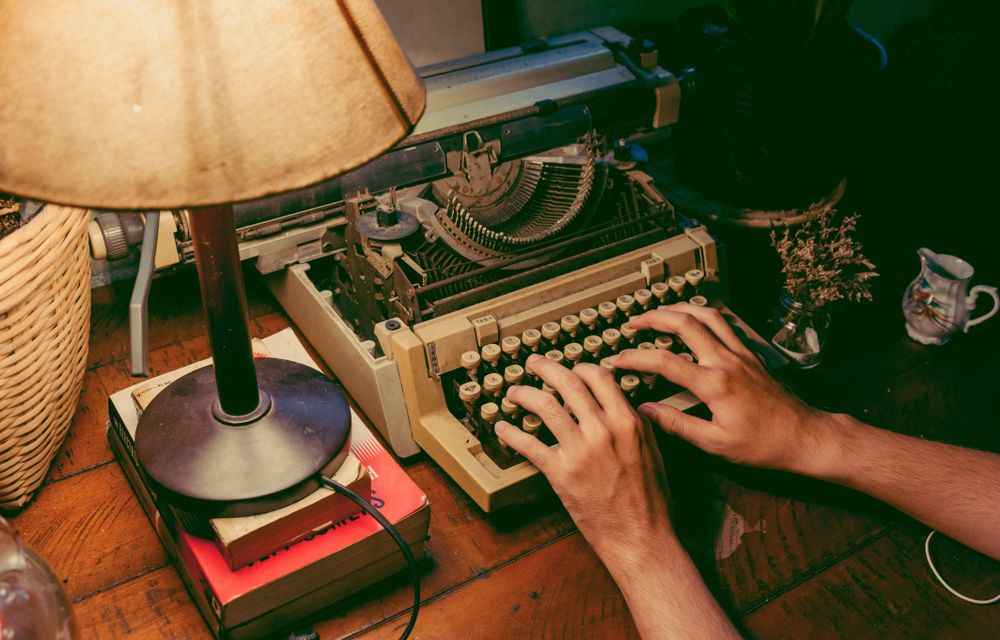
The study is the room steampunk loves most. A real one survives at Down House, in Downe on the edge of south-east London, the home of Charles Darwin, now cared for by English Heritage. Its Old Study still contains almost every original piece of furniture and dozens of Darwin's possessions, some from his voyage on HMS Beagle, and the room remains structurally unaltered from his time; it was set back to its arrangement of the 1870s in 1929. A room like that, with a big desk, a reading chair, a wall of books, instruments and specimens, is the model for a steampunk study.
The pieces that matter
Every steampunk room needs one or two pieces of furniture that carry the look: a leather armchair or a deep-buttoned sofa, a big desk or table in dark wood, a tall bookcase, a trunk or chest, perhaps a cabinet with glass doors for a collection. Around those, the other furniture can be quite plain. Our guide to steampunk furniture, shelves and ornaments describes each of them, and the Victorian furniture they come from.
Arranging the room
Arrange the furniture in groups rather than round the edges of the room: two chairs and a small table by the fire, a desk under a window with a lamp on it, a bookcase with a reading chair beside it. Each group becomes its own little scene, and the room feels lived in. For how Victorian houses themselves were planned and furnished, see our guide to Victorian architecture and interiors.
Pictures, maps and collections
Maps
Maps are the perfect steampunk picture, because they speak of travel and exploration. Britain's national mapping agency, Ordnance Survey, counts 21 June 1791 as its birthday, and published its first map in 1801; by the Victorian years it was mapping the country at large scales, and in 1855 it began using photography to enlarge and reduce maps. Old maps of your own town, a chart of a coastline, or a map of an imaginary land, framed in dark wood, all suit a steampunk wall. A large map can even be the frieze at the top of a three-part wall.
Drawings, engravings and patents
Technical drawings, engine diagrams, anatomical plates, botanical prints and Victorian engravings of machines look wonderful in plain black or dark wood frames, hung close together. Prints of old patent drawings, a scientist's sketches or a cutaway airship all tell the story of the room. Our guide to steampunk art and artists has more on the art itself. If you copy or print someone else's picture to hang, remember that a picture made by a living artist, or one who died recently, belongs to them.
Hanging them
Victorian rooms often had a picture rail, a moulding fixed round the walls between 2.1 and 2.7 metres above the floor, from which framed pictures are hung on cords or wires so that the plaster need not be drilled at all. If your room has one, it is the easiest way to hang a wall of pictures, and if it has not, one can be added. Group pictures tightly, with their edges lined up, so that they read as one block rather than scattered across the wall.
Collections
A collection gives a room its character: a shelf of old brass instruments, a row of bottles with handwritten labels, a case of keys, a set of old cameras, a stack of leather books. Choose one or two kinds of thing and show them together, on a shelf, in a glass-fronted cabinet or under a dome, rather than spreading odd objects all round the room. Ten keys in a frame look like a collection; ten keys scattered on different shelves look like clutter.
A steampunk room on a budget
Paint first
The cheapest change is also the biggest: paint. A dark colour on one wall, or a dark dado with a lighter wall above, changes the room before anything else is bought. Old furniture painted black or dark green, with brass-coloured handles, joins in. A small tin of metallic paint turns plastic frames, hooks and ornaments into brass or copper.
Second-hand and found things
Charity shops, car boot sales and house clearances are full of things that suit a steampunk room: old picture frames, wooden boxes, brass candlesticks, old books bought by the yard, scientific-looking glass, a leather suitcase that becomes a side table. The same habits as our guide to a steampunk costume on a budget apply: buy for the shape and the material, not the colour, which can be changed. Avoid second-hand electrical things unless an electrician has checked them, and leave old clocks and watches with luminous dials alone.
Make your own
Printed maps, aged with tea and framed, cost almost nothing. Gears cut from card or thin plywood and painted brass make a frieze or a clock. Copper pipe and a few valve wheels make a curtain pole, a towel rail or a shelf bracket. Brown paper, crumpled and pasted to a wall, looks like old leather. A single good lamp and a single good clock will do more than a dozen cheap ornaments, so if you have a little money to spend, spend it on those.
If you rent
A tenancy may limit what you can change in a home, from painting walls to drilling holes, so check your agreement and ask the landlord before you start. Much of a steampunk room needs no changes to the building at all: rugs, lamps, furniture, a freestanding screen covered in maps, pictures leaning on a shelf, and a trunk or two can make the room without a single hole in the wall. For the clocks that finish it, see our guide to steampunk clocks.