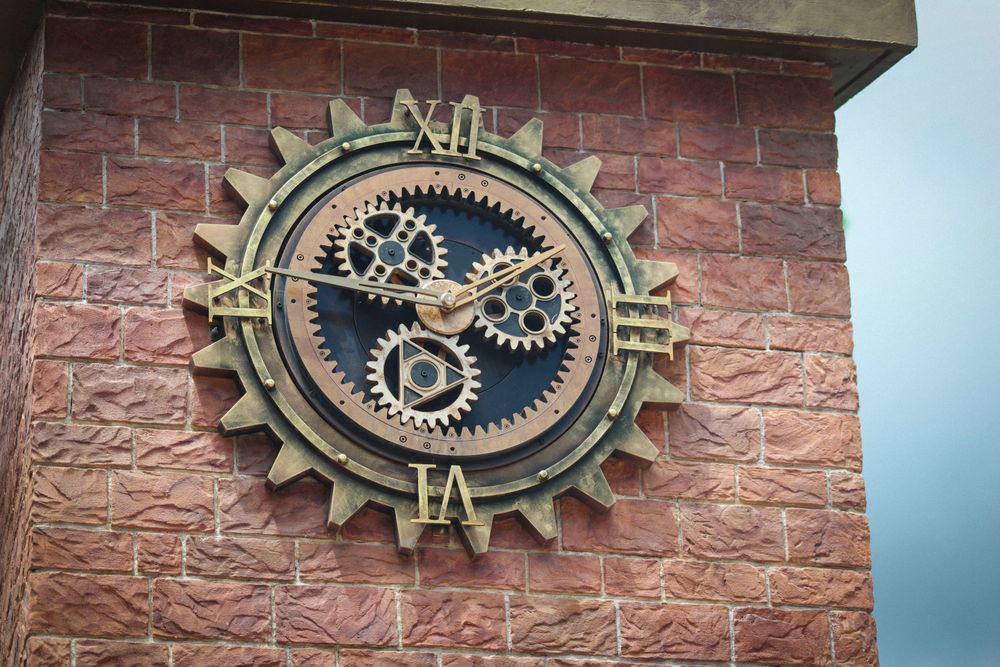
Steampunk furniture and steampunk ornaments are the things that tell a visitor who lives in a room. A leather armchair and a globe say explorer. A workbench covered in brass instruments says inventor. A steampunk shelf made of black iron pipe, holding a row of bottles and a stuffed bird under a glass dome, says someone curious about everything. The walls and the light set the scene, but the objects in it are the story.
This guide explains the Victorian furniture steampunk borrows from, leather chairs and the Chesterfield, pipe shelves and industrial tables, trunks, chests and cabinets of curiosities, globes, maps, telescopes and instruments, the ornaments that finish a room, and how to do up old furniture safely, including the one hazard old paint can hide. It names no shops or brands. Our guide to decorating a room in steampunk style covers the walls, floors and light around them.
The Victorian furniture it borrows from
Many styles at once
There was no single Victorian style of furniture. Makers borrowed freely from earlier periods, Gothic, Tudor, Elizabethan, Rococo and classical, and the Gothic and Rococo revival styles were the most common. That is good news for a steampunk room, because almost any solid, dark, old-looking piece will fit, as long as it looks made rather than mass-produced.
Dark woods
The wood that defines the look is mahogany, the reddish-brown timber whose colour deepens with age and takes a warm shine when polished. After the Naval Stores Act of 1721 removed the duty on timber from British colonies, imports into Britain rose sharply, and by 1875 Britain was importing more than 80,000 tons a year. In a steampunk room, dark wood is the background against which brass and copper shine.
Pugin and the Gothic
The Gothic Revival gave Victorian furniture some of its finest pieces. In 1850 the designer A. W. N. Pugin designed a chair for the House of Commons in plain, chamfered oak, covered in green leather fixed with brass nails, and the V&A says it became the standard model for the Commons' lobbies, refreshment rooms, libraries and offices. The museum also has the Pugin Armoire, a carved oak cabinet with brass tracery in its central doors, designed in 1850 for the Medieval Court at the Great Exhibition of 1851; it was the first piece of British furniture the museum chose for its collection. Oak, leather and brass nails are the steampunk palette exactly. Our guide to Gothic Revival architecture explains where the style came from.
Plainer furniture
Not every Victorian liked the carved and curving furniture of the middle of the century. Charles Eastlake's book Hints on Household Taste in Furniture, Upholstery and other Details, first published in Britain in 1868 and in America in 1872, inspired a style of furniture named after him that flourished in North America later in the century. For a steampunk room, the plainer, straight-lined pieces of the later Victorian years are often easier to live with than the grand ones, and easier to find second-hand.
Leather chairs and the Chesterfield
The Chesterfield
The Chesterfield is the sofa people picture in a Victorian gentleman's club: large, tightly stuffed, often covered in leather, with straight arms the same height as its back. Dictionaries record the word for a sofa from the late 1880s and say it was named after an Earl of Chesterfield, without saying which one, and which Earl, and why, is not known for certain. A Chesterfield's deep buttoning, the buttons pulled down into the stuffing in a pattern of diamonds, is what gives it its quilted look.
Buttons and springs
Deep buttoning and soft, padded shapes are typical of Victorian upholstery, and coil springs, which became part of upholstery after about 1850, made seats far more comfortable than before. Better steel springs let upholsterers build up a seat and back independently of the wooden frame, which is why Victorian chairs look so round and full.
The leather armchair
A leather armchair is the single most useful piece of steampunk furniture. A wing chair, a club chair with rolled arms, or a buttoned chair on short turned legs all suit the style. Brown leather that has creased and faded with use looks better than new, and an old chair with a worn seat often costs less than a new one. A plain chair can also be made to fit with a leather or tweed cushion and a tartan or paisley throw.
Looking after leather
Leather lasts for generations if it is kept clean and not allowed to dry out. Dust it with a soft cloth, keep it out of strong sun and away from radiators and fires, which crack and fade it, and treat it now and then with a product made for furniture leather, testing it first somewhere that does not show. Old, cracked leather can often be restored by an upholsterer, which is usually better than covering it.
Pipe shelves and industrial tables
The steampunk shelf
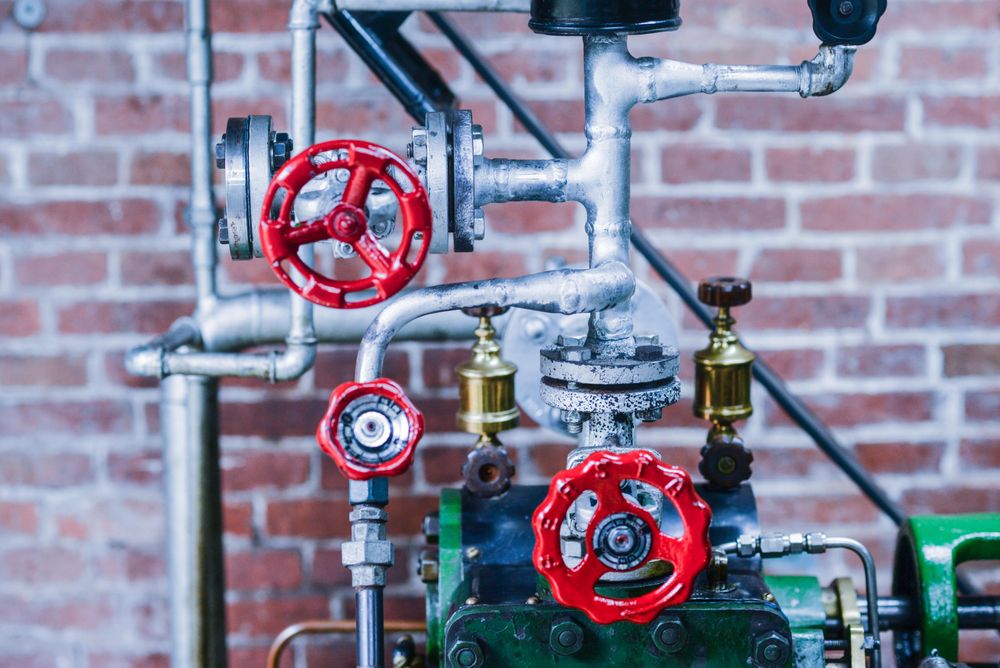
A steampunk shelf made from iron or copper pipe and fittings, with thick wooden boards, is one of the easiest pieces of steampunk furniture to make. The pipes and flanges screw together into brackets or a whole frame, and the boards rest on them or are held by them. Dark wax on the boards and a rub of brass or copper colour on the pipe joints finish the look. A row of valve wheels, a small gauge or two and some brass hooks underneath turn a plain shelf into a piece of the engine room.
Fixing shelves to a wall
Pipe shelves are heavy before anything goes on them, so the fixing matters more than the look. Use fixings made for your kind of wall. A brick, block or stone wall takes screws in wall plugs, the plastic or fibre sleeves that expand in the hole as the screw goes in. A hollow wall, usually plasterboard on a frame of timber or metal studs, needs fixings made for hollow walls, such as toggles that open out behind the board, or, for anything heavy, screws into the studs themselves. Plain plastic plugs in plasterboard will not hold a loaded shelf.
Before drilling, think about what is behind the surface. Electrical Safety First warns that a common mistake is drilling, nailing or screwing into cables hidden in the wall. Cables buried in walls normally run straight up, down or across from switches and sockets, so avoid those lines, and use a cable detector to check. Fix shelves level, check they are firm before loading them, and keep heavy things on the lower shelves.
Industrial tables
Industrial furniture, the tables, stools, cabinets and trolleys of old factories and workshops, suits the working side of steampunk. A thick wooden top on a cast iron base, a drawing table that tilts, a metal cabinet with many small drawers or a workbench with a vice fixed to one end makes a room feel like an inventor's workshop rather than a drawing room. Old workshop furniture can be heavy and have sharp edges, so check that it stands firm and file down anything that catches.
Making your own
Wear gloves when handling pipe, because cut ends and threads can be sharp, and clean new black iron pipe before using it indoors, since it often comes with an oily coating. Keep to sizes you can lift, and ask someone to hold a long shelf while you fix it. Our guide to making steampunk props safely covers tools, glue and paint.
Trunks, chests and cabinets of curiosities
Trunks
A travelling trunk is the perfect steampunk coffee table, side table or store for blankets, because it looks as if it has crossed the world. Victorian trunks were usually boxes of pine, covered in leather or hide on the earliest ones and later in paper, canvas or tin, held with wooden slats and metal bands. Dome-topped trunks, with a high curved lid, mostly date from the 1870s to the 1900s. Flat-topped steamer trunks appeared in the late 1870s, and were typically about 14 inches tall, so that they would fit under the berths of trains and in a steamer's cabin. Hat trunks, small and square, were popular from the 1860s to the 1890s.
An old trunk may smell musty and its lid may be heavy, so check that the hinges hold and, if children are about, that the lid cannot fall shut on fingers.
Cabinets of curiosities
The cabinet of curiosities is the ancestor of the museum and the heart of a steampunk room. From the sixteenth century, collectors in Europe filled cabinets and whole rooms, known in German as Wunderkammern, wonder-rooms, with things from nature, art and history, before anyone had decided where one kind of thing ended and another began. The Danish collector Ole Worm, who lived from 1588 to 1654, kept a famous one; its catalogue was published in 1655, and he worked out that the narwhal's tusk came from a whale rather than a unicorn.
Britain had its own. The collection of the Tradescant family, known as Tradescant's Ark, was on show to the public in South Lambeth by the 1630s for a small fee, and through Elias Ashmole it went to Oxford in 1675 and became the start of the Ashmolean Museum. When Sir Hans Sloane died in 1753, he left around 71,000 objects to the nation in return for £20,000 for his heirs. An Act of Parliament set up the British Museum on 7 June 1753, and it opened to visitors on 15 January 1759.
A cabinet of your own
A glass-fronted cabinet, a bookcase with its doors taken off, or a set of small wooden drawers can become a cabinet of curiosities. Fill it with things that belong together in a story: shells, fossils, old keys, bottles with handwritten labels, maps, small instruments, a skull made of resin, letters and photographs. Label things in handwriting on small cards, as a Victorian collector would. Keep it full but ordered, so that each object can be seen.
Globes, maps, telescopes and instruments
Globes
A globe on a stand is the explorer's ornament. The oldest terrestrial globe that survives was made in 1492 by Martin Behaim, and in the nineteenth century, small pocket globes less than 3 inches across were status symbols for gentlemen and educational toys for rich children. From 1851 to 1862 London even had a globe you could walk inside, Wyld's Great Globe, a hollow globe more than 60 feet across. A large floor globe in a wooden stand, or a small desk globe, suits any steampunk study, and an old one with countries that no longer exist is all the better.
The orrery
An orrery is a working model of the solar system, in which the planets turn round the Sun when a handle is wound. It is named after Charles Boyle, the 4th Earl of Orrery, for whom John Rowley made a copy, early in the eighteenth century, of a model designed by the clockmaker George Graham, who had built one with Thomas Tompion. Joseph Wright of Derby's painting A Philosopher Lecturing on the Orrery, from around 1766, hangs in Derby Museum and Art Gallery, and it shows exactly the mixture of lamplight, brass and wonder a steampunk room is trying for. A brass orrery on a desk is clockwork and astronomy in one ornament.
Telescopes, compasses and barometers
A brass telescope on a wooden tripod by a window, a ship's compass in a wooden box, a sextant, a set of drawing instruments in a velvet-lined case: scientific instruments are the ornaments that most clearly say inventor or navigator. A barometer on the wall belongs too. The Met Office was founded in 1854 by Vice-Admiral Robert FitzRoy, who had been captain of HMS Beagle, and FitzRoy wrote the first public weather forecast, for 31 July 1861.
Mercury and luminous dials
Two old instruments need care. Many old barometers and thermometers contain mercury. The UK Health Security Agency says that mercury spilled from a broken thermometer or barometer can give off mercury vapour; a small spill must never be vacuumed, because that spreads the vapour, and for a spill from a barometer or another larger device you should contact your local council's environmental health department for advice. So hang an old mercury barometer firmly, and never take it apart. Old instruments, gauges and clocks with numbers that glowed in the dark may have been painted with radium, which was used on clocks and aeroplane instruments through most of the twentieth century; an intact one is usually a low risk, but never open one or scrape its paint. Our guide to steampunk clocks has more on that.
Ornaments: gears, birds and bell jars
Steampunk ornaments
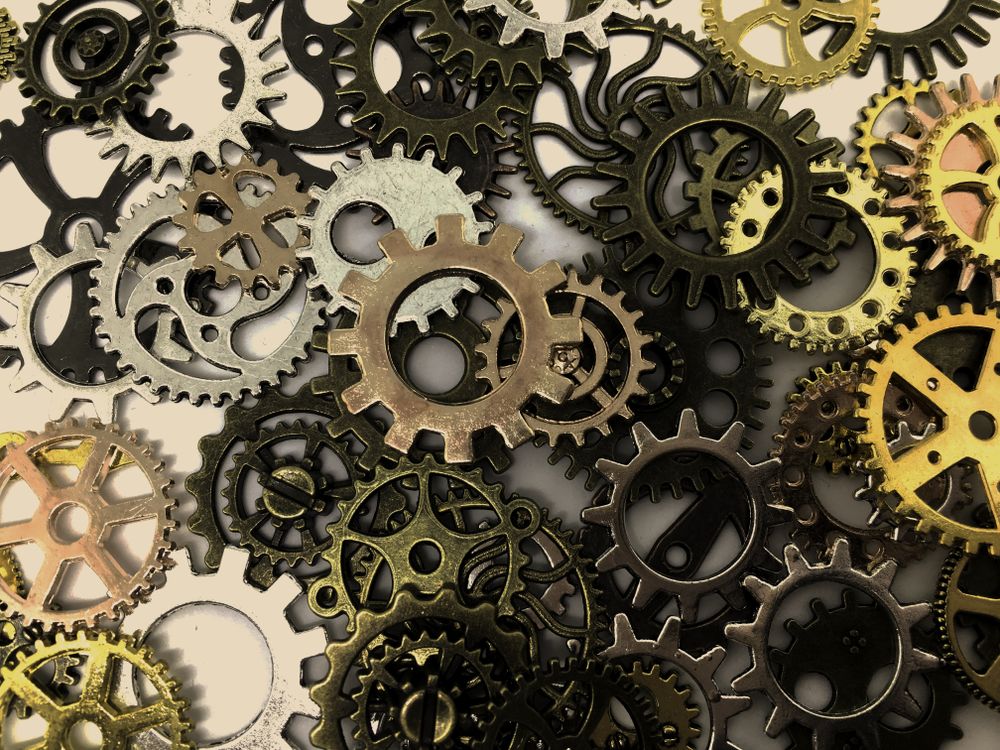
Steampunk ornaments range from a single brass gear on a stand to a whole machine that does nothing. Gears are the commonest: mounted on a block of wood, stacked into a sculpture, framed on velvet, or hung as a mobile. A model airship hung from the ceiling, a brass diving helmet, an old camera on a tripod, a typewriter or a set of old keys all work as ornaments, because each one is a machine with a story. Our guide to cogs, gears and machines explains the parts, and our guide to steampunk robots, animals and insects covers the mechanical creatures, from clockwork birds to brass beetles.
Bell jars and glass domes
A bell jar is a glass jar shaped like a bell and open at the bottom. In laboratories it was used to hold a vacuum, and in Victorian homes, thinner decorative ones protected and displayed clocks, stuffed animals, shells, and flowers and fruit made of wax. A glass dome turns almost anything into a specimen: a single gear, a pocket watch, a dried flower, a small mechanical insect, a rolled letter. A dome makes an object look precious and keeps the dust off it, which is the same thing Victorian collectors wanted.
Birds under glass
Birds were the favourite subject. The Museum of the Home in London has a Victorian dome holding eight stuffed birds, among them three hummingbirds, on a little tree with dried grasses; its label explains that millions of hummingbird skins were exported from Central and South America to Europe to be stuffed as drawing-room ornaments. The Victorian age was the great age of taxidermy: at the Great Exhibition of 1851 John Hancock showed mounted birds that sparked wide interest, and the taxidermist Walter Potter, who lived from 1835 to 1918, became known for scenes of stuffed animals arranged as people, such as a village school of rabbits.
This guide gives no advice on buying animal specimens. For the look without them, a dome can hold artificial birds and feathers, a carved or painted wooden bird, a brass bird on a perch, or a clockwork one, and an old birdcage with a mechanical bird inside is as steampunk as any stuffed one.
Arranging ornaments
Group ornaments in odd numbers, three or five, at different heights, on a tray, a shelf or a mantelpiece, rather than lining them up. Give the best one some space around it. And dust them: a steampunk room should look as if it belongs to a collector, not as if it has been shut up for a century.
Doing up old furniture safely
Old paint and lead
Old furniture is the heart of a steampunk room, and doing it up is satisfying work, but old paint can hide a real hazard. The Health and Safety Executive says that lead pigments were widely used in paints for homes until the 1960s, and that lead was not removed from all commonly used paint until the early 1980s, so a piece painted before then may have lead paint under newer coats. Lead is absorbed into the body when its dust or fumes are breathed in, or when dust on the hands is swallowed, and it can cause headaches, tiredness, stomach pains and, with long exposure, damage to the kidneys, nerves and brain.
What to do, and what not to do
The HSE's advice is plain:
- Leave old paint alone if it is in good condition, and only strip it back if it is flaking, chipping or a risk to children.
- If the paint is sound, rub it down with wet abrasive paper to give the new coat something to grip, rather than stripping it.
- If it is in poor condition, remove it with a chemical paint stripper and a scraper.
- Never dry sand old paint, and never burn it off with a blowlamp or a gas torch, which can turn the lead into fumes; a hot air gun should be kept below 500 degrees Celsius.
- Wipe up the debris with a damp cloth, and put it, with the cloths and the used paper, in a plastic bag for disposal.
For a chemical stripper, read and follow the instructions on the tin, wear gloves, and work outside or with the windows open. Keep children and pets out of the room while you work, and wash your hands before eating.
Wood, wax and brass
Much old furniture needs far less than stripping. A good clean, a coat of dark wax and a buff with a soft cloth can bring dull wood back to life, and small scratches can be hidden with wax or a touch-up stick in the right colour. Brass handles and hinges can be taken off, cleaned and put back; leave a little of the darkening in the corners, which looks older and better than a mirror shine. If a piece might be valuable, ask an antiques restorer before you change anything, because a careless refinish can take away much of what an old piece is worth.
Checking what you bring home
Before an old piece comes into the house, check it is sound: that chairs do not wobble, drawers run, and shelves and doors are firmly fixed. Tall bookcases and cabinets should be fixed to the wall so they cannot tip forward, especially where children climb. And leave the wiring of any old lamp or clock to an electrician, as our guide to steampunk lamps and lighting explains, so that the oldest things in a steampunk room are also the safest.