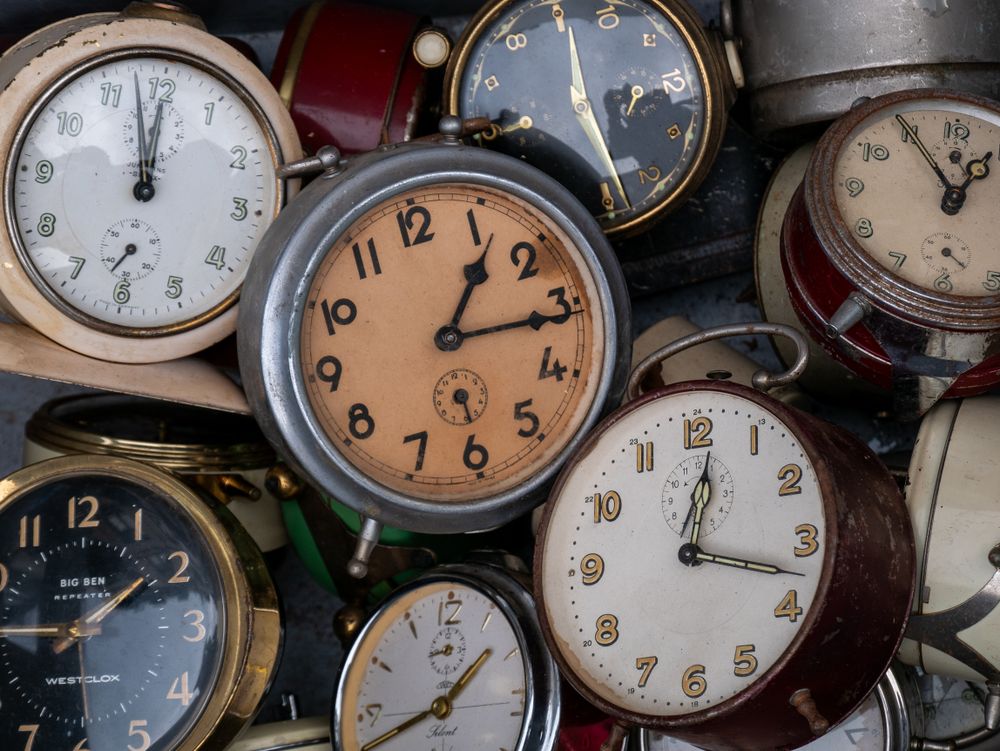
Steampunk clocks are the second most popular thing people look for when they want to bring the style into a home, after lamps, and it is easy to see why. A clock is a machine that every room already needs, it hangs at eye level where everyone sees it, and the gears and springs that make it work are exactly the kind of workings steampunk likes to put on show. A steampunk wall clock with its gears turning behind the hands can carry a whole wall on its own.
This guide explains what makes a clock steampunk, the Victorian skeleton clocks the look comes from, the kinds of wall, mantel and table clock, how the railways gave Britain one time and a new kind of clock to show it, what is inside a clock, whether clockwork or a battery, how to make or dress up a clock yourself, and where a clock looks best in a room. It names no clocks to buy. For the smaller clockwork you wear, see our guide to steampunk watches and pocket watches.
What makes a clock steampunk
The workings on show
An ordinary clock hides its works behind a dial and inside a case. A steampunk clock does the opposite. The gears are visible, either because the dial has been cut away or because the clock has no dial at all, only a ring of numbers with the wheels turning in the middle. That one idea, letting people see how the thing works, is what the whole style rests on, and a clock shows it more plainly than anything else in a house.
The materials
The materials are the ones steampunk uses everywhere: brass and copper for the wheels and the frame, dark wood or black iron for the case, aged paper or cream enamel for the dial, and Roman numerals in a plain Victorian style. A little wear helps. A dial that looks as if it has hung in a railway office for a century reads as steampunk; a bright white face with modern numbers does not, however many gears are glued round it.
The details
Beyond the gears, the details that say steampunk are borrowed from machines: rivets round the rim, a gauge beside the dial, a valve wheel as a bracket, a pendulum swinging behind glass. Our guide to cogs, gears and machines explains what each part of a real clock does.
Real clockwork and decoration
There are two kinds of steampunk clock. One is a real mechanical clock whose moving parts you can watch, which needs winding and care. The other is an ordinary battery clock dressed in gears that are there only for show. The first is a machine; the second is a picture of one, and a room can happily have both.
Skeleton clocks and open gears
What a skeleton clock is
A skeleton clock is a clock from which the parts that would normally hide the mechanism have been taken away or cut back, so that the workings can be seen. There is no official definition. The parts usually on show include the escapement, which lets the power out a step at a time, the wheels that count the time, and the spring or weight that drives them. The dial is usually missing, made of glass, or reduced to a narrow ring carrying the hour numbers.
English skeleton clocks
The skeleton clock is the real Victorian ancestor of the steampunk clock. The Science Museum Group shows one made in England around 1830 by Charles McDowall, a brass and steel clock with a silvered dial and a skeletonised movement, on loan from the Worshipful Company of Clockmakers. Victorian homes kept clocks under glass domes, which kept the dust off open wheels while leaving them in full view. The museum also holds a copy of a skeleton clock first made by the clockmaker Dwerrihouse, built in London in 1973, which still has its glass dome, its pendulum and its winding handle.
The frames of British skeleton clocks came in several styles. The collector Derek Roberts sorted them into rafter frames, Gothic frames, scroll and lyre frames, floral frames and architectural frames. The architectural ones are the most remarkable: some were made in the shape of buildings, with simple commercial clocks modelled on cathedrals such as York Minster and Lichfield. Many struck just once on the hour, a single note called a passing strike. Most British skeleton clocks were driven by a spring working through a fusee, a cone-shaped pulley with a spiral groove round it, joined to the spring by a cord or a fine chain. As the spring runs down and pulls more weakly, the chain moves onto the wider part of the cone, which evens out the force, so the clock keeps better time over the whole of its run.
Modern open-gear clocks
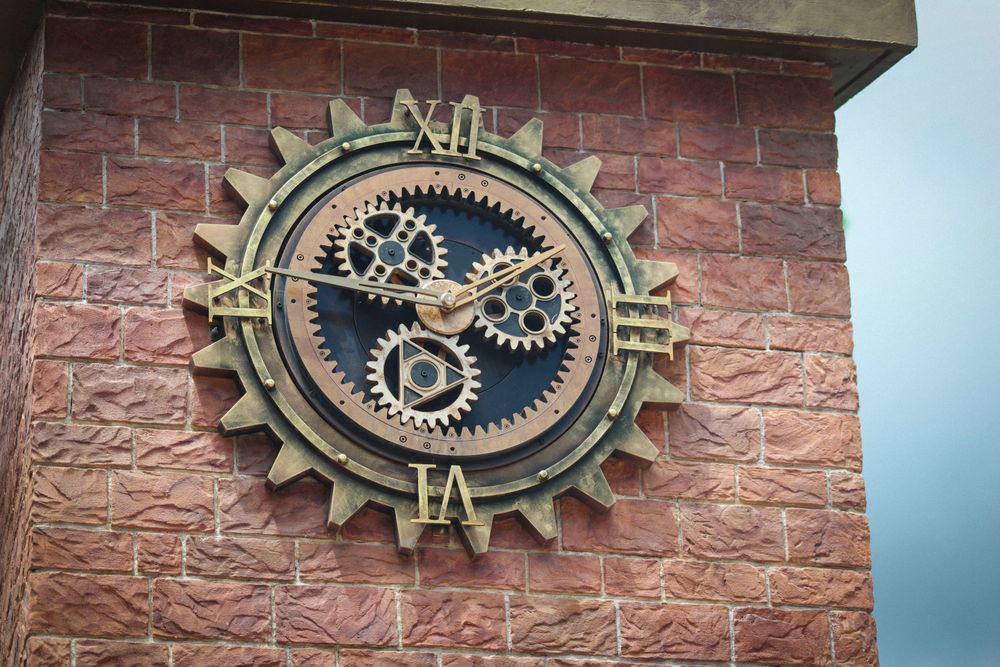
Most skeleton wall clocks made today are a different thing. They usually run on a battery-powered quartz movement, a small sealed box behind the centre, and the large gears round it are decoration, often turning slowly or not at all. They are mass-produced and often very plain, while the higher-quality pieces are made by hand from wood or wrought iron. A big open-gear wall clock of this kind is the most common steampunk clock in British homes, and there is nothing wrong with it, as long as you know that what is keeping the time is the little box in the middle.
Wall clocks, mantel clocks and table clocks
Clocks for the home come in a handful of old shapes, and each one has a story that suits a different corner of a steampunk room.
The steampunk wall clock
The simplest wall clock, and the one most steampunk wall clocks borrow from, is the plain round dial clock of offices, schools and railway stations, with a large painted face in a wooden surround. A bigger and older cousin is the Act of Parliament clock, also called a tavern clock: a large wall clock hung in British inns and taverns from the middle of the eighteenth century, with a plain face two to five feet across. In 1797 the Prime Minister, William Pitt, brought in a tax of five shillings on clocks. It was so unpopular with clockmakers that it was repealed after nine months. These big clocks are often said to have been made because of the tax, but that story is not true, and the name came into use long after the clocks were made.
Mantel clocks
A mantel clock is a fairly small clock made to stand on a shelf or on the mantelpiece above a fireplace. Unlike the older chamber clocks of a similar size, it has no carrying handles. The form was first developed in France in the 1750s, and mantel clocks are often very decorated, in gilt bronze, porcelain or wood. A mantel clock in dark wood or black stone with brass feet, or a small skeleton clock under a dome, makes the mantelpiece the centre of a steampunk room.
Bracket clocks and carriage clocks
A bracket clock is a portable table clock of the seventeenth and eighteenth centuries, in a wooden case that is often ebony. The name comes from the early pendulum clocks driven by hanging weights, which had to sit on a bracket on the wall to leave room for the weights to fall. Clocks were expensive, so bracket clocks usually had a handle on top, to be carried from room to room. A carriage clock is a small spring-driven clock in a rectangular case with a handle, made for travelling. The first was made by Abraham-Louis Breguet for Napoleon in 1812. Its case, often set with glass panels and a small window in the top that shows the escapement working, gives it the look of an instrument, which suits a steampunk desk or a bedside table.
Longcase clocks
The tall clock that stands on the floor is the longcase clock, which most people call a grandfather clock. Its case is tall because it holds a long pendulum, about a metre long, whose every swing takes one second, and because the weights that drive it need room to fall. The Oxford English Dictionary credits the 1876 song My Grandfather's Clock, by Henry Clay Work, with making grandfather clock the everyday name. A longcase clock is a big piece of furniture as much as a clock, and in a steampunk hall or study it sets the whole tone of the room.
Railway time and the station clock
One time for the whole country
Before the railways, every town in Britain kept its own time by the sun, and Bristol, for example, was ten minutes behind London, which made railway timetables a muddle. The Great Western Railway was the first to run its timetable on London time, in November 1840, and on 22 September 1847 the Railway Clearing House decided that Greenwich time should be adopted at every station as soon as the Post Office allowed it. Some town clocks coped by showing both times. The Exchange clock in Bristol, put up in 1822, was later given a second minute hand, so that it showed both local time and London time.
Time down the telegraph
The railways also brought the means of sharing the time: the electric telegraph, first put up beside a short stretch of the Great Western Railway in 1839. In 1852 a new electric clock at the Royal Observatory in Greenwich was linked by telegraph to Lewisham and London Bridge stations, and by 1855 Greenwich time signals could be sent along railway telegraph wires across Britain. That master clock, made by Charles Shepherd of Leadenhall Street in London, sent regular electric pulses to other clocks that moved in step with it. One of them, put up at the Observatory gates in 1852, was the first clock to show Greenwich Mean Time directly to the public. It still has an unusual 24-hour dial, and it shows Greenwich Mean Time all year round, never changing for summer time. On 2 August 1880 the Statutes (Definition of Time) Act made a single standard time for Great Britain the law.
The station clock
The station clock became the most trusted clock in town. The National Railway Museum holds a typical one from the North Staffordshire Railway, a wall clock with a 12-inch dial and a fusee movement, its face marked with the railway's initials and the maker's name, Thomas Armstrong and Brother of Manchester. Its plain round dial, bold numbers and wooden surround are the look most steampunk wall clocks are trying for.
The grandest station clocks were huge. When St Pancras station in London opened on 1 October 1868, a clock with a slate dial 16 feet 9 inches across, about 5.1 metres, was hung at the south end of the train shed, described at the time as the largest at any railway station in England. In 1968 it was dropped and shattered while being taken down. A railway guard, Roland Hoggard, bought the pieces for £25 and rebuilt a working clock on the side of his barn in Nottinghamshire, and when the station was restored, a new clock 18 feet across was modelled on the parts he had saved. It was put up in November 2007.
The Science Museum notes that railways now take their time from satellites or from the radio signal broadcast from Anthorn, in Cumbria, that also sets radio-controlled clocks at home. For the trains themselves, see our guide to steampunk trains, cars and machines.
Clockwork or battery: what is inside
Weights, springs and the pendulum
A mechanical clock is driven either by a weight on a cord, slowly falling, or by a coiled spring, slowly unwinding. The power runs through a train of gears to the hands, and an escapement lets it out one small step at a time, which makes the tick. What keeps the steps even is the pendulum. The Dutch scientist Christiaan Huygens invented the pendulum clock on 25 December 1656 and patented it the following year. Before the pendulum, clocks were accurate to about 15 minutes a day; the pendulum made them accurate to about 15 seconds a day. Around 1658 Robert Hooke invented the anchor escapement, which let the pendulum swing through a much smaller arc, and that made possible the tall longcase clock with its pendulum of about 99 centimetres, swinging once a second.
A pendulum clock must stand or hang level: if it is not, the tick and the tock come unevenly, and it is said to be out of beat. And heat makes the pendulum rod very slightly longer, so a clock in a warm place loses time.
Electric clocks
Electric clocks are Victorian too. The Scottish inventor Alexander Bain's first patent, dated 11 January 1841, described a clock whose pendulum was kept swinging by pulses of electricity, and the master clock at Greenwich worked on the same idea. In the 1930s and 1940s, clocks driven by the mains, which keep time by the steady rhythm of the electricity supply, replaced most pendulum clocks in homes.
Quartz and battery clocks
The first quartz clock was built in 1927 by Joseph Horton and Warren Marrison at Bell Telephone Laboratories in America. Today almost every battery clock is a quartz clock. Inside is a tiny piece of quartz crystal that vibrates at 32,768 times a second. A small circuit counts the vibrations into one pulse a second, and a tiny stepping motor moves the hands. An ordinary quartz clock gains or loses about 15 seconds a month.
Radio-controlled clocks
A radio-controlled clock is a quartz clock that also listens for the national time signal and sets itself. In Britain the signal, called MSF, is broadcast on 60 kilohertz from Anthorn Radio Station in Cumbria, under contract to the National Physical Laboratory, and has been since 1 April 2007, when it moved from Rugby. It can be received across the United Kingdom and much of northern and western Europe, and it carries a warning of each change to and from summer time, so the clock changes its own hour. A radio-controlled movement behind a steampunk dial gives you Victorian looks with the time always right.
Making or dressing up a clock
Starting from a plain clock
The easiest steampunk clock starts as an ordinary one. Take the back off a cheap battery wall clock and you will find a small square quartz movement, held to the dial by a nut round the spindle in the middle, with the hands pushed onto that spindle. Lift off the hands, undo the nut, and the dial, case and movement come apart. You can then paint the case, replace the dial with one printed on aged card, add brass gears round the edge and put it back together, checking that the hands turn freely all the way round.
Building a clock from scratch
Craft shops sell quartz clock movements on their own, with hands, for people who want to make a clock from a piece of wood, an old dish or a slice of tree trunk. The one thing to measure is the depth of the face you are fixing it to, because the movement's spindle has to be long enough to reach through it and still leave room for the nut and the hands. Gears for decoration can be cut from card, thin plywood or craft foam and painted to look like brass, which is safer and lighter than metal. Our guide to making steampunk props safely covers the glue, the paint and the tools.
Never take apart an old luminous clock
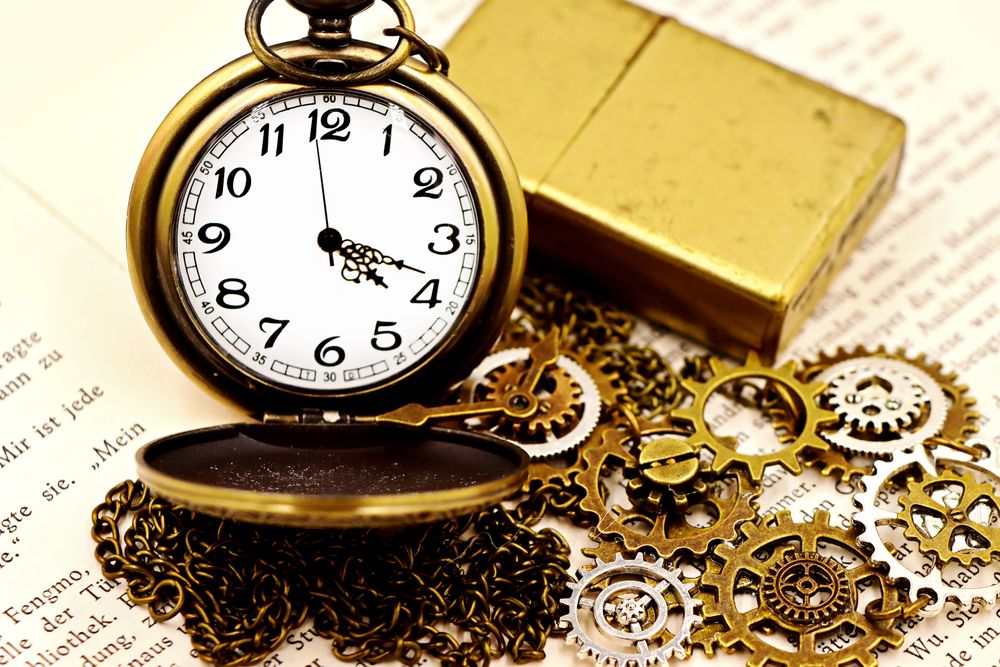
Old clocks and watches are tempting as a source of real gears, but there is one hazard to know. From soon after radium was discovered in 1898, paint mixed with radium was used to make the numbers and hands of clocks and watches glow in the dark, and it was used through most of the twentieth century until it was replaced in the 1970s. The radium has a half-life of about 1,600 years, so an old dial is still radioactive, even when it no longer glows. An intact clock in good condition is usually a low risk; the danger is in opening it up, when flakes of the old paint can be breathed in or swallowed. So never take apart a clock or watch with a luminous dial made before the 1970s, and never use its parts for a craft project, as our guide to a steampunk costume on a budget also warns. A clock you are not sure about is best taken to a clockmaker.
Mains clocks and lights
A clock that plugs into a socket needs a proper UK plug, which Electrical Safety First says should be marked BS 1363, with a fuse marked BS 1362 of the size the maker gives; stop using it if the plug or cable is discoloured, hot or buzzing. Leave any rewiring to an electrician, as our guide to steampunk lamps and lighting explains, and use small battery LED lights inside a home-made clock.
Where a clock looks best in a room
One clock as the centre
A large steampunk wall clock works best as the one big thing on its wall. Hang it where the eye falls on entering the room, above a fireplace, a sideboard or a sofa. A pair of small wall lights either side will frame it; a crowd of other objects will make it look like stock in a shop.
Hanging it safely
A big metal or wooden clock can be heavier than it looks, so fix it with a screw and a wall plug suited to your wall rather than a picture hook. Before you drill, think about what is behind the plaster. Electrical Safety First warns that a common mistake is drilling, nailing or screwing into cables hidden in the wall; cables buried in walls are normally run straight up, down or across from switches and sockets, so avoid those lines, and a cable detector can help you find them first.
Mantelpieces and shelves
A mantel clock belongs in the middle of the mantelpiece, with a candlestick or an ornament either side, and a skeleton clock under a dome needs a place where it will not be knocked. Keep a pendulum clock on a level, solid surface or a firm wall, away from radiators, fires and strong sun, since heat changes the length of the pendulum and the clock's timekeeping with it.
Radio-controlled clocks
The National Physical Laboratory advises keeping a radio-controlled clock away from televisions, electric motors, fluorescent lights and large metal objects, including metal window frames, all of which can block the signal, and turning it so that its aerial faces towards or away from Anthorn. If a new clock does not set itself, give it a few minutes, then try it in another part of the room.
Light, sound and the bedroom
A clock with its gears on show looks its best with light falling across it from one side, which throws the teeth of the wheels into relief. A mechanical clock ticks, and some chime: lovely in a hall, less so beside a bed. For the rest of the room around the clock, see our guide to decorating a room in steampunk style.