Victorian London is the city steampunk dreams in. Its fog, its gas lamps, its railway stations of iron and glass, its steam trains running in tunnels under the streets and its great gap between rich and poor are the background of countless steampunk stories, drawings and costumes. Between 1837 and 1901 its population roughly tripled, and almost everything about it changed.
This guide describes the real Victorian London: the city at the start and the end of the reign, the railways and the great stations, the world's first underground railway, the fog and the Great Stink of 1858, the sewers and bridges that tamed the Thames, the West End and the East End, and the places where you can still see the Victorian city. Our guide to steampunk trains, cars and machines has more on the engines themselves.
London in 1837 and in 1901
When Victoria came to the throne in June 1837, aged 18, Buckingham Palace became the monarch's main London home, and she was the first monarch to live there. The city around her was already enormous. The London Datastore, which publishes the Office for National Statistics' historic figures, gives about 1.9 million people in 1831 and about 2.2 million in 1841 for the area that is now Greater London. Other tables give somewhat lower figures for the same years, so these are best read as round numbers.
Getting about in 1837
London in 1837 moved on foot, on horseback and behind horses. The first omnibus service, a horse-drawn coach for anyone who paid the fare, had been started by George Shillibeer on 4 July 1829, running from Paddington to the Bank of England with three horses side by side and room for 16 to 18 passengers. Railways were only just arriving. The first London terminus, London Bridge, had opened in December 1836, and Euston opened a month after Victoria became queen.
London in 1901
By the end of the reign, the same area held about 6.5 million people by the Datastore's figures, roughly three times as many. Steam and electric trains ran beneath the streets, the Thames had stone embankments with sewers inside them, and Tower Bridge stood over the river. One figure shows how the city had changed shape: the City of London, the old square mile at its heart, had about 124,000 people in 1841 and only about 27,000 in 1901, while London as a whole tripled. Queen Victoria died at Osborne, her house on the Isle of Wight, in January 1901.
The railways and the stations
The railways remade Victorian London more than anything else. Each company built its own terminus, and most of them still stand.
The first termini
London Bridge station opened on 14 December 1836 for the London and Greenwich Railway. It is described as one of the oldest railway stations in the world and the oldest London terminus still running. Euston opened on 20 July 1837 as the terminus of the London and Birmingham Railway, the first inter-city railway terminal in London. Its entrance was the Euston Arch, designed by Philip Hardwick, completed in May 1838 and 72 feet high. It was demolished in 1961 and 1962. The Great Western Railway opened a temporary terminus at Paddington on 4 June 1838. Its present station, designed by Isambard Kingdom Brunel with Matthew Digby Wyatt, was formally opened on 29 May 1854, under a glazed roof carried on wrought iron arches in three spans.
King's Cross and St Pancras
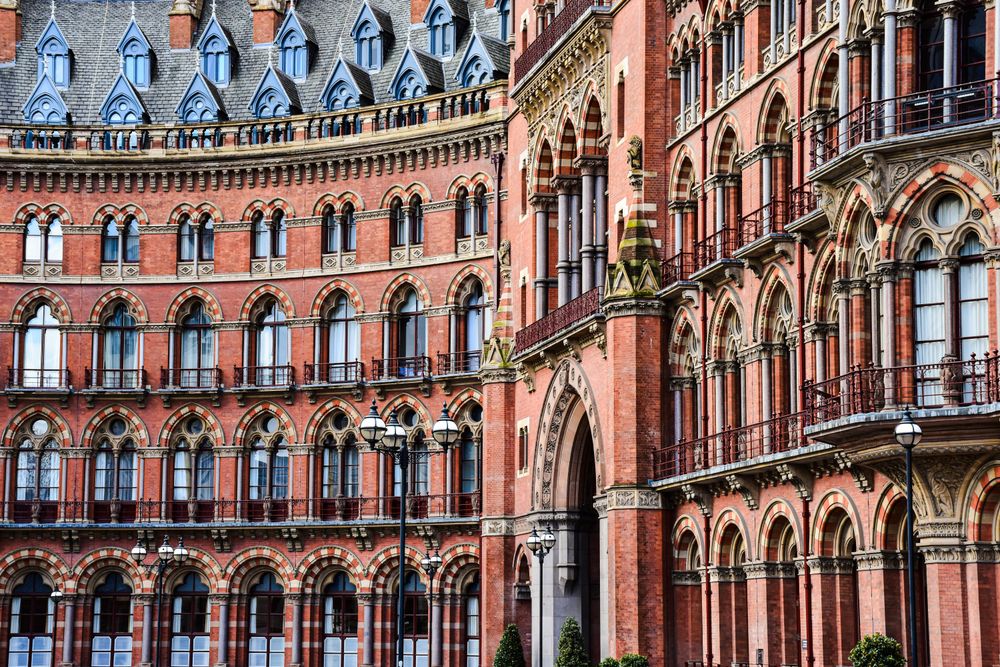
King's Cross opened on 14 October 1852 as the London terminus of the Great Northern Railway. Lewis Cubitt designed it plainly: two great arched train sheds, a brick front that echoes the arches, and a clock tower 112 feet high. Next door, St Pancras opened on 1 October 1868 for the Midland Railway. Its train shed, designed by William Henry Barlow, was then the largest single-span roof in the world, and across its front stands George Gilbert Scott's red-brick Gothic hotel. Our guide to Gothic Revival architecture tells its story.
The railways also changed time itself, because every town had kept its own local time until the railways needed one clock for the whole country. Our guide to steampunk clocks explains railway time.
The Underground: the first in the world
Charles Pearson, the City of London's solicitor, proposed a central railway station for the City in 1846 and became a leading promoter of underground railways for London. He did not live to see it: he died in September 1862, a few months before it opened.
The Metropolitan Railway, 1863
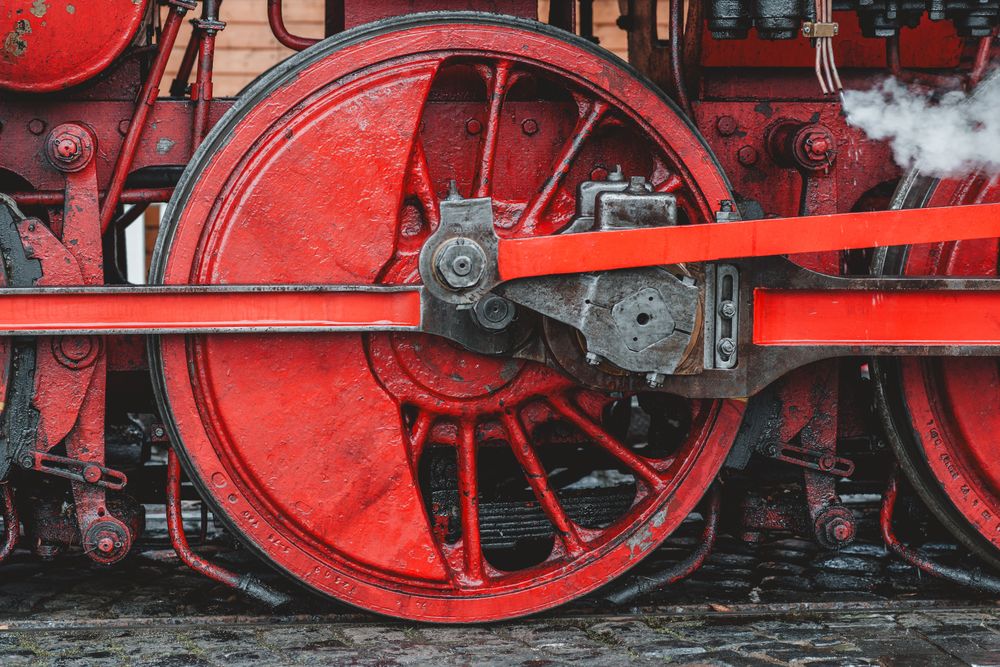
The Metropolitan Railway held its grand opening on 9 January 1863 and opened to the public on 10 January 1863, the world's first underground railway for passengers. It ran 3.75 miles from Paddington (Bishop's Road) to Farringdon Street, by way of Edgware Road, Baker Street, Portland Road, Gower Street and King's Cross. Most of it was built by cut and cover: a trench was dug along the line of the New Road, the railway was laid in it, and the trench was roofed over. The carriages were wooden and lit by gas, and they were hauled by steam locomotives fitted with equipment to condense their steam and keep it out of the tunnels. Some 38,000 people rode on the first day, and about 9.5 million in the first twelve months. The inner circle was completed in 1884, and the circular service began on 6 October that year.
The first tube, 1890
The next step went deeper. The City and South London Railway was opened by the Prince of Wales on 4 November 1890 and to the public on 18 December 1890. It ran about 3.2 miles from King William Street in the City to Stockwell, in twin tunnels under the Thames, and it was the first successful deep-level tube railway in the world and the first major railway to use electric trains. Its engineer, James Henry Greathead, drove the tunnels with a tunnelling shield and lined them with rings of cast iron. Its small carriages, with high-backed seats, felt so shut in that they were nicknamed padded cells. Electric trains came to the Metropolitan only in 1905, after the reign had ended.
Fog, smoke and the Great Stink
Victorian London was dirty in a way that is hard to imagine now. Millions of coal fires heated its homes and drove its works, and almost all its sewage went into the river.
The fog
London's worst fogs were known as pea-soupers. They were made from soot and the poisonous gas sulphur dioxide, mostly from burning soft coal at home and in industry, and they could be very thick and greenish-yellow. They were also called London particulars. They were dangerous to the old, the very young and anyone with weak lungs. Francis Albert Rollo Russell, who blamed the smoke of household hearths more than factories, wrote that more than 2,000 Londoners had choked to death in the long fogs of late January and early February 1880. Charles Dickens's Bleak House, published in parts in 1852 and 1853, is credited with bringing city fog into the novel. The soot blackened buildings so badly that when Alfred Waterhouse built the Natural History Museum, which opened in 1881, he faced it in terracotta, partly because it resisted grime better than carved stone.
The Great Stink of 1858
London's old sewers emptied straight into the Thames, along with the waste of factories and slaughterhouses. Flushing toilets made it worse, by sending more water into the sewers. In the summer of 1858 a long hot spell lowered the river and left the sewage exposed on its banks. The smell was already severe in June, and in July and August it became known as the Great Stink. The curtains of the Houses of Parliament, beside the river, were soaked in chloride of lime to keep it out, and moving Parliament to Oxford or St Albans was discussed. On 15 June Benjamin Disraeli brought in a bill to make the Metropolitan Board of Works responsible for cleaning the Thames, with £3 million to borrow, and it became law on 2 August 1858.
Cholera
The stink frightened people because many believed that disease was spread by foul air. The real killer was in the water. Cholera killed 6,536 Londoners in 1831, 14,137 in 1848 and 1849, and 10,738 in 1853 and 1854. The doctor John Snow argued in 1849 that cholera spread through water, and his study of the Broad Street pump in Soho in 1854 supported him, but few listened at the time.
The dirty city in steampunk
Steampunk keeps the drama of this city and quietly leaves out the smell. Its London is lit by gas lamps glowing through yellow fog, with airships above the chimneys and sewers below the streets, and its heroes are often the engineers who fight the dirt and disease with machines. The real story suits that very well, because the Victorians did beat the Great Stink with engineering, with brick tunnels, iron pumps and steam engines the size of houses.
Sewers, bridges and the Thames
The answer to the Great Stink was the work of the engineer Joseph Bazalgette. His plan, finished in June 1856, used a network of great sewers that carried the city's waste eastwards to outfalls beyond the built-up area, instead of into the river in the middle of London.
Bazalgette's sewers
Work on the northern system began on 31 January 1859. The scheme took about 1,100 miles of street sewers and 82 miles of main sewers, and used about 318 million bricks. Where the sewage had to be lifted, pumping stations did the work. Crossness, which completed the Southern Outfall Sewer, was opened by the Prince of Wales on 4 April 1865. Historic England lists it at Grade I, and its list entry notes its fine cast iron interior and four colossal beam engines built by James Watt and Company. At Abbey Mills, pumps lifted the sewage 36 feet into the main sewer. The western drainage was finished in 1875, at a final cost of about £6.5 million. An outbreak of cholera in 1866 killed 5,596 people in the East End, in an area the new system did not yet serve, and was traced to one water company, which helped prove that the disease travelled in water. Bazalgette's sewers are still in use.
The embankments
Part of the scheme was a set of new stone riverbanks, the embankments. Work on them began in February 1864. The Albert Embankment was completed in November 1869, the Victoria Embankment opened in July 1870 and the Chelsea Embankment in July 1874.
Tower Bridge
Tower Bridge was officially opened on 30 June 1894 by the Prince of Wales, representing Queen Victoria. It was designed by the City of London's architect, Horace Jones, with the engineer John Wolfe Barry. Its two halves, the bascules, could be lifted to let cargo ships through to the busy Pool of London, and they were raised by hydraulic machinery driven by steam from the bridge's engine rooms until 1976. Its towers were made to look medieval, to suit the White Tower of the Tower of London beside it.
Rich and poor: the West End and the East End
Victorian London held great wealth and deep poverty side by side.
The West End
To the west, new districts of grand houses were laid out for the wealthy. Belgravia was developed for the Grosvenor family by the builder Thomas Cubitt, with grand terraces of white stucco built between 1830 and 1847 around Belgrave Square and Eaton Square. In 1851 the Great Exhibition filled the Crystal Palace, a building of iron and glass designed by Joseph Paxton, in Hyde Park. It opened on 1 May and closed on 15 October, and the V&A estimates that about six million people visited, the equivalent of a third of the British population. Prince Albert wanted the profits used for museums and colleges, and the exhibition's Royal Commission bought an estate of 86 acres that became South Kensington. The museum that is now the V&A moved there in 1857, and the Natural History Museum followed in 1881.
The Crystal Palace itself was a wonder of the steam age. It was about 1,850 feet long, held up by more than a thousand iron columns and glazed with some 293,000 panes of glass, and its iron and glass parts, made in advance, let it be put up quickly. After the exhibition it was taken down and rebuilt at Sydenham in south London, where it opened in June 1854. It stood there for more than eighty years, until it was destroyed by fire on 30 November 1936.
The East End and the poor
The journalist Henry Mayhew wrote about London's poor in the Morning Chronicle in the 1840s, and his book London Labour and the London Poor (1851, with later volumes in 1861 and 1862) described the people who scraped a living in the streets: street sellers, mudlarks searching the Thames mud for anything of value, toshers searching the sewers for scrap metal, and pure-finders collecting dog dung for the tanneries. His friend Charles Dickens sometimes went with him on his walks through the poorest streets.
The most famous survey came later. Charles Booth, a businessman born in Liverpool, led an Inquiry into the Life and Labour of the People in London from 1886 to 1903. Its first map, of east London, appeared in 1889, drawn from information given by the School Board's visitors and checked against the reports of charities and social workers. In 1891 the map was enlarged to four sheets reaching from Kensington to Poplar, and in the late 1890s Booth's investigators walked the streets of the whole city beside police officers, noting what they saw. Revised maps followed, and the last, of 1902 and 1903, covered a wider area in twelve sheets. The map coloured every street by the people who lived there, in seven colours from black, for the lowest class, through dark blue for the very poor and light blue for the poor, to purple for mixed streets, pink for the fairly comfortable, red for the middle class and yellow for the wealthy. Booth's surveys found that 30.7 per cent of Londoners lived in poverty, more than had been thought. One of the worst slums on his first map was the Old Nichol in Shoreditch. It was cleared, displacing 5,719 people, and the London County Council built the Boundary Estate on the site in the 1890s; it was opened by the Prince of Wales in 1900, one of the earliest housing schemes built by a local council.
Charity housing
Private charity got there first. In 1862 George Peabody, an American banker living in London, gave £150,000 to house the poor, and later raised his gift to £500,000. The first block of Peabody dwellings, on Commercial Street in Spitalfields, opened on 29 February 1864, with 57 homes and shared baths and laundries. For a steampunk character, this divided city is a gift: an inventor can live in a Belgravia house and an engineer in a Shoreditch street, and our guide to steampunk names and characters shows how to build one.
Where to see Victorian London today
A great deal of Victorian London still stands, and much of it is still in daily use. The places below have their own websites; check each one before you go, because what is open, and when, changes.
Stations, bridges and the river
King's Cross, St Pancras and Paddington are working stations. Tower Bridge's own site says the original Victorian pumping engines, accumulators and boilers are on display in its engine rooms. A walk along the Victoria Embankment follows Bazalgette's work.
Museums
The London Transport Museum in Covent Garden, in a Victorian iron and glass building that was once part of the market, shows buses, trams and trains from the nineteenth and twentieth centuries, and keeps Metropolitan Railway locomotive No. 23, one of the steam engines built for the early Underground. Crossness Pumping Station is run by the Crossness Engines Trust, a charity, and opens to the public only on selected dates, including days when an engine is in steam. The Charles Dickens Museum is at 48 Doughty Street, where Dickens lived from 1837 to 1839 and wrote Oliver Twist and Nicholas Nickleby. In South Kensington, the V&A and the Natural History Museum are Victorian buildings as well as museums, and our guide to Victorian architecture and interiors describes what to look for in them.
Highgate Cemetery
Highgate Cemetery opened in 1839, one of seven large cemeteries built around London because the churchyards in the centre had run out of room. Its west side was dedicated on 20 May 1839. Its Egyptian Avenue, the Circle of Lebanon and the tomb of Karl Marx are Grade I listed, and it is run by a charity, the Friends of Highgate Cemetery Trust. It is a place of graves, so visit it with respect. For clothes to wear on a day out in Victorian London, see our guide to Victorian men's fashion.