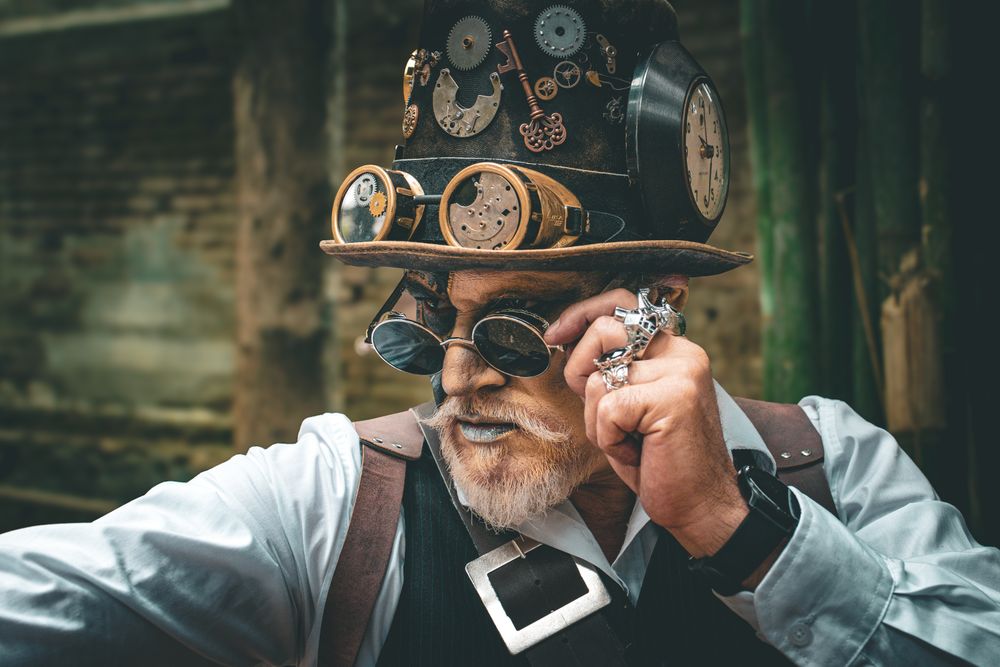
Victorian men's fashion is the other half of almost every steampunk outfit. The frock coat, the waistcoat with a watch chain across it, the high collar, the top hat and the beard all come straight from the nineteenth century. At a glance the men of Queen Victoria's reign seem to wear the same dark clothes from start to finish, but they did not. Coats were cut differently from one decade to the next, new kinds of hat arrived, and by 1901 a man could go about in something close to the modern suit.
The dark colours were already settled when the reign began. Historians call the change the Great Masculine Renunciation, a name the British psychologist John Flügel gave it in 1930: towards the end of the eighteenth century, wealthy men in the West gave up bright colours and elaborate shapes, left them to women's clothes, and made their mark instead through the cut and the quality of the cloth. This guide follows Victorian men's fashion piece by piece: the coats, the waistcoats, shirts and collars, trousers and braces, the hats, the beards, and what a man wore for work, sport and evening. It ends with how it all changed between 1837 and 1901.
The frock coat and the morning coat
Two coats ruled a Victorian man's day, and they are easy to tell apart once you know where to look. A frock coat has skirts that go all the way round the body to just above the knee. A morning coat has fronts that slope away from the waist towards the back, leaving the legs and much of the waistcoat in view.
The frock coat
The frock coat appeared by the 1820s, alongside full-length trousers. Towards the end of that decade it gained a seam at the waist and a fitted, hourglass shape that lasted into the 1840s. Early ones came in several dark colours, but within a few years plain black became the established practice. Charcoal grey was acceptable but less common in the Victorian years, and midnight blue rarer still. The cloth was usually broadcloth, a smooth, dense wool.
Around the 1850s the frock coat was accepted as formal dress for the daytime, which left the tailcoat to the evening. For the rest of the reign it was the standard business and formal daytime coat, worn at weddings and funerals and by professional men. The double-breasted version with peaked lapels became known as the Prince Albert, after Queen Victoria's husband, who is usually credited with making it popular. The single-breasted version, with notched lapels, was more for everyday professional wear. In the 1860s business frock coats were heavy, padded and fitted, and usually single-breasted and knee length.
The morning coat
The V&A explains that the morning coat began as a single-breasted tailcoat of the early nineteenth century, also called the riding coat or the Newmarket. By the 1850s it had settled halfway between a riding coat and a frock coat, and it was often called the cutaway, because its fronts sloped back towards broad skirts behind. In 1870 a variant called the University, or angle-fronted coat, appeared, cut sharply away from the second button to show much of the waistcoat. Morning coats were usually dark, made of worsteds and other firm wools, often with a collar faced in velvet and edges that were bound, corded or stitched. The museum notes that the morning coat became popular enough to rival the frock coat for day and business wear, and Wikipedia's history of the frock coat says that around the 1880s it began to replace it as formal daytime dress, leaving the frock coat more and more to older and more conservative men.
The lounge jacket
A third coat came in quietly. The lounge jacket was cut to fit the waist without a waist seam, using a long dart from under the arm. The V&A's record says it became popular for its comfort in the 1860s, and also dates the first lounge suit to the 1870s, when the jacket was worn with a matching waistcoat and trousers. Wikipedia's account of the 1860s says it was worn at home and not thought right for public places until the 1870s. In the last quarter of the century, the V&A says, the morning coat, the frock coat and the lounge coat were the three main day coats of a fashionable man, and early in the twentieth century the lounge suit replaced the other two. Our guide to steampunk coats and jackets shows how each of these coats is worn in steampunk today.
Waistcoats, shirts and collars
Under the coat, a Victorian man wore a waistcoat over a white shirt with a stiff collar and something tied at the neck. These were the pieces that told other men most about him, because the coat was nearly always dark.
Waistcoats
In the 1840s waistcoats were single or double-breasted, with a shawl collar, which curves round in one piece, or a notched collar like a coat's, and some ended in two points at the waist. They could be boldly checked or patterned against a plain coat and striped trousers, and for a man in a dark coat they were a place for colour and pattern. In the 1860s they were generally cut straight across the front and had lapels. In the 1890s contrasting waistcoats were popular again, and the usual style was single-breasted.
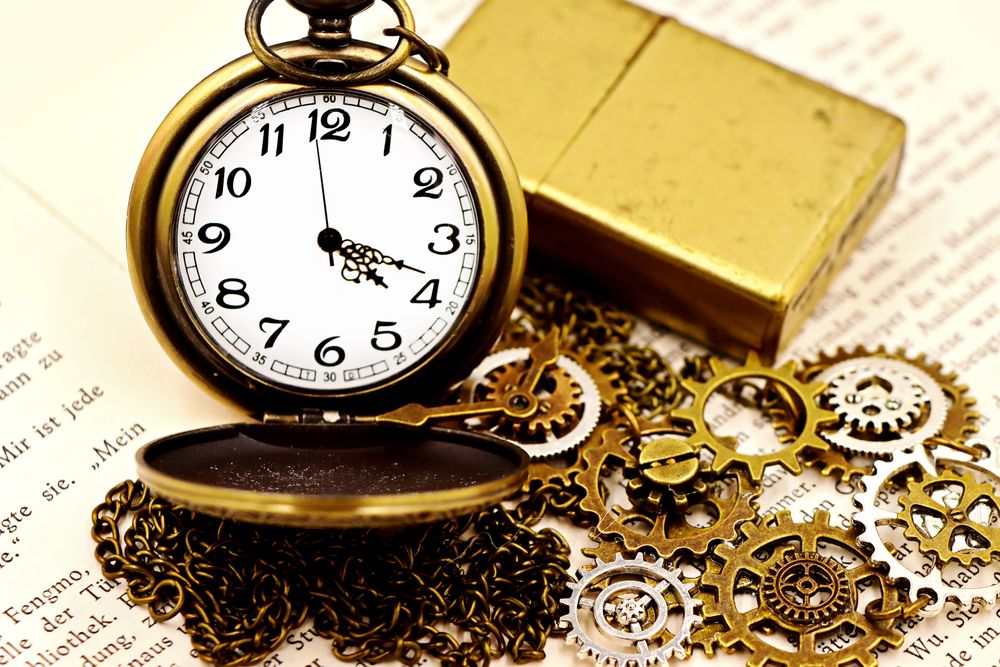
The waistcoat also carried the watch. A pocket watch sat in a front pocket, and its chain ran across to a buttonhole. In British English that chain is called an albert, after Prince Albert. Our guide to steampunk watches and pocket watches explains the albert and how to wear one.
Shirts and collars
Shirts were made of linen or cotton, and from early in the century the collar could be a separate piece. Local history in Troy, New York, credits Hannah Montague with inventing it in 1827, because she wanted to wash only her husband's collars rather than his whole shirts. By the 1860s detachable collars were widely standard for men. A collar was fastened to the shirt with a pair of studs, one at the back and one at the front, and it could be starched until it was as stiff as card.
Collar shapes changed over the reign. In the 1840s they were lower standing collars, sometimes turned down. In the 1860s they stood high or were turned over. In the 1890s they were turned over or pressed into wings, the points folded outwards at the front, and they grew taller through the decade.
Cravats and neckties
In the 1840s men wore wide cravats tied in many ways: a puffed knot at the front, ends tucked into the waistcoat, a bow, or a wide pointed bow. Dark cravats were usual for the day and patterned ones in the country. In the 1860s neckties grew wider and were tied in a bow or a loose knot held with a stickpin, and the four-in-hand, the long tie knotted much as ties are today, came into fashion. A white cravat stayed with evening dress. By the 1890s the usual choice was a four-in-hand or an Ascot tie, and the bow tie had come back for the day. Our guide to steampunk corsets and waistcoats covers the steampunk waistcoat.
Trousers and braces
Trousers were still fairly new when Victoria came to the throne. In the early nineteenth century long, close-fitting pantaloons became fashionable in England, and by the middle of the century they had replaced knee breeches as fashionable street wear. Breeches survived where tradition demanded them: in the 1840s they were still required at formal functions at the British court and for riding, usually with tall boots.
The shape and cloth of trousers
Victorian trousers reached the shoe and had fly fronts. In the 1860s they were usually made of a different cloth from the coat. A suit with coat, waistcoat and trousers all of one cloth, known then as a ditto suit, was still a novelty. Over the following decades the matching suit became normal, and by the 1890s three-piece suits were common, though some men still paired a matching coat and waistcoat with trousers of another cloth. Not everyone liked trousers. The V&A notes that artists and dress reformers late in the century attacked them as dingy tubes and argued for knee breeches instead.
Braces
Braces were popularised in London in the 1820s, and because trousers were cut high at the waist, where a belt was impractical, they were almost universal from the middle of the century. The V&A has a pair from the 1840s, embroidered with sprays of red flowers on canvas, lined with silk and fitted with leather tabs. Its record explains that in the 1840s and 1850s braces were usually two separate bands with tabs and buttonholes, passed over the shoulders and buttoned to the trousers. By 1850 the two straps were joined at the back, and later in the century braces of elastic webbing with sliding ends became the standard style. Braces were often brightly patterned, and between 1857 and 1866 many were embroidered in coloured Berlin woolwork. Women often embroidered them at home as presents for close friends and relations.
All that colour was hidden. Braces counted as underwear, not meant to be seen, and a waistcoat covered them. That is one of the clearest differences between Victorian dress and steampunk: a steampunk outfit often shows its braces over a shirt, with no waistcoat, as an inventor in his workshop might. Our guide to men's steampunk outfits starts from exactly that base.
The top hat, the bowler and other hats
In town and on formal occasions a Victorian man wore a hat, and the kind of hat said a good deal about him.
The top hat
Between the late eighteenth and early nineteenth centuries, the felted beaver fur of the top hat was slowly replaced by silk plush, though some men held on to beaver. In the 1840s and 1850s the top hat reached its most extreme shape, with ever taller crowns and narrow brims. A straight-sided one was called a stovepipe and one with slightly curved sides a chimney pot. Top hats were worn across the classes, and by the middle of the century they had become a sign of respectability in town, especially after Prince Albert began wearing them in 1850. Around 1840 in France, Antoine Gibus's spring-loaded design gave the collapsible top hat, known as the gibus or the opera hat, which could be folded flat and carried under the arm. At the end of the century the top hat was still required for formal wear among the upper classes, and it went with the morning coat.
The bowler
The bowler was made in 1849 by two London hat makers, Thomas and William Bowler, for a customer who wanted a close-fitting, low-crowned hat for gamekeepers on horseback, whose top hats were easily knocked off by low branches. Accounts differ over who that customer was. In the 1860s the bowler became popular as an informal hat, usually black for most of the year and brown in summer. It was popular with working men in Britain and Ireland in the second half of the century, and was later taken up by the middle and upper classes. In the United States it was called the derby.
Hats for the country and the summer
The deerstalker, a tweed cap with a peak at the front and another at the back and ear flaps that tie under the chin, was made for hunting deer in the countryside. It is now linked with Sherlock Holmes because the illustrator Sidney Paget drew him in one, though Arthur Conan Doyle never named it. The homburg, a felt hat with a single dent down the crown, is named after the German town of Bad Homburg, and the Prince of Wales, the future Edward VII, made it popular around the 1890s as a less formal hat than the top hat. The boater, a flat hat of stiff straw, became popular late in the century for boating, sport and the seaside. Our guide to steampunk hats and top hats shows how each one becomes steampunk.
Beards, moustaches and grooming
The bearded Victorian is a stereotype, but it took time to arrive. When the reign began, the fashion was for curled hair and sideburns, with moustaches. Wikipedia's history of the beard describes a dramatic shift after the revolutions of 1848, when beards became far more common; Charles Dickens and Benjamin Disraeli are among the British men it names who wore them. The beard came to be linked with ideas of manliness and courage, which helped create the picture of the stern, black-clad and heavily bearded Victorian.
Whiskers of every kind
The word sideburns is a nineteenth-century twist on burnsides, after the American Civil War general Ambrose Burnside, who wore thick side whiskers joined by a moustache, with a shaved chin. Sideburns joined to a moustache in that way are now often called mutton chops, and those of the nineteenth century were larger than most worn today. By the 1890s hair was generally worn short, often with a pointed beard and a full moustache.
The army's moustaches
The army had its own rules. After the Crimean War, regulations required British soldiers of all ranks to keep a moustache, though many soldiers were clean-shaven all the same. The rule lasted until an Army Order of 6 October 1916, issued by Lieutenant-General Sir Nevil Macready, who is said to have shaved off his own moustache straight away.
Macassar oil
Victorian men oiled their hair. The best known dressing was Macassar oil, which a London barber, Alexander Rowland, began selling around 1793, and which became one of the first products advertised across the country. It rubbed off on the backs of chairs, so households laid small washable cloths over them, called antimacassars. Our guide to steampunk make-up and hair explains how to wear Victorian whiskers and hair today.
Dressing for work, sport and evening
A Victorian man changed his clothes to suit the occasion, and the rules were stricter the higher he stood in society.
Work
A professional man, a banker, a lawyer or a doctor, wore the frock coat to work for most of the reign, with the top hat in town, and the lounge suit took over for less formal business only slowly. Working men wore what was practical, and the bowler was their hat. In the countryside, farm workers wore the smock, a loose overgarment with its fullness gathered across the chest in rows of stitching. The V&A has one from the 1860s, embroidered with plant and insect designs, and notes that smocks were often embroidered with motifs linked to the wearer's work, and that their use was dying out in the countryside by the end of the century.
Sport
Sport brought looser clothes. The Norfolk jacket is a loose, belted, single-breasted tweed jacket with box pleats, first designed as a shooting coat that did not bind when the elbow was raised to fire. It became fashionable after the 1860s in the sporting circle of the Prince of Wales, whose country home was Sandringham in Norfolk. By the 1890s a Norfolk jacket with matching breeches made a Norfolk suit, worn for cycling and golf. The blazer, a navy, bright or striped flannel jacket with patch pockets and brass buttons, was worn for sport and sailing, and the straw boater went with it.
Evening
For the evening, a gentleman wore a dark tailcoat. By the 1890s that meant a white bow tie and a shirt with a wing collar, what is now called white tie. The dinner jacket began as something less formal. The V&A records that in the middle of the century the Prince of Wales asked his tailor for a black version of the lounge coat to wear at informal, men-only dinner parties at Sandringham. A guest is said to have taken the idea home to Tuxedo Park in New York, which gave the dinner jacket its American name, the tuxedo. By the 1890s it had a shawl collar faced in silk or satin and generally one button.
Aesthetic dress
A few men turned their backs on all of this. The V&A has a brown velvet suit from about 1880 to 1885, a velvet lounge jacket worn with knee breeches every day, which was unconventional at the time. Such suits were linked with the leading men of the Aesthetic Movement, and Gilbert and Sullivan mocked them in their comic opera Patience (1881). Oscar Wilde wore a velvet coat, velvet waistcoat and knee breeches on his lecture tour of America in 1882.
How it changed from 1837 to 1901
Put together, the changes over the reign run like this. Knowing which decade a piece belongs to helps when you are putting together a costume, because the frock coat of 1850 and the lounge suit of 1895 tell different stories about the man wearing them.
- The late 1830s and 1840s. A fitted frock coat with a waist seam and narrow, sloping shoulders, a patterned waistcoat, a wide cravat, a tall top hat, curled hair and sideburns. Dark tailcoats for the evening.
- The 1850s. The frock coat becomes formal day dress. The top hat is at its tallest, and Prince Albert wears one from 1850. The bowler is made in 1849 and the beard spreads after 1848.
- The 1860s. Heavy, padded frock coats for business, the looser lounge jacket at home, trousers in a contrasting cloth, detachable collars as standard, the four-in-hand tie and the bowler as an informal hat.
- The 1870s. The morning coat rivals the frock coat, the angle-fronted coat arrives in 1870, and the lounge suit of matching jacket, waistcoat and trousers can be worn in public.
- The 1880s. The morning coat begins to replace the frock coat as formal day dress, and the Aesthetic Movement puts a few men in velvet and knee breeches.
- The 1890s. Three-piece lounge suits, tall wing collars, the Norfolk suit for cycling and golf, the blazer and the boater, the homburg, short hair with a pointed beard, and the dinner jacket for informal evenings.
From history to steampunk
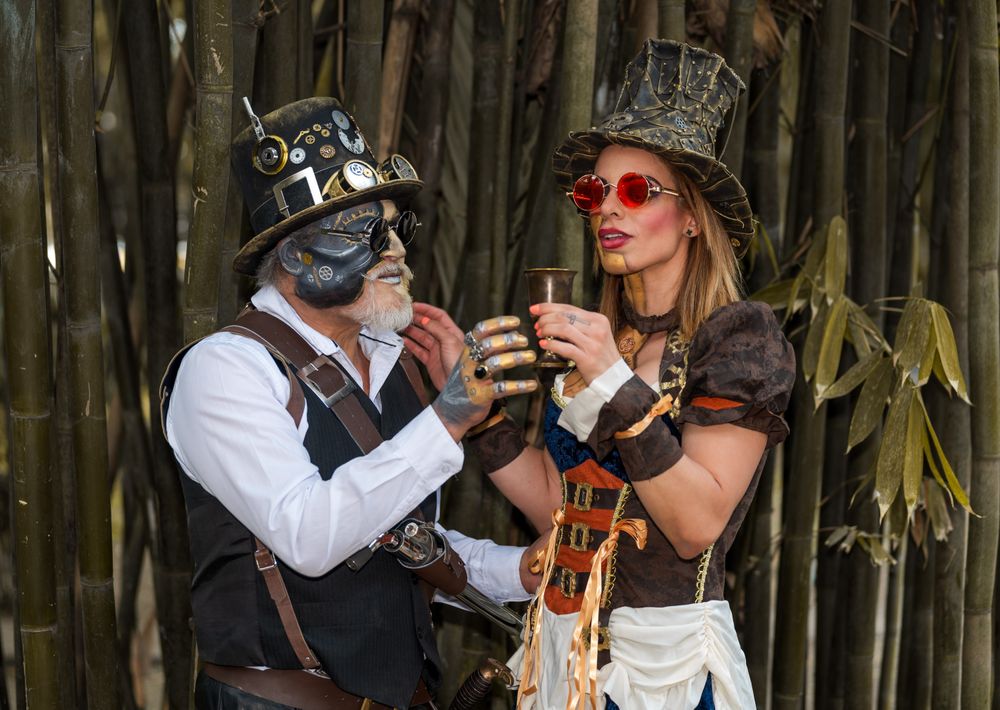
Steampunk takes these pieces and puts them to work. A frock coat or a morning coat, a waistcoat with an albert across it, a high collar and a top hat or a bowler are the Victorian base, and goggles, leather straps, gauges and tools are added on top. The one great change is that steampunk often shows what the Victorians hid, the braces, the workings of a watch, the shirt sleeves of a man at work. For the women's side of the story, see our guide to Victorian fashion for women, and for the black clothes worn after a death, our guide to Victorian mourning dress.