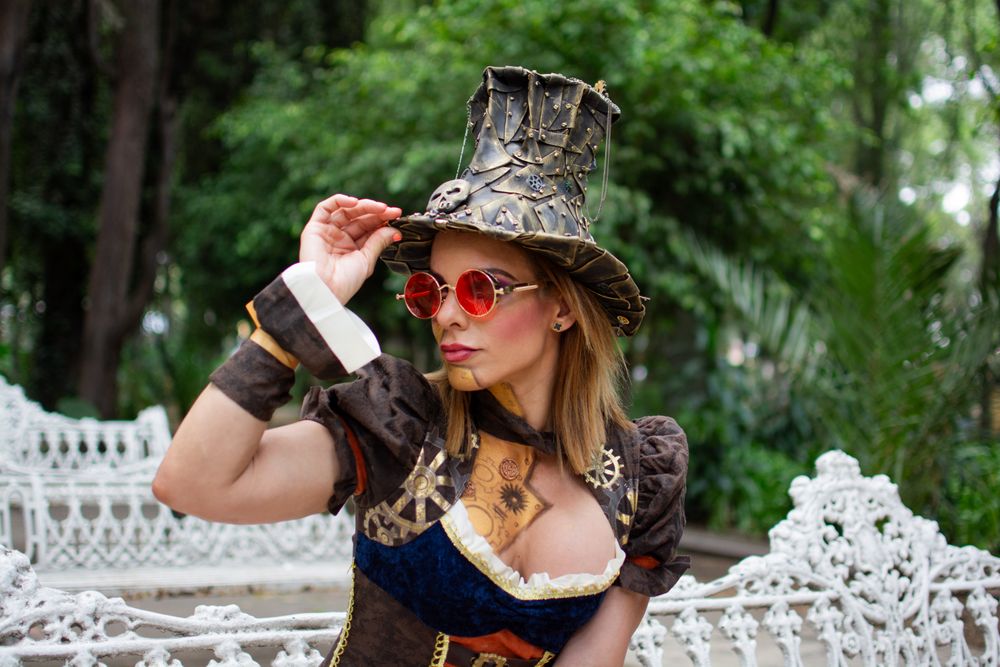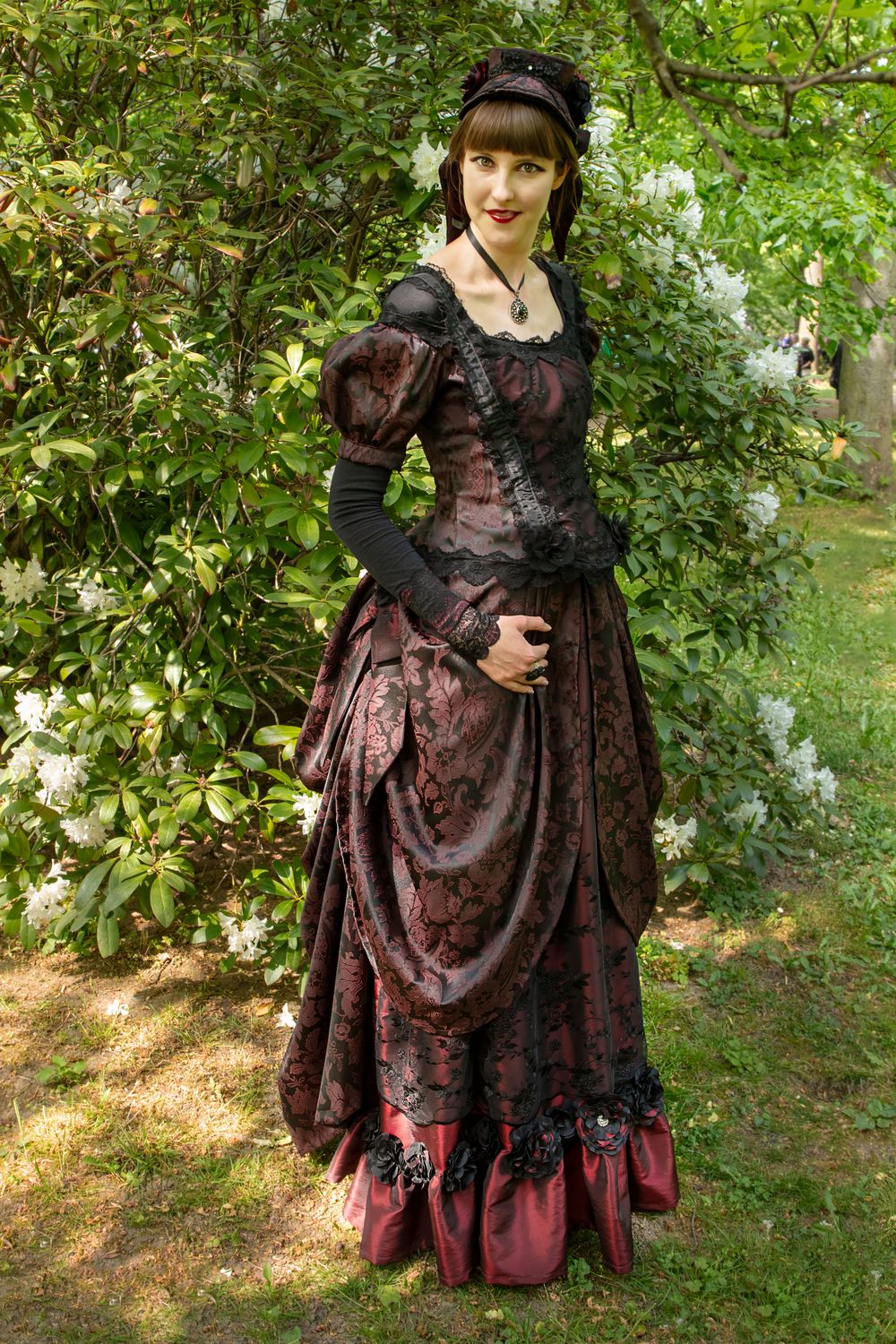
A steampunk dress is a dress with a Victorian shape and a little of the machine age added: a corset worn on the outside, brass buttons and buckles, a skirt pulled up to show the boots beneath. A steampunk skirt does the same work on its own, under a blouse, a waistcoat or a short jacket. Between them they are the foundation of most women's steampunk outfits, and the piece people notice first from across a room.
This guide is about those two garments in detail. It explains what makes a dress steampunk rather than simply Victorian, the skirt shapes that recur, from the bustle to the pick-up skirt and the high-low hem, dresses with a corset built in, the fabrics and colours that work, how to wear a dress with boots and accessories, and how to make or alter a skirt yourself. For the whole outfit around them, see our guide to women's steampunk outfits.
What makes a dress steampunk
A steampunk dress has three things. The first is a Victorian shape. The second is a set of materials and colours taken from an imagined world of engines and workshops. The third, and the one that matters most, is that some of its workings are on show.
The Victorian shape
Victorian dress changed a great deal over Queen Victoria's long reign, and a Victorian steampunk dress can take its shape from almost any part of it. The V&A describes how the cage crinoline, a frame of steel hoops, arrived in 1856 to hold skirts out wide. In the 1870s the fullness moved round to the back, held up by a bustle. In the early 1870s the dressmaker Charles Frederick Worth introduced the princess line, a dress cut in long panels with no seam at the waist, named in honour of Princess Alexandra and popular by the late 1870s. In the second half of that decade bodices were cut long and boned, reaching down over the hips. The bustle came back in the early 1880s, grew to its largest around 1886 to 1888, and had gone by the end of the decade. In the 1890s skirts fell smoothly in a bell shape, and tailored walking suits paired ankle-length skirts with matching jackets.
For steampunk, the two most useful shapes are the bustle dress of the 1870s and 1880s, which is the silhouette most people picture as Victorian, and the plainer skirts of the 1890s, which are easier to find, to make and to move in. Our guide to Victorian fashion for women follows these changes year by year.
The workings on show
A Victorian woman hid the structure of her clothes. Her corset, her bustle and her laces were all underneath. A steampunk dress brings that structure out into the open. The corset goes on top. The skirt is lifted and tied so that you can see how it is held. Buckles, straps and hooks become decoration. Add a few brass buttons, a leather belt with a pouch, perhaps a watch pinned to the bodice, and a period dress becomes a steampunk one.
What it is not
A dress covered all over in printed cogs is rarely convincing, and neither is a very short party dress with a pair of goggles. The Victorian shape comes first, and the steampunk details sit on it lightly. Our complete guide to steampunk fashion explains the same idea for the whole outfit.
Bustles and pick-up skirts
The bustle
A bustle is a pad or a frame worn under the back of the skirt, just below the waist, to give the skirt fullness there and to hold up the drapery above it. The first bustles of the 1870s supported overskirts that had been gathered up at the back. The later bustle of the 1880s was larger and stood out from the back almost like a shelf. The V&A describes one design, the New Phantom, patented in 1884, with a pivot that let its steel wires fold up when the wearer sat down. By the late 1880s the angular bustled shape had fallen from favour, replaced by a small pad of horsehair. Bustles are rarely worn today, except in bridal fashion, in film and theatre costume, and in neo-Victorian styles such as steampunk.
A steampunk outfit seldom needs a full frame. A small cushion tied round the waist under the skirt, or simply a generous overskirt gathered and tied up at the back, gives the same line and is far easier to sit in, to travel in and to dance in.
The pick-up skirt
A pick-up skirt is a skirt drawn up in several places, with ties, ribbons, cords or buttons, so that the fabric falls in soft swags and puffs between the points where it is held. Often the outer skirt is pulled up to show a second skirt, a petticoat or a pair of boots underneath. It is one of the most familiar shapes in steampunk, because it looks both elegant and practical, as though the wearer has hitched up her skirt to climb into an airship.
The pick-up skirt has real Victorian relatives. Outdoor dresses of 1874 had overskirts caught up with buckled ribbons, and in the 1870s and 1880s skirts were looped, draped or tied up in various ways over underskirts in matching or contrasting colours. The polonaise, a fitted overdress caught up and draped over an underskirt, revived a style of the 1780s. Victorian women also had a small tool for the job: the skirt lifter, a clamp that gripped the hem and hung from the belt by a cord, ribbon or chain. It was at its most popular from the 1860s to the 1880s, and was known by many names, among them dress holder, skirt grip and page. A brass skirt lifter is about as steampunk as a real Victorian object can be.
Wearing one
Choose the underskirt to contrast with the outer one: cream under brown, black under burgundy, a stripe under a plain colour. Pull the outer skirt up higher at the sides than at the back, so the fullness gathers behind. Ties that can be undone let you drop the skirt to full length for a formal moment and pull it up again for walking.
Short at the front, long at the back: the high-low skirt
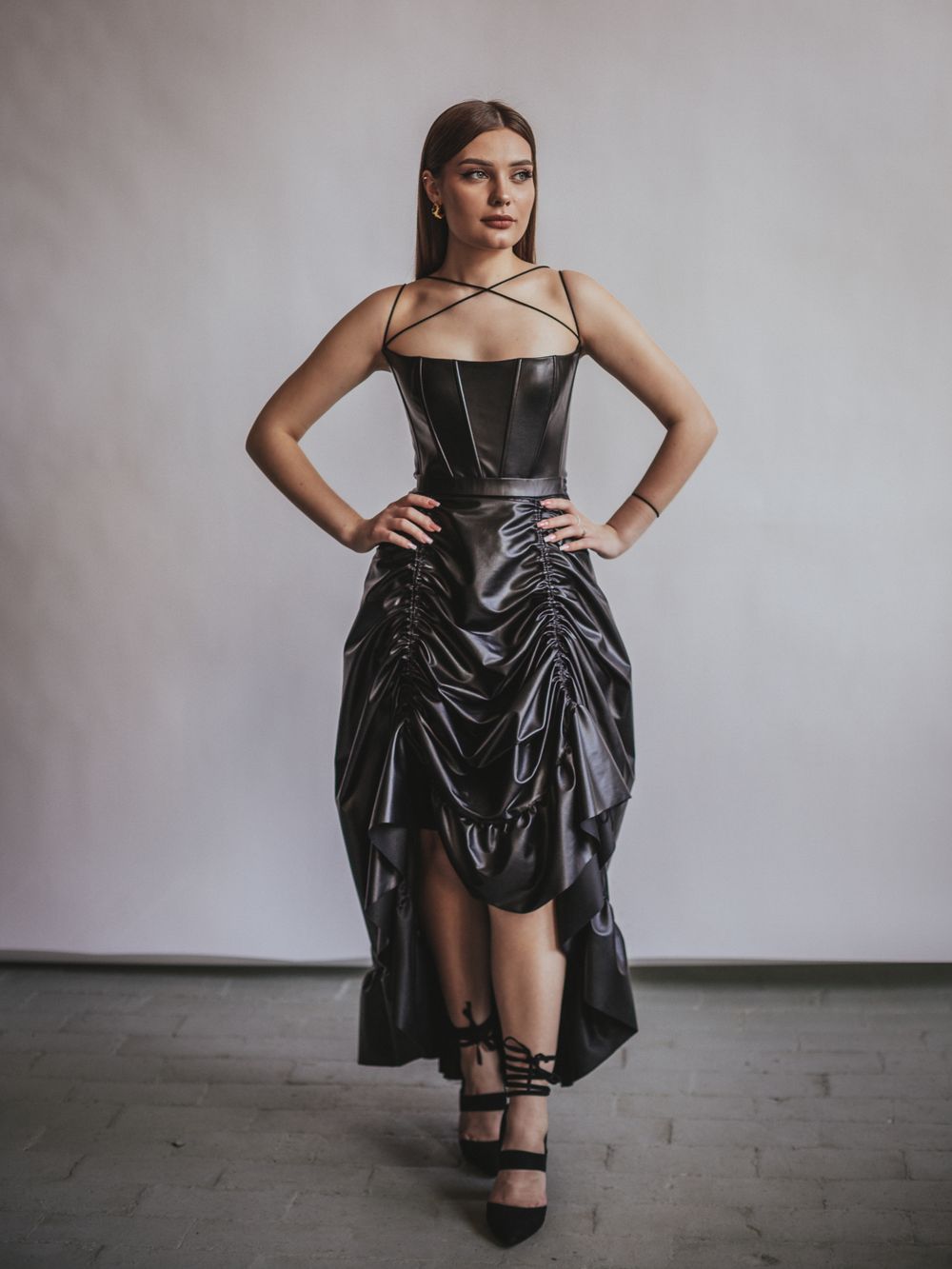
A high-low skirt has a hem that is short at the front, often at the knee or mid-calf, and sweeps down to the ankle or the floor at the back. It is a modern shape rather than a Victorian one. For most of Victoria's reign a fashionable skirt reached the ground. But the high-low skirt echoes two Victorian things: the long trains of the mid-1870s, when the fullness of a dress dropped into the lower back and the train, and the overskirts caught up at the front and gathered behind.
Why steampunks like it
The high-low skirt does several useful things at once. It shows off a good pair of boots, which a long skirt hides. It keeps the front hem out of the mud and away from your feet when you walk, climb stairs or step on and off a train. And it keeps the long, flowing Victorian line from behind and in photographs. The late Victorians were already moving in the same direction: the 1890s brought cycling costumes with shorter skirts or bloomers, and walking skirts with shorter hems that stayed out of puddles.
Ways to wear it
- As an overskirt, worn over a shorter underskirt, a petticoat, leggings or close-fitting trousers. This is the most adventurous version, and suits an aviator or an explorer.
- Over a bustle pad, so the long back stands out and falls in a train. This looks the most Victorian.
- As a whole dress, with a corset bodice and a high-low skirt in one. This is a popular choice for a party or a steampunk wedding.
Keep the back hem a little off the ground if you will be on your feet all day. A train that drags will be trodden on, by you and by others, and it will be filthy by lunchtime.
Dresses with a corset built in
A corset is a stiffened garment that shapes the waist and supports the body, laced or hooked closed. In Victorian times it was underwear, hidden beneath the dress. A great many steampunk dresses build a corset into the dress itself, so that the bodice is boned, shaped and laced like a corset and the skirt hangs from it in one piece.
A Victorian ancestor
This, too, has a Victorian relative. In the second half of the 1870s, bodices were cut as long, boned forms reaching over the hips, so close and stiff that they looked like a corset worn on the outside. In the 1880s, long, fitted bodices called basques, cut rather like jackets, were popular for daytime. So a dress with a boned, corset-like bodice is not as far from the real nineteenth century as it might look.
What to look for
A built-in corset should do the work of a corset, not just look like one. Look for real boning in the seams, which keeps the bodice smooth when you sit and move. Lacing at the back, or a laced panel at the side, lets you adjust the fit through the day. Lacing that is sewn on only for show, with a zip doing the real work, is easier to get in and out of but gives less shape. An overbust bodice reaches up over the bust; an underbust one stops below it and needs a blouse or a chemise underneath. The underbust version is cooler and often more comfortable for a long day.
Wearing one safely
A corset, built in or separate, should never be laced so tight that breathing or moving is hard. You should be able to breathe deeply, sit, bend and eat a meal. If you feel faint, dizzy or short of breath, loosen it or take it off at once. Wear any new corset dress at home for an hour or two before you wear it for a whole day. Our guide to steampunk corsets and waistcoats explains how to choose and fit one.
Fabrics and colours
Fabrics
Natural fabrics with a little weight make the most convincing steampunk dresses and skirts. Wool and cotton twill hang well and suit skirts for walking. Linen is cool for summer. Velvet, which was very popular in the 1880s, gives a rich, deep colour for a formal dress. Brocade and damask, with their woven patterns, suit a bodice or a corset. Silk and silk taffeta rustle and catch the light for a party or a wedding. Leather and faux leather suit a corset, a belt or a set of straps.
The fabrics that most often let a dress down are thin, shiny satins and lightweight polyesters. They cling where a Victorian skirt should fall, and they look cheap under bright lights and in photographs. A heavy cotton or a wool blend from a charity shop will usually look better than a new dress in a thin, shiny cloth.
Colours
Steampunk's colours come from its materials: brown in every shade, tan, cream, rust, burgundy, bottle green, navy, grey and black, with brass, copper and bronze for the metal. A good dress usually takes one main colour for the skirt, a second for the bodice or corset, and lets the metal of the buttons and buckles tie them together.
The Victorians themselves were far fonder of strong colour than old photographs suggest. In 1856 the young chemist William Perkin, trying to make the malaria medicine quinine, made instead the first synthetic organic dye, mauveine. The Science Museum records that demand rose after Queen Victoria and the French Empress Eugénie were seen wearing the colour, and many other new dyes followed. So a steampunk dress in deep purple, emerald or crimson has as good a Victorian pedigree as one in brown. The Victorians also dressed darker in winter and lighter in summer, which is a sensible rule for an outdoor event today.
Patterns
Stripes, small checks, tartans, brocades and small floral prints all suit the period. Large modern prints, bright neon colours and printed cogs do not. A plain skirt with a patterned bodice, or the other way round, usually looks better than two patterns together.
Wearing a dress with boots and accessories
Boots
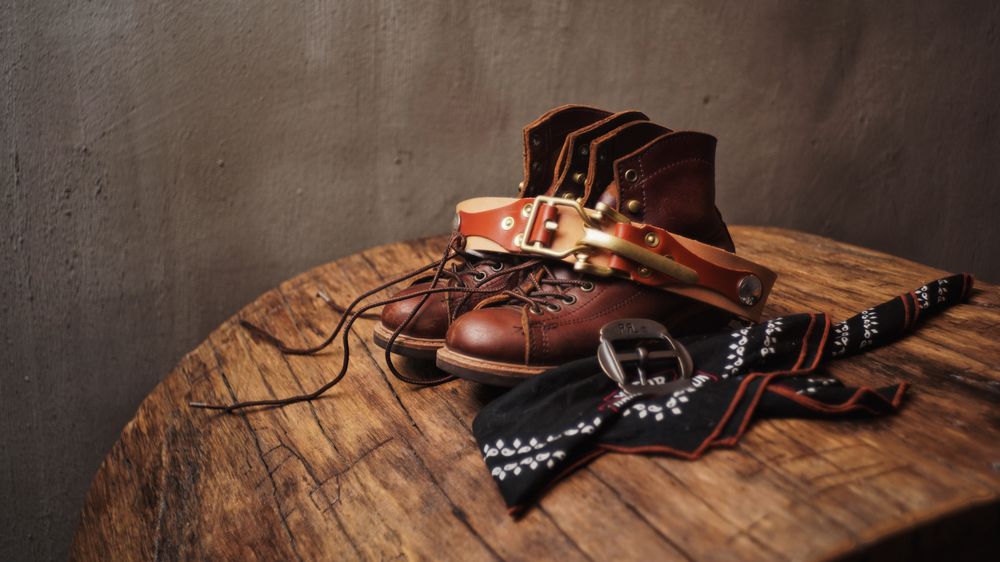
Boots and a steampunk skirt belong together. Laced or buckled boots that reach above the ankle, in brown or black leather, with a low, sturdy heel, suit almost every dress. A pick-up or high-low skirt shows them off, so they are worth choosing with care and wearing in before the day. Our guide to steampunk boots goes through the kinds.
What goes underneath
A petticoat gives a skirt body and swish, and stops it clinging to the legs. Under a high-low or pick-up skirt that shows a good deal of leg, bloomers, leggings or close-fitting trousers keep the look in period and keep you warm.
Over the top
A short fitted jacket, cut to end at the waist, shows off the line of a corset dress. A long coat flares out over the skirt and keeps you warm outdoors. Try any jacket on over the dress you will wear it with, because a jacket that closes over a blouse may not close over a corset bodice.
Accessories
Choose a few that suit your character and leave the rest:
- A wide leather belt with one or two pouches, which also holds a phone, keys and money out of sight.
- A pocket watch on a chain, pinned to the bodice or hung from the belt.
- A small top hat or a riding hat, pinned at an angle, with or without goggles on the brim.
- Gloves in lace or fine leather, or a single gauntlet.
- A cameo, a locket or a cog brooch at the throat.
- A parasol, which is useful on a sunny day out and looks the part.
As with every steampunk outfit, restraint helps. One belt, one watch, one brooch and a good hat are plenty with a strong dress.
Making or altering a skirt
A steampunk skirt is one of the easiest pieces of the whole style to make or alter at home, even with little sewing experience.
A simple gathered skirt
The simplest long skirt is a rectangle of fabric gathered onto a waistband.
- Measure your waist, and the length from your waist to the floor in the shoes you will wear.
- Cut fabric two to three times your waist measurement in width, joining pieces if you need to, and as long as your waist-to-floor measurement plus a few centimetres for the hem and the waistband.
- Sew the short edges together to make a tube, leaving an opening at the top for getting in and out.
- Gather the top edge to fit your waist and sew it to a waistband, or make a channel and thread a drawstring through it.
- Try it on, mark the hem, and sew it.
A heavier fabric, such as a cotton twill or a wool blend, will hang better and need less underneath it.
Turning it into a pick-up skirt
Sew a length of narrow tape or ribbon down the inside of the skirt at each side, from the waist to the hem, fixed at the bottom and loose at the top. Pull the tape up and tie it at the waist, and the skirt gathers into swags. Two or three tapes, at the sides and the back, give the classic shape. Undo them and the skirt drops back to full length.
Making a high-low hem
Put the finished skirt on, and with a helper mark a smooth curve from the front, at the length you want, round to the full length at the back. Cut along it a little longer than marked, and hem it. Cutting a long skirt from a charity shop this way is a quick route to a high-low skirt.
Altering what you have
Long plain skirts turn up often in charity shops, and small changes make them steampunk: brass buttons along the waistband, a ruffle or a strip of lace at the hem, ribbon ties to pull it up at the sides, a contrasting underskirt, or a wide leather belt worn over the top. A pale cotton skirt can be dyed a deeper colour. Our guide to a steampunk costume on a budget has more ideas of this kind.
Working safely
Keep pins in a pin cushion rather than in your mouth, unplug the iron when you leave it, and keep sharp scissors and craft knives away from small children. If you dye fabric, wear gloves and work in a well-ventilated room, following the instructions on the dye. A skirt you have made yourself, worn with a good pair of boots, is one of the most satisfying things in steampunk, and it is the start of many a steampunk wedding dress too.