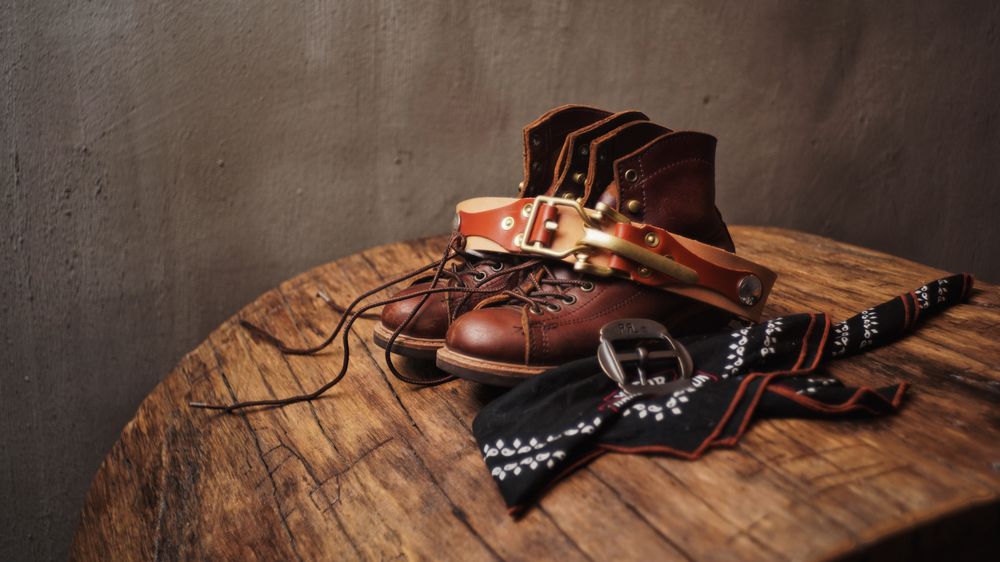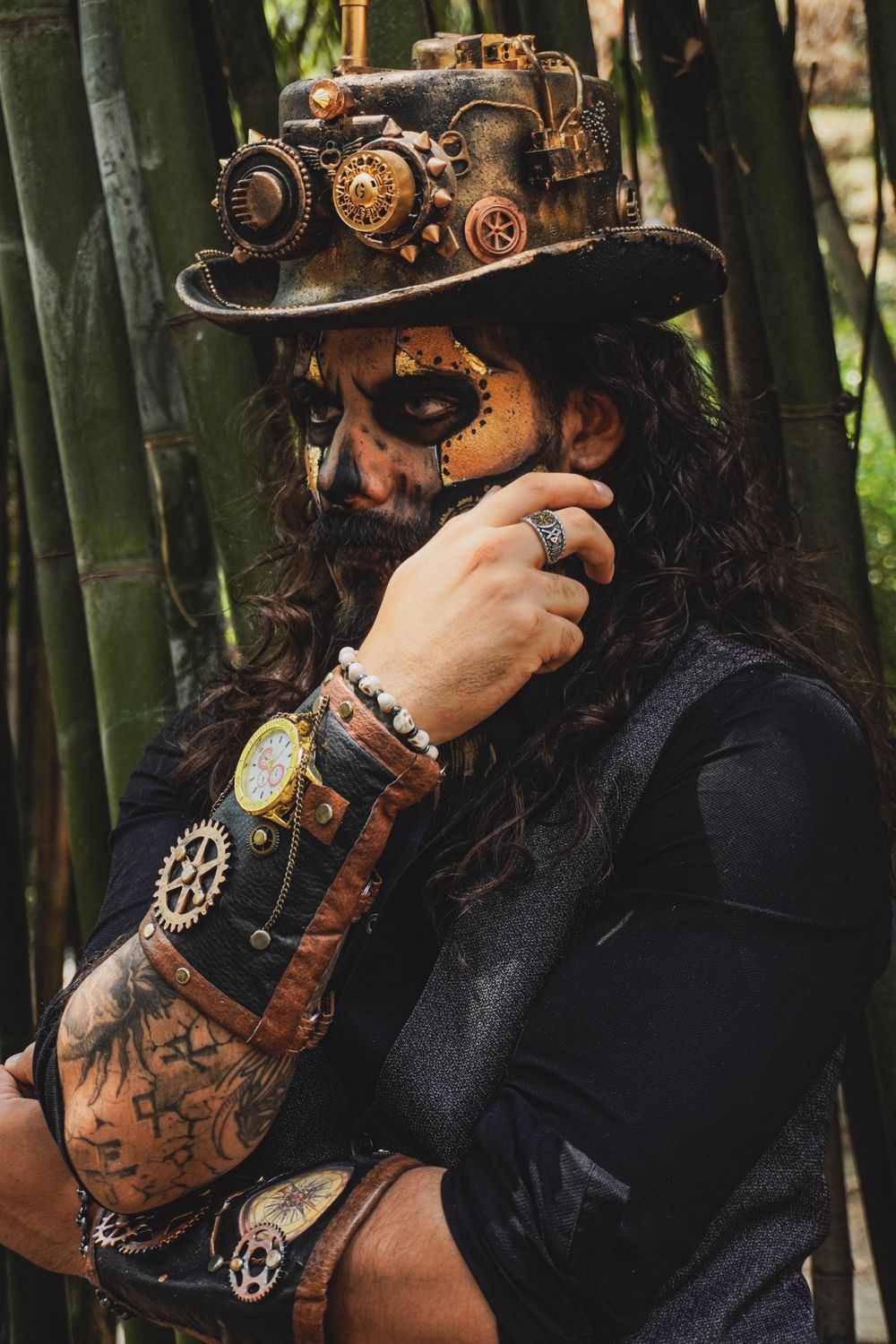
A male steampunk outfit is built from the clothes of a Victorian gentleman, or of a Victorian working man, with the brass, leather and instruments of an imagined age of airships added on top. Steampunk men turn up at gatherings as airship captains, inventors, explorers, engineers and gentlemen of leisure, and the steampunk attire men wear varies as much as the characters do. What the outfits that look right have in common is the order they are put together in.
That order is the one a Victorian man dressed in: a shirt, trousers and braces first, then a waistcoat, then a coat, then the hat, the boots and the small details. This guide takes each layer in turn, puts them together as five outfits to copy, and ends with how to stay comfortable through a long day. Our complete guide to steampunk fashion explains the ideas behind the style for everyone, and our guide to women's steampunk outfits does the same job for women's dress. Many of the pieces here work just as well on anyone.
The base: a shirt, trousers and braces
The base is the layer that decides whether a steampunk man costume looks Victorian or looks like modern clothes with a pair of goggles on top. It is also the cheapest layer to get right, because plain shirts and trousers of the right shape are easy to find.
The shirt
Victorian men's shirts were made of linen or cotton. In the 1840s collars were low, sometimes turned down, and from the 1850s men wore shirts with high collars that stood up or turned over. For a gentleman, a white or cream shirt with long sleeves and a collar that stands up round the neck is ideal. A band collar, which is a narrow strip of fabric round the neck with no points, or a shirt with no collar at all, looks rougher and suits a working character such as an engineer, a stoker or an airship deckhand. Avoid button-down collars, short sleeves and printed patterns. Roll the sleeves for an engineer; keep them buttoned for a gentleman.
The trousers
Victorian trousers sat high, at the natural waist, well above where modern jeans sit, and they were cut straight down the leg. Trousers already had fly fronts in the 1840s, and in the 1880s men wore breeches of tweed or wool for rough outdoor pursuits. For steampunk, look for high-waisted trousers in wool, tweed or heavy cotton. Grey, brown, charcoal, black and muted checks all work, and quiet pinstripes have a Victorian feel. Breeches tucked into tall boots suit an aviator, an explorer or a cavalry officer of the skies.
Jeans are the piece that most often spoils a male steampunk outfit, because even dark denim reads as modern at once. Plain dark work trousers or the trousers from an old suit make a far better start.
Braces
Braces are the straps over the shoulders that hold trousers up. Americans call them suspenders, a word that means something else in British English. Trousers in the nineteenth century were cut so high at the waist that a belt was impractical, and braces were nearly universal from the middle of that century into the early twentieth. The modern form was made popular by a London haberdasher in 1822. Braces of that era fastened with leather tabs to buttons sewn on the waistband, rather than with the metal clips common today. Button braces look more convincing, and many trousers can be given a set of brace buttons in a few minutes with a needle and thread.
Braces also give an outfit something to show when the coat comes off. A shirt, trousers and braces, with the sleeves rolled, is a whole costume in itself for an engineer.
Waistcoats, and why they matter
If you buy or make only one piece for a men's steampunk outfit, make it a waistcoat. It does more than anything else to make a plain shirt and trousers look Victorian, and it is the piece most steampunk men keep on all day.
Where the waistcoat came from
The waistcoat is older than the Victorians. On 8 October 1666 the diarist Samuel Pepys wrote that King Charles II had settled on a new fashion of a vest, a long garment worn under the coat, and that entry is the first documented mention of it. By the nineteenth century it had become shorter and tighter, worn under the frock coat. In the 1840s waistcoats were single or double breasted, with shawl collars, which curve round in one piece, or notched collars like the lapels of a jacket. Men's formal dress in the Victorian age was less colourful than it had been in the century before, but a brilliant waistcoat was still the place where a man could show some colour.
Why it matters
A waistcoat does three jobs. It shapes the body, giving even a loose shirt a fitted Victorian line. It adds a second colour and texture between the shirt and the coat. And it gives the pocket watch a home: before wristwatches, a man kept his watch in the front pocket of his waistcoat, on a chain threaded through a buttonhole. Without a waistcoat, a watch chain has nowhere to hang.
Choosing one
A waistcoat should reach just below the waistband of the trousers, so that no shirt shows between them, which is one more reason high-waisted trousers matter. Single-breasted waistcoats are the most common and suit everyone. Double-breasted ones look more formal and a little military, which suits an airship officer. Brocade, a heavy fabric woven with a raised pattern, suits a gentleman. Tweed, wool or canvas suits a traveller or an engineer, and leather suits a sky pirate. Deep red, bottle green, plum, mustard, grey and brown all sit well against a brown or black coat. Our guide to steampunk corsets and waistcoats goes further into fabrics and fit.
Coats: frock coats, greatcoats and long dusters
The coat is the largest piece of a steampunk outfit, so it sets the main colour and much of the character. The steampunk mens coat most people picture is a long one, and there are several kinds to choose from.
The frock coat
A frock coat is a fitted coat with a skirt cut all the way round, so that it does not fall away into tails at the back. Frock coats appeared in the 1820s and were the standard business dress of the Victorian age. In the 1840s they were close-fitting and reached the calf, and in the 1860s they were shortened to the knee for business. From the 1880s the morning coat began to replace the frock coat as formal day dress, and the frock coat became the choice of older and more conservative men. For steampunk it is the classic coat, because its long skirt and nipped-in waist read as Victorian from across a room. Black, charcoal, brown and deep green all work, in wool or a heavy cotton.
The greatcoat
A greatcoat is a large woollen overcoat made for warmth and for protection against wind and weather, with a collar that turns up and, on many, a short cape at the shoulders. It has a long history in military uniform. In steampunk it suits an airship officer or anyone standing on an open deck in a cold wind, and with a double row of brass buttons it is one of the most striking pieces a steampunk man can wear.
The Inverness cape
The Inverness is a weatherproof outer coat with a cape over the shoulders; in the 1880s the sleeves were removed, leaving armholes beneath the cape. Many people link it with Sherlock Holmes, though the stories describe him in an Ulster, a sleeved coat with a shorter cape. Either suits a detective or a gentleman traveller.
The long duster
A duster is a light, loose, long coat. The first dusters were worn by American horsemen to keep the dust of the trail off their clothes. They were made of light canvas or linen and slit up the back so they could be worn in the saddle. In steampunk the duster belongs to the frontier: a gunslinger, a bounty hunter, a railway engineer in the American West or a sky pirate.
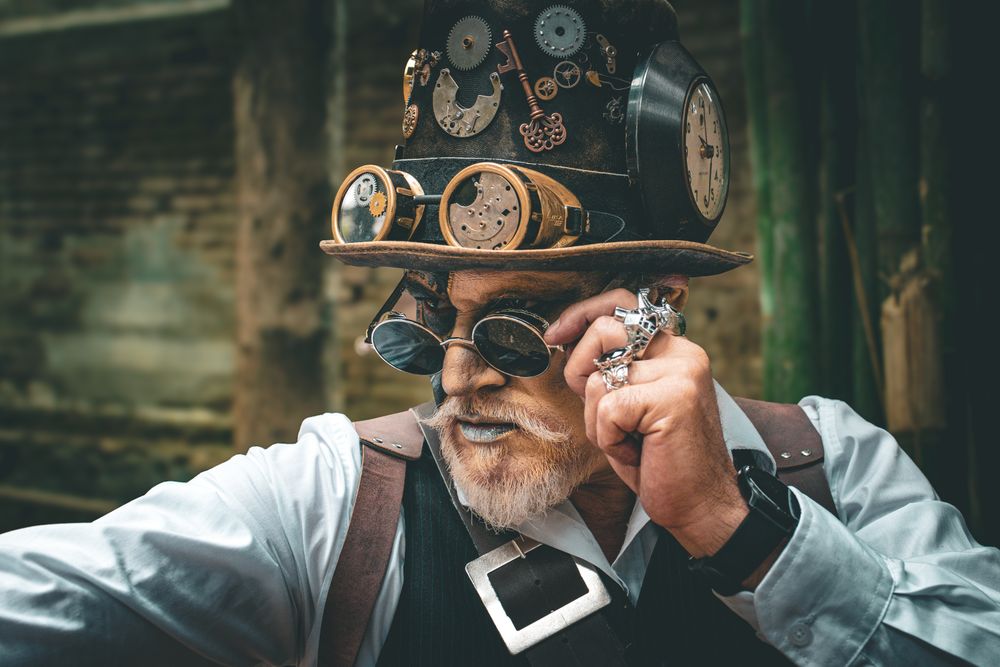
Whichever kind you choose, try it on over the waistcoat you will wear under it. Our guide to steampunk coats and jackets covers each kind in more detail.
Hats and goggles
The hat is the part of a steampunk outfit people look at first, and in photographs it is often the part they remember.
The top hat
The tall top hat dominated men's dress for the whole of the nineteenth century. Early ones were made of felted beaver fur, and silk plush gradually took over from beaver around the turn of the century. Prince Albert began wearing one in 1850, which helped make it the hat of urban respectability, and in the 1860s top hats briefly grew very tall in the shape called the stovepipe. For steampunk, the top hat is the most recognised hat of all, worn full height or cut down shorter, plain or fitted with goggles, gauges, cogs, a leather band and buckle, or a feather.
The bowler
The bowler, a round, hard hat with a short brim, was designed in London in 1849 to protect gamekeepers on horseback, whose top hats kept being knocked off by low branches. In the second half of the century it was popular with working men in Britain, and in the American West cowboys and railway workers wore it because it stayed on in the wind. It suits an engineer or a frontier character.
Other hats
The pith helmet, a light helmet of pith or cork covered in cloth, first appeared in India in the 1840s, and Western travellers in hot countries wore it from the middle of the century. It is the explorer's hat. The deerstalker, a cloth cap with a peak at the front and the back, was worn in the English countryside for hunting. It is linked with Sherlock Holmes because Sidney Paget, who illustrated the stories in The Strand Magazine, drew him in one, though Arthur Conan Doyle's stories never call it a deerstalker by name. A leather flying cap suits an aviator, and a peaked cap an airship officer.
Goggles
Goggles are the best-known single piece of steampunk, though real ones belong to the years just after Victoria. In the first ten years after the invention of the aeroplane in 1903, goggles became a necessity for pilots as aircraft grew faster and the wind grew stronger, and drivers of open cars wore them against dust and wind. On a man's outfit they usually sit on the hat brim, round the neck or over a flying cap. Round tinted glasses, or a monocle for a gentleman scientist, give the same feeling and are far easier to wear all day. Our guide to steampunk hats and top hats goes further into every kind of hat.
Boots, belts and gauntlets
Boots
Boots matter more in a men's steampunk outfit than almost anything else, because they show in every full-length photograph and they are what you stand in all day. The Wellington boot began as a leather boot of soft calfskin reaching to mid-calf, made for the Duke of Wellington by his London shoemaker; leather riding boots of that shape suit an aviator or an officer. The ankle boot with elastic sides, now called the Chelsea boot, is credited to Queen Victoria's shoemaker, Joseph Sparkes Hall, and was fashionable by the late 1840s. A plain pair suits a gentleman.
Beyond those, any plain leather boot in brown or black that reaches above the ankle will do: lace-up work boots for an engineer, tall boots for an explorer, buckled boots for a sky pirate. Spats, short cloth covers buttoned over the instep and ankle, were worn by men in the late nineteenth century to keep mud off their shoes, and a pair over plain black shoes makes a gentleman look very finished. Avoid trainers, and wear new boots in for weeks before an event.
Belts
A belt worn over the waistcoat or the coat, rather than holding the trousers up, is where a steampunk man carries his kit. A wide leather belt with two or three pouches turns an outfit into a working character, and a leather harness across the chest does the same for an explorer. Three pouches look purposeful; ten look like a builder's tool belt.
Gauntlets and gloves
Leather gloves suit a gentleman, and fingerless ones suit an engineer who needs his fingers free. A gauntlet, a glove with a long, wide cuff, sometimes with metal plates over the back of the hand and the fingers, is one of the boldest pieces a steampunk man can wear. One is usually enough; a pair can start to look like armour rather than tools. If you make one from card, foam or thin metal, file any metal edges smooth and check that you can still bend your fingers.
The details: watches, cravats and tools
The pocket watch
A pocket watch on a chain is the finishing touch for almost every steampunk man. Pocket watches remained the usual watch for men until early in the twentieth century, and began to give way to wristwatches around the time of the First World War. The watch sits in a waistcoat pocket, and the chain runs across to a buttonhole. In British English a chain of this kind, fastened to the waistcoat, is called an albert, a nineteenth-century word that comes from Prince Albert, Queen Victoria's husband. An open-faced watch shows its dial at all times. A hunter has a hinged metal lid that closes over the dial and the glass, which suits a gentleman who likes to flip it open to check the time. Our guide to steampunk watches and pocket watches covers the different kinds.
Cravats and ties
The cravat, a band of cloth tied round the neck, is the ancestor of the modern tie. An account published in 1828 says the style came to France in 1660 with a regiment of Croatian soldiers, and was at first called a Croat, a word that later became cravat. Victorian men wore wide cravats or neckties in the 1840s. For steampunk, a cravat or ascot in silk or cotton, tucked into the waistcoat and held with a tie pin, makes a gentleman at once. A bow tie suits a scientist or evening dress. A plain neckerchief knotted at the throat suits a working man, a sky pirate or a frontier character.
Tools and instruments
The small things a steampunk man carries tell people what he does: a magnifying lens for an inventor, a compass and a map case for an explorer, a telescope for an airship captain, a spanner for an engineer. Choose two or three that belong to your character and leave the rest at home. Props that look like weapons, such as ray guns, swords and pistols, follow the rules of each event you go to, and those rules differ from one gathering to the next, so read them before you set off.
Five outfits to copy
These five steampunk men's costumes each start from the same layers. Wear them as they stand, or swap pieces between them.
1. The gentleman inventor
A white shirt with a high collar, a silk cravat, and a brocade waistcoat in deep red or green with a pocket watch on its chain. Grey or pinstriped trousers with braces, and black boots, or shoes with spats. Over the top, a black or charcoal frock coat. A top hat with a pair of brass goggles on the brim, and a magnifying lens on a chain. A good model is the Time Traveller in H. G. Wells's The Time Machine (1895), a Victorian scientist whose real name is never given: a respectable man who happens to have built a machine in his own house.
2. The airship captain
A cream shirt, a double-breasted waistcoat, and breeches or straight trousers tucked into tall leather boots. A greatcoat or a military-style jacket with a double row of brass buttons, a peaked cap or a top hat with goggles, and leather gloves. A belt with a telescope case and one pouch.
3. The engine-room engineer
A collarless shirt with the sleeves rolled, braces over the shoulders and a leather or canvas apron. Heavy work trousers and lace-up boots. Goggles pushed up on the forehead or worn round the neck, fingerless gloves, a bowler, and a spanner through the belt. A smudge of soot is optional. It is the cheapest of the five to put together and the most comfortable to wear all day.
4. The gentleman traveller
A tweed suit, or tweed trousers with a matching waistcoat, a white shirt and a knotted tie. An Inverness cape or a long travelling coat over the top, and a deerstalker or a bowler on the head. A leather bag over the shoulder, a pocket watch and a compass. The model is Phileas Fogg, the wealthy and precise British gentleman of Jules Verne's Around the World in Eighty Days, first published in French in 1872, who bets half his fortune that he can travel round the world in eighty days. Fogg lives by the clock, so the watch matters more here than anywhere.
5. The frontier gunslinger
A plain shirt and a leather or canvas waistcoat, dark trousers and tall boots. A long duster coat in brown or tan, a bowler or a wide-brimmed hat with goggles, a neckerchief and leather gloves, with a belt and holster for a prop pistol where the event allows one. The film that shows this side of steampunk best is Wild Wild West (1999), Barry Sonnenfeld's story of two American government agents in 1869, played by Will Smith and Kevin Kline, which ends with a giant mechanical spider.
Each of these can be changed with a single swap: put the airship captain in the gunslinger's duster and he becomes a sky pirate. For the real clothes these outfits start from, see our guide to Victorian men's fashion.
Dressing for comfort at an all-day event
Steampunk gatherings often run from morning to night, partly outdoors and on foot for hours, and heavy coats, tall hats and stiff boots bring their own troubles. For where and when people gather, see our guide to UK events.
Feet first
Wear boots you have already worn in, with thick socks and a cushioned insole, which nobody will see. If you are not sure of your boots, carry a plain pair of comfortable dark shoes in a bag.
Heat and layers
A wool frock coat or a greatcoat is welcome on a cold morning and hard work on a sunny afternoon. Plan the outfit so that it still looks complete with the coat off: a good waistcoat, a clean shirt and braces are an outfit in their own right. Natural fabrics breathe far better than synthetics.
Carry the modern things in character
A pouch on a belt, a leather satchel or the inside pocket of a frock coat can hold a phone, money, keys, plasters and a snack without spoiling the outfit. Drink plenty of water, especially in a heavy coat on a warm day.
Props and the event's rules
Costume weapons, ray guns and large props follow each event's own rules, which can differ from one gathering to the next, so check them before you set off. Leave anything heavy at home if you will be on your feet all day. The best steampunk outfit for a man is the one he is still glad to be wearing at the end of the evening.