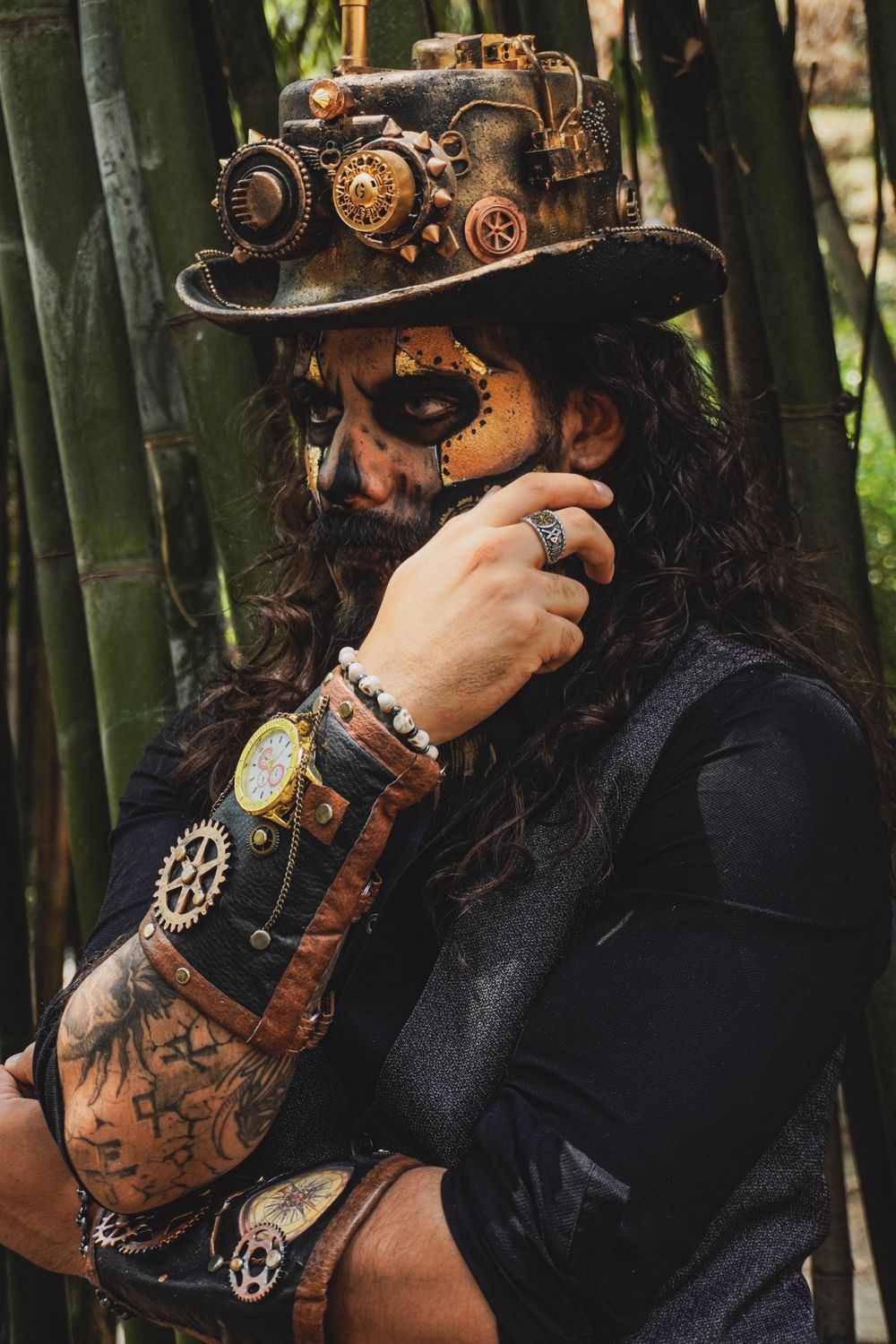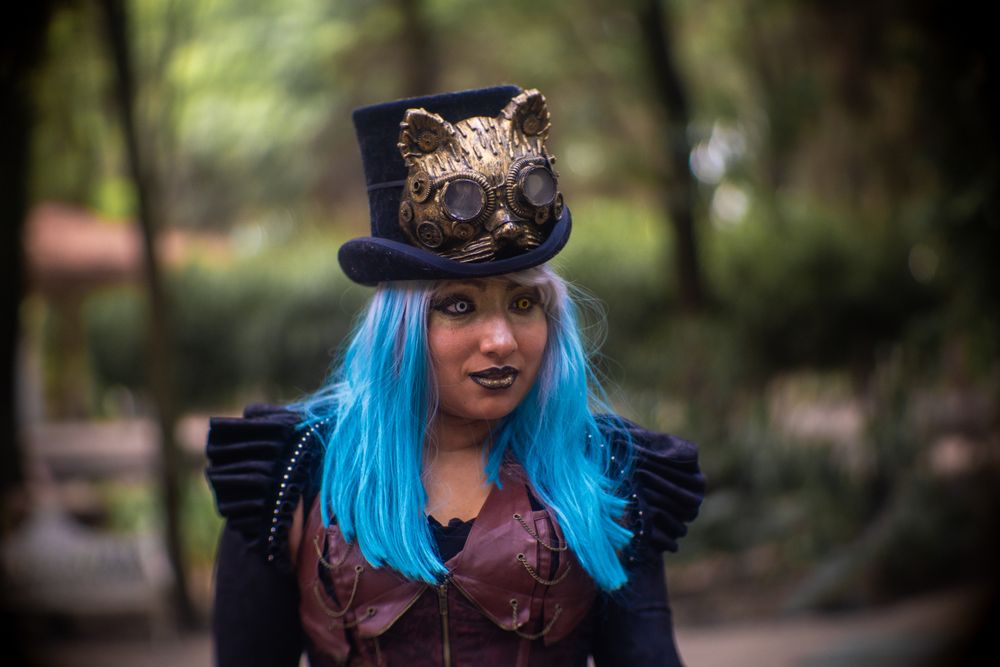
Women's steampunk outfits draw on the clothes of Victorian women, then add the brass, leather and goggles of an imagined age of airships and inventors. The result can be anything from a lady in a bustle gown with a brass spyglass at her waist to an aviator in breeches, boots and a flying jacket. There is no single way to do it, and female steampunk outfits are some of the most varied at any gathering.
What the best ones share is that they are built in layers, the same way a Victorian woman dressed: a base of blouse and skirt or dress, a corset or waistcoat, a jacket or coat, and then hat, goggles and accessories. This guide takes each layer in turn, then puts them together into five outfit ideas you can copy as they stand or change to suit yourself, and ends with how to stay comfortable at an event that lasts all day. For the wider picture, including men's dress, see our complete guide to steampunk fashion.
The base: a blouse, skirt or dress
The base is the layer closest to the body, and it decides how Victorian the whole outfit looks. There are two ways to build it: a blouse and skirt, or a dress.
The blouse
A Victorian blouse has long sleeves and a high neck, and it is usually white, cream or a soft pale colour. Lace at the collar or cuffs, pin-tucks down the front, a ruffle or a jabot of lace at the throat all help. In the 1880s daytime necklines rose, often to a high collar, and in the 1890s sleeves swelled into great puffs at the shoulder, called leg-of-mutton sleeves for their shape, at their largest around 1896. Either detail makes a modern blouse look right at once. A plain white cotton blouse with a high neck is the single most useful piece in women's steampunk, because it goes under a corset, a waistcoat or a jacket equally well.
The skirt
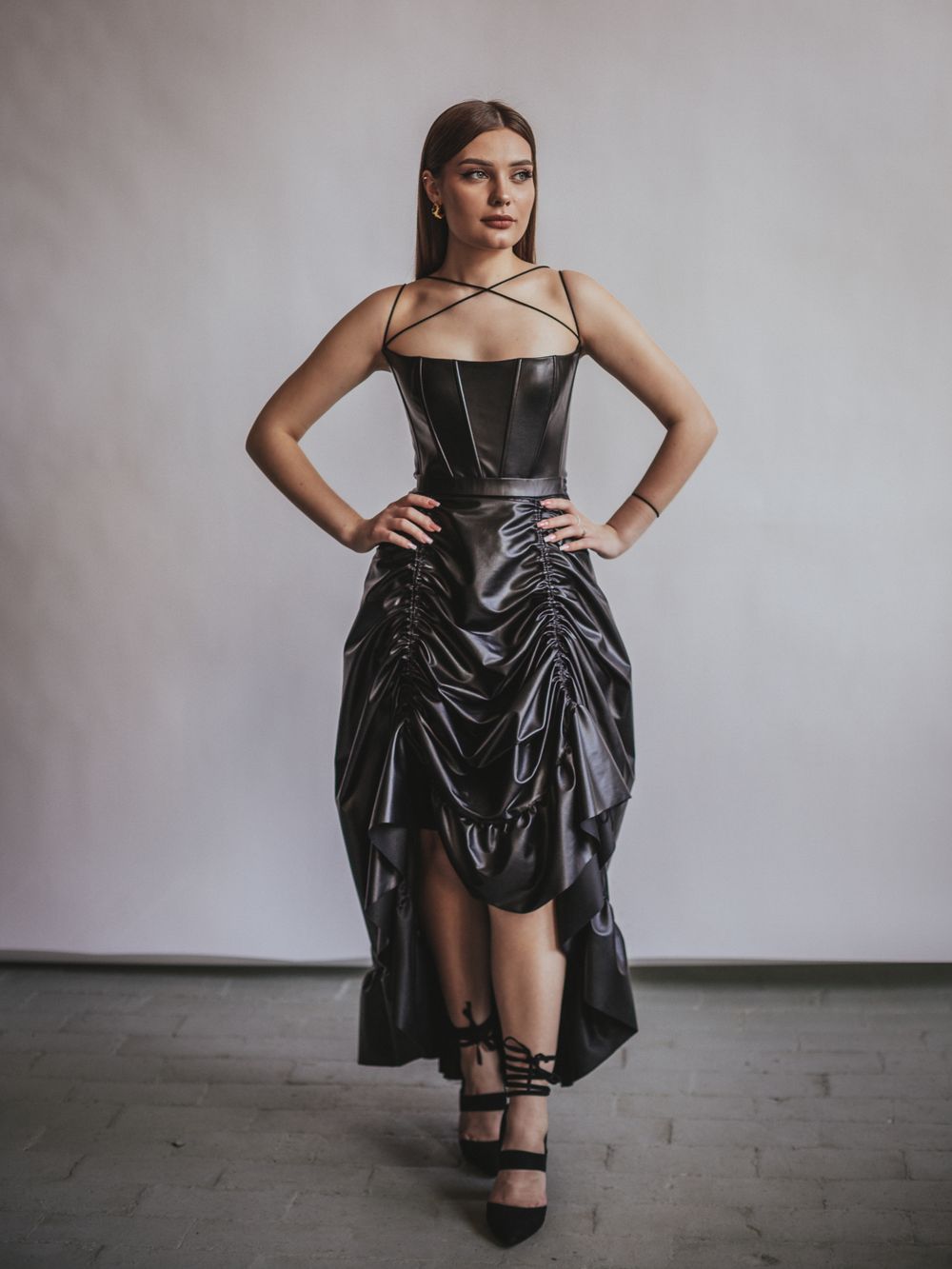
A long skirt, reaching to the ankle or the floor, in a fabric with some weight: wool, cotton twill, velvet, brocade or a heavy linen. Brown, black, burgundy, bottle green, navy and grey all work. A skirt with tiers or layers gives movement, and one that can be pulled up at the sides with ties or ribbons shows a petticoat or boots beneath, which looks practical and adventurous. Our guide to steampunk dresses and skirts goes through the shapes in detail.
The dress
A whole dress makes the simplest base of all. A Victorian-style gown with a fitted bodice, a high neck and a long skirt is complete in itself, and needs only a few steampunk touches to change it. A plainer dress in a dark colour can be worn with a corset over the top, which pulls it in at the waist and turns it into a steampunk outfit at once.
Corsets and waistcoats, and how to wear one comfortably
The corset is the piece most people picture when they think of women's steampunk. In Victorian times a corset was underwear, hidden beneath the dress, and its job was to give the dress its shape. The V&A's collection shows how they changed through the reign: hand-sewn cotton stiffened with whalebone in the early years, then easier fastenings at the front in the 1850s and 1860s, and in the 1880s boning covered in leather. Steampunk takes the corset out from under the dress and puts it on show, worn over a blouse, often fastened with buckles and straps.
Overbust and underbust
An overbust corset covers the bust and reaches up towards the top of the chest. An underbust corset starts below the bust and covers the waist and ribs only. For steampunk, the underbust is the more common and more comfortable choice, because it sits over a blouse and leaves the blouse's lace and collar on show. Leather, brocade, strong cotton and heavy canvas all work; a corset with real boning keeps its shape far better than a soft fashion top that only looks like one.
Wearing one comfortably
A corset should never be laced so tight that breathing or moving is hard. Lace it snug enough to shape and support, and no further. You should be able to breathe deeply, sit down, bend and eat a meal. If you feel faint, dizzy or short of breath at any point, loosen it or take it off straight away. Wear it at home for an hour or two before you wear it for a whole day, and wear it over a cotton blouse or vest rather than straight against the skin, which is more comfortable and keeps the corset clean. Even the Victorians argued about tight lacing: dress reformers of the 1890s said it harmed health, and the V&A notes that some of their claims were overstated, but the safe rule is simple: if it hurts, it is too tight.
The waistcoat
A waistcoat is the corset's easy-going alternative. It shapes the body, takes a watch chain, and needs no lacing at all. A fitted women's waistcoat, or a man's waistcoat taken in, over a high-necked blouse, is smart, practical and comfortable for a whole day. A waistcoat in brocade or a strong colour can carry an outfit on its own. Our guide to corsets and waistcoats explains how to choose either.
Skirts, bustles and trousers
The bustle
The bustle is the most Victorian of all shapes. It was a pad or frame worn under the skirt at the back, introduced in the 1870s to hold up skirts gathered behind. It faded at the end of that decade, then came back around 1883 in a larger form that stood out from the back almost like a shelf; one design of 1884 even folded up when its wearer sat down. By the late 1880s it had gone out of fashion. For steampunk, a full frame is rarely needed. A small pad, or an overskirt bunched and tied up at the back, gives the same silhouette and is much easier to sit in.
Skirts that work for a living
The adventurous lady needs a skirt she can move in. Skirts that loop up at the sides, a shorter skirt over trousers or leggings, or a skirt with a slit at the front for walking all suit a traveller. A practical skirt was not necessarily a weakness. Mary Kingsley, who travelled in West Africa in the 1890s, kept to her long skirts, and wrote in Travels in West Africa (1897) that when she fell into a game pit lined with spikes, the fullness of her skirt saved her from injury.
Trousers
Trousers have a real Victorian history for women too. In 1851 Elizabeth Smith Miller in America adopted loose trousers gathered at the ankle, worn under a short dress, and the editor Amelia Bloomer promoted the outfit so well in her magazine that such trousers are still called bloomers. In London the Rational Dress Society, founded in 1881, argued for more practical clothing for women, including the divided skirt; its president, Lady Harberton, wore a shorter skirt over full trousers when cycling. The traveller Isabella Bird describes her own riding dress in A Lady's Life in the Rocky Mountains as a half-fitting jacket, a skirt to the ankles and full trousers gathered over the boots, a serviceable outfit for rough travelling.
So trousers, breeches or bloomers tucked into tall boots are entirely in keeping. They suit an aviator, an explorer or an engineer, and they are easier to wear all day than any long skirt.
Jackets and coats
A jacket finishes the outfit's shape, and it is often the piece people notice from across a room.
The short fitted jacket
A short jacket, cut to end at or above the waist, worn open over a corset, shows off the waist and the corset together. Puffed or long fitted sleeves, a high collar and brass buttons all help. This is the most popular jacket in women's steampunk because it works with almost everything.
The riding jacket and the tailcoat
A fitted jacket cut longer at the back, or a woman's version of the gentleman's tailcoat, cut away at the front and falling to tails behind, gives a smart, slightly military line. Both suit a lady adventurer or an airship officer.
The long coat
A long coat to the knee or below, fitted at the waist and flaring out over the skirt, makes a dramatic outfit and keeps you warm outdoors. A loose travelling coat in canvas or heavy cotton suits a sky pirate or explorer. A military-style coat with braid and a double row of brass buttons suits an airship captain. Whatever the style, try a jacket on over the corset or waistcoat you will wear beneath it, because a jacket that fits over a blouse alone may not close over a corset. Our guide to steampunk coats and jackets covers each kind.
Hats, goggles and hair
Hats
A small top hat, pinned or clipped at an angle and trimmed with feathers, lace, a ribbon or a pair of goggles, is the best-known women's steampunk hat. A full-sized top hat suits a ringmaster or a lady inventor. A riding hat, a bowler, a straw boater or a pith helmet, the light sun helmet worn by Victorian travellers in hot countries, all have their characters. An aviator's leather flying cap suits a pilot. Fascinators, small decorations on a clip or band, are an easy alternative if a hat is not for you.
Goggles
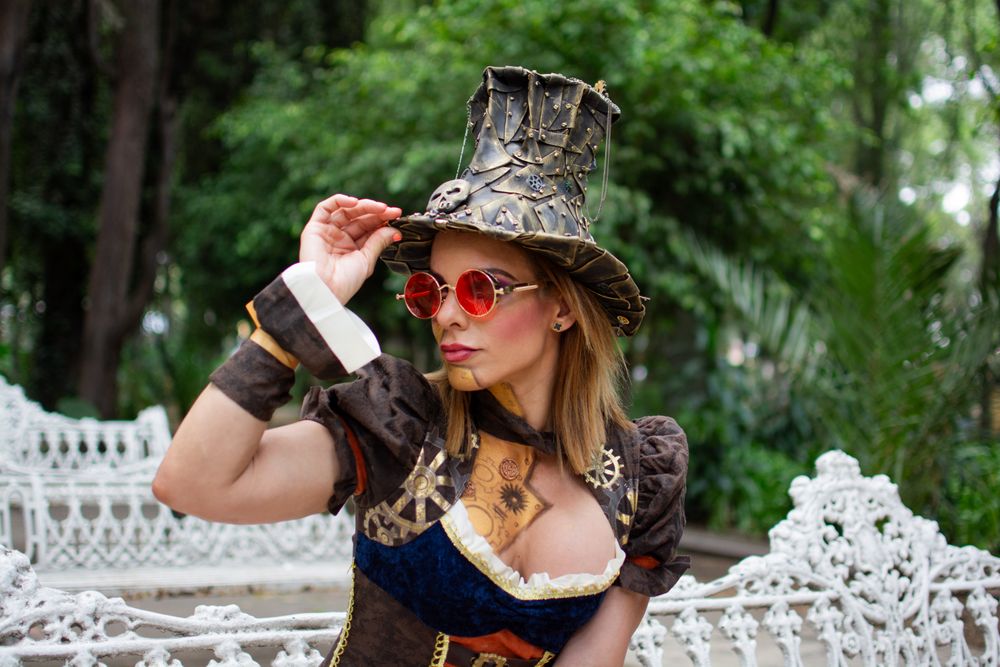
Goggles are the badge of steampunk, worn on a hat brim, round the neck or, for the true aviator, over a leather cap. Real goggles became a necessity for pilots in the years after the first aeroplane flight of 1903, and drivers of early open cars wore them against dust and wind. If goggles feel like too much, round tinted glasses in amber, red or smoke give the same feeling and are far easier to wear all day.
Hair
Hair worn up suits the Victorian line: a bun, a twist or a braided crown, with a few loose curls at the front or the sides. Long hair can be braided or tied back with a ribbon. Short hair suits an aviator or engineer look very well, especially under a cap. Steampunk does not insist on natural colours either; a brightly dyed head of hair under a small top hat is a familiar sight. Our guide to steampunk make-up and hair has step-by-step ideas.
Accessories that finish the look
Accessories are where a women's steampunk outfit tells its story. Choose a few that fit your character, and leave the rest.
- A chatelaine. A clasp worn at the waist with chains hanging from it, each holding something useful, such as scissors, keys, a thimble or a watch. The V&A holds a steel one made around 1850 that was shown at the Great Exhibition of 1851; its description notes that pockets were uncommon in women's clothes before the 1850s, which is what made the chatelaine useful. It is a perfect steampunk accessory, because it is real Victorian and already looks like a kit of tools.
- A pocket watch. Worn on a chain from a waistcoat, pinned to the jacket, or hung from a chatelaine.
- Jewellery. Cog brooches, cameos, lockets, chokers and drop earrings. Black jet jewellery is a true Victorian touch: Queen Victoria wore Whitby jet while in mourning for Prince Albert. Our guide to steampunk jewellery covers the rest.
- Gloves. Lace or fine leather for a lady, fingerless leather for an engineer, or a single gauntlet with metal plates.
- A parasol or fan. Both are Victorian, and both are useful on a sunny day out.
- A belt with pouches. Practical and in character, it holds your phone, keys and money out of sight.
- Instruments. A compass, a spyglass, a small map case or a magnifying lens on a chain, chosen to match what your character does.
Five outfits to copy
These five steampunk outfit ideas for women each start from the same layers. Use them as they are, or swap pieces between them.
1. The airship aviator
A cream shirt, a brown leather underbust corset or a fitted waistcoat, and brown breeches tucked into tall laced boots. Over the top, a short leather or canvas jacket, and a scarf at the neck. On the head, a leather flying cap with goggles over it, or goggles on a small top hat. A belt with a couple of pouches and a compass completes it. This is the outfit to choose if you want to move freely all day.
2. The explorer
A pale linen or cotton blouse with the sleeves rolled, a khaki or tan skirt looped up at one side over boots, or breeches instead. A leather harness across the chest, carrying a map case, a spyglass or a water bottle. A pith helmet or a wide-brimmed hat with a scarf tied round it. The colours are all light, warm and dusty, as if just back from the desert or the jungle.
3. The lady inventor
A white high-necked blouse, a brocade waistcoat or corset, and a dark skirt. A leather apron tied over the skirt, goggles pushed up into the hair, fingerless gloves and a belt of small tools. A magnifying lens on a chain and a chatelaine at the waist. A smudge of soot on the cheek is optional.
4. The society lady
A Victorian-style gown in burgundy, plum or bottle green, with a fitted bodice and a bustle or a gathered overskirt at the back. Lace at the throat and wrists, lace gloves, a small top hat trimmed with feathers and a single pair of brass goggles on the brim. A pocket watch on a chain, a cameo or jet brooch, and a parasol. This is the most elegant of the five, and the one that shows best how little steampunk detail a really good Victorian outfit needs.
5. The gothic steampunk
Black all through: a black blouse with a high lace collar, a black corset with dark metal fittings, a long layered black skirt and a long black coat. A black top hat with smoked goggles, a veil or a black feather. Jet jewellery, a pocket watch in a dark case, and black boots. It is the darker side of steampunk, where the inventor works by candlelight.
Each of these can be changed with a single swap. Put the society lady's gown under the aviator's jacket and you have an airship captain's wife who flies the ship herself. Give the explorer the gothic steampunk's black coat and she becomes a ghost hunter back from a haunted island. The layers are the same in every case; what changes is the story you choose to tell, and the few pieces that tell it.
Dressing for comfort at an all-day event
Steampunk gatherings often last from morning to night, outdoors and indoors, on foot for hours. The outfit that looked perfect in the mirror can be miserable by mid-afternoon if comfort was not part of the plan. For where and when people gather, see our guide to UK events, and for the day itself, our guide to what to wear to your first steampunk event.
Feet first
Wear boots you have already worn in. New boots on a long day are the most common cause of a miserable afternoon. Thick socks, a cushioned insole and a low heel make a great difference. If you are unsure of them, carry a second pair of plain, comfortable shoes in a bag, and change when you need to.
Breathe and move
If you wear a corset, lace it loosely enough to breathe deeply, sit and eat. Loosen it at lunch if you need to, and take it off if you feel faint. A waistcoat is a comfortable alternative for a very long or very hot day.
Layers for the weather
British weather can change several times in a day. Wear layers you can take off and carry: a jacket over a blouse, a shawl or a coat. Natural fabrics breathe better than synthetics in warm weather. Carry a parasol for sun, and something waterproof that does not spoil the look, such as a long coat or a dark umbrella, for rain.
Hats and goggles
Pin small hats firmly, because wind finds them. Goggles worn on a hat brim all day are more comfortable than goggles over the eyes, and tinted round glasses are easier still.
Carry the modern things in character
A pouch on a belt, a small leather bag or a chatelaine can hold a phone, money, keys, plasters, water and a snack without spoiling the outfit. Drink plenty of water, especially in a corset and a heavy coat.
Props and the event's rules
Costume weapons, ray guns and large props follow each event's own rules, which can differ from one gathering to the next, so check them before you set off. Leave anything heavy at home if you will be on your feet all day. The best women's steampunk outfit is the one you are still enjoying at the end of the evening.