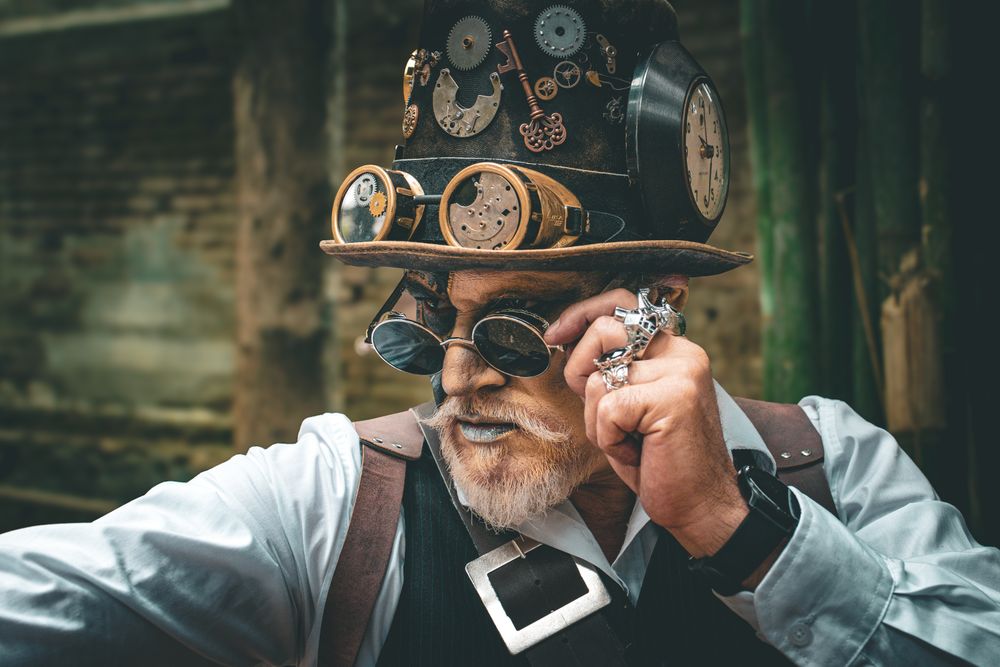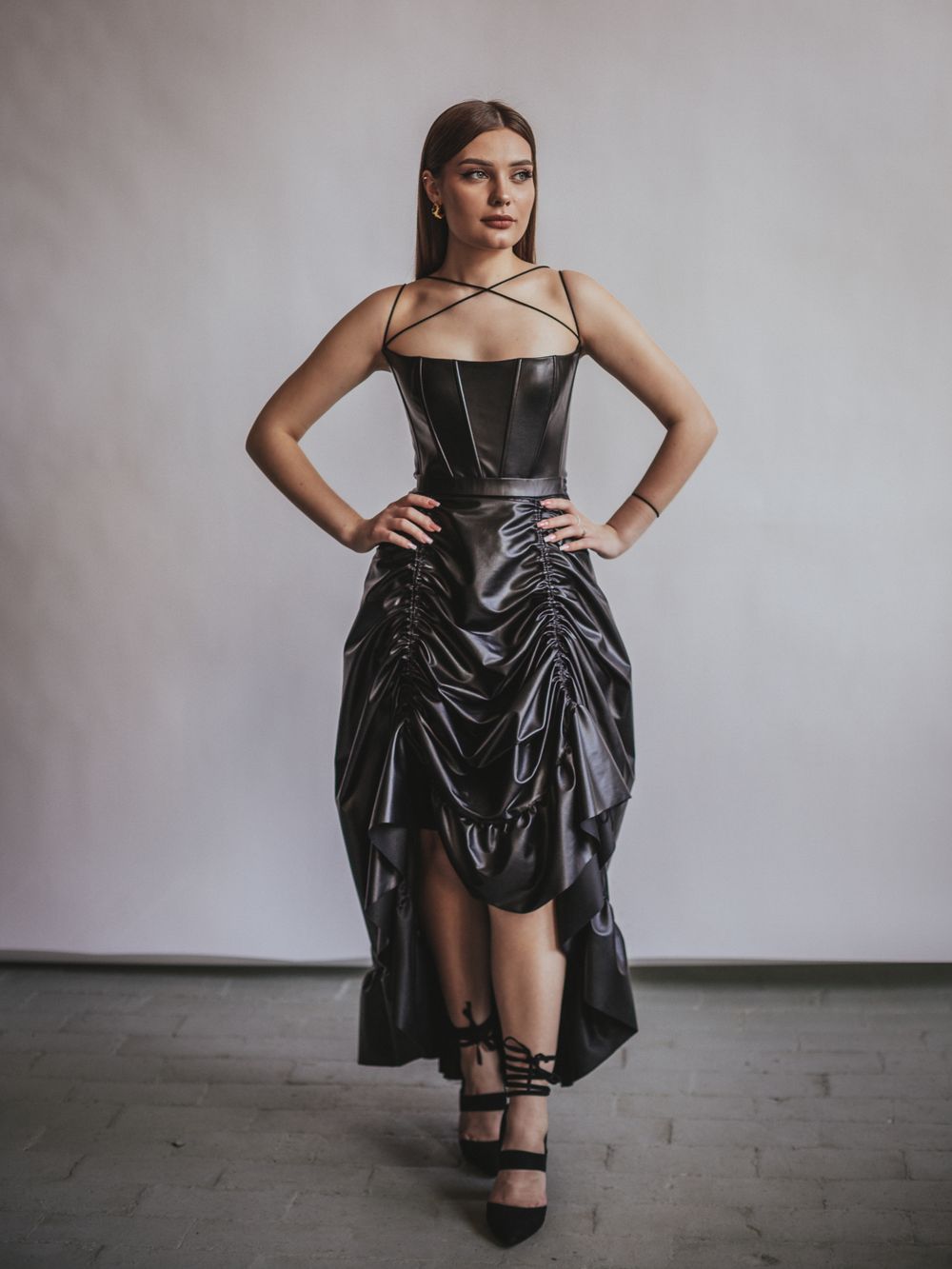
Steampunk corsets and waistcoats are the two pieces that give an outfit its Victorian middle. A steampunk corset, worn on the outside over a blouse or a shirt, is the piece many people picture first when they think of the style. A steampunk waistcoat does much the same job for men and women alike, with no lacing at all. Between them they shape the body, hold the layers of an outfit together, and give a pocket watch somewhere to live.
This guide is about the pieces themselves: what a corset is and what it is not, the main kinds, the boning inside them, how to lace one up and wear it comfortably, the waistcoat, the fabrics and fastenings that suit both, and how to get the size right. Our guides to women's steampunk outfits and men's steampunk outfits show how each one fits into a whole outfit.
What a corset is, and what it is not
What it is
A corset is a close-fitting garment stiffened with narrow strips called bones, laced or hooked closed, that shapes and supports the body round the waist and ribs. The word is a diminutive of the Old French word for the body, so it means something like "little body". In earlier centuries the same kind of garment was called a pair of bodies, or stays.
Most corsets have a stiff, flat piece down the centre front called the busk. In the early Victorian years busks of wood or metal were slipped into the front of the corset to give a smooth line. In the 1850s and 1860s, busks split down the middle, with loop-and-stud fastenings, made dressing much easier, because the corset could now be fastened and unfastened at the front. The lacing runs up the back through metal eyelets, which were invented in the 1820s and allowed corsets to be laced more tightly than before.
The V&A's history of Victorian underwear shows how the corset kept changing through the reign. Early ones were hand-sewn in hard-wearing cotton. In the late 1860s Edwin Izod developed a way of moulding corsets with steam on heated copper forms, which gave stiffer, more rounded shapes. In the 1870s the spoon busk shaped the stomach and spread the pressure more widely. And in the 1880s it became fashionable to cover the boning with a contrasting fabric, often leather, which is a look steampunk has borrowed very happily.
Corsets were not only for women. From the 1820s fashionable men wore corsets too, and their waistcoats were cut skin-tight, some with whalebone stiffening and lacing at the back. A man in a steampunk outfit who wears a corset or a cincher has more history behind him than he may realise.
What it is not
In Victorian times a corset was underwear, hidden under the dress, and its job was to give the dress its shape. Steampunk turns that round. The corset goes on the outside, over a blouse or a shirt, and becomes part of the costume, often with buckles and straps that make it look like a piece of equipment.
A real corset is also not the same thing as a soft top made to look like one, with laces sewn on for show and no real boning. Those can look fine in a photograph, but they will not hold their shape or give the Victorian line. And a steampunk corset is not a waist trainer. This guide makes no claims about waist training, which is the practice of wearing a corset for long periods in the hope of changing the shape of the waist. A steampunk corset is a costume piece, laced for the look and only as far as is comfortable.
A few myths are worth leaving behind as well. The story that Victorian women commonly had ribs removed to make their waists smaller has no basis. The V&A notes that some of the health claims made by the dress reformers of the 1890s seem to have been accurate, while some campaigners exaggerated or made up their arguments. The safe rule for anyone today is the simple one: if it hurts, it is too tight.
Overbust, underbust and waist cinchers
Steampunk corsets come in three main lengths, and the length decides what you wear with it and how it feels after a few hours.
The overbust corset
An overbust corset covers the bust and runs from just under the arms down towards the hips. It can be worn on its own as a top, with a blouse under it for a Victorian look, or with a short jacket over it. Because it supports the whole upper body, it gives the most dramatic shape, and it is also the most work to wear all day.
The underbust corset
An underbust corset starts just under the bust and runs down towards the hips, covering the waist and the ribs. This is the most common steampunk corset, because it sits over a blouse and leaves the blouse's collar, lace and sleeves on show. It is easier to breathe and move in than an overbust, and it works under an open jacket or coat.
The waist cincher
A waist cincher is a short corset that covers only the waist, from low on the ribs to just above the hips. It is still boned and laced at the back, but its shortness is what sets it apart. Cinchers were the fashionable undergarment of the late 1940s, when they were also called waspies. In steampunk a cincher sits over a shirt like a very wide belt. It is the easiest of the three to wear, the easiest to sit down in, and a good first corset for anyone, men included.
| Kind | Covers | Wear it over | Suits |
|---|---|---|---|
| Overbust | Bust, ribs and waist | A blouse, or nothing | An evening outfit, a lady inventor in her finest |
| Underbust | Ribs and waist | A blouse or shirt | Almost every steampunk character |
| Waist cincher | The waist only | A blouse or shirt | A first corset, an engineer, a long day |
Steel boning and plastic boning
The bones of a corset are the rigid strips, sewn into narrow channels, that form its frame. They are what make a corset a corset, and the material they are made of decides how well it keeps its shape.
From reeds and whalebone to steel
In the seventeenth and eighteenth centuries corsets were boned with giant reeds or with whalebone, which was the most expensive. Whalebone is not bone at all. It is baleen, the tough, flexible plates that some whales have in their mouths instead of teeth. By the middle of the nineteenth century steel and whalebone were the main materials, and as whalebone became scarcer later in the century, makers tried cork, cording and watch-spring steel among other things. Since the turn of the twentieth century steel has been the standard for a good corset.
Flat steel and spiral steel
Modern steel boning comes in two kinds. Flat steel boning bends in only one direction, so it suits the places where the corset needs to stay straight and firm. Spiral steel boning bends easily in two directions, so it can follow a curved seam over the hips or the ribs, and it gives a gentler support.
Plastic boning
Plastic boning has long been thought of as low in quality and not very supportive. It suits a soft fashion top, a light costume piece or a child's dressing-up outfit, but it will not hold a firm shape once a corset is laced. A newer kind, sold as synthetic whalebone, is light and supportive and moulds well to the body. Costume makers short of steel have even used plastic cable ties from a hardware shop.
What this means when you choose one
If you want a corset that shapes the waist and keeps its line through a long day, look for one described as steel-boned, with a steel busk at the front. If you want something light that only gives the look of a corset, plastic boning is fine, as long as you lace it gently. A corset with no boning at all is a top with laces, and that is all it will ever be.
Lacing one up and wearing it comfortably
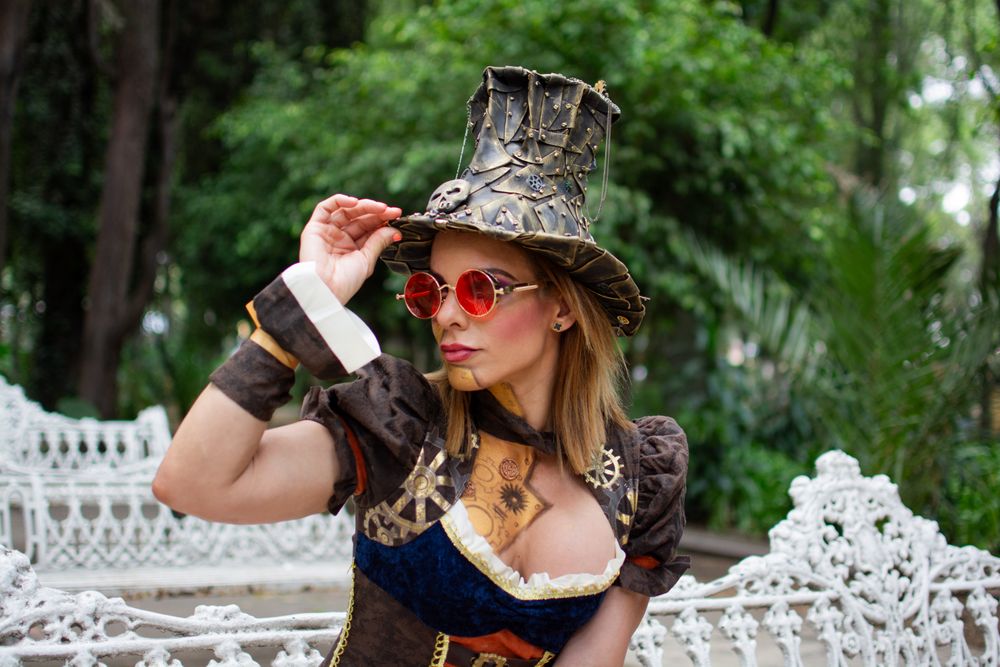
Corsets are held closed by lacing, usually at the back, and tightening or loosening the laces changes how firmly the corset holds. The laces are often threaded so that they meet at the waist in two long loops, sometimes called bunny ears, so that pulling the loops tightens the waist more than the top or the bottom.
Putting one on
- Loosen the laces at the back all the way, so the corset opens wide.
- Put on a cotton blouse, shirt or vest first. A layer between the corset and the skin is more comfortable and keeps the corset clean.
- Wrap the corset round you and fasten the busk at the front, one stud at a time.
- Take up the slack in the laces gently, working from the top and the bottom towards the loops at the waist.
- Pull the loops a little at a time, stopping while it still feels snug rather than tight.
- Tie the laces in a bow and tuck the ends in, so they cannot catch on anything.
A friend can lace a corset far more evenly than you can lace your own, especially the first few times.
Wearing it comfortably
A corset should never be laced so tight that breathing or moving is hard. Lace it firmly enough to shape and support, and no further. You should be able to take a deep breath, sit down, bend to pick something up, and eat a meal. If at any point you feel faint, dizzy or short of breath, loosen it or take it off straight away, and sit down.
Wear a new corset at home for an hour or two before you wear it for a whole day, and lace it loosely the first few times, so you find out where it presses. At an event, loosen it a little before you sit down to eat, and drink plenty of water, because a corset over a blouse is warm. Plan for the practical things too: a long corset makes sitting in a car harder, and a trip to the toilet is easier if the corset stops above the hips. If you have any health condition that a corset might affect, ask your doctor first.
Taking it off
Loosen the laces before you undo the busk, rather than forcing the studs open while the corset is still tight, which strains the fastenings. Hang it over a chair to air before you put it away.
The waistcoat, for men and women
A waistcoat is a sleeveless garment worn over a shirt and under a coat. In the United States and Canada it is called a vest, a word that in Britain means something worn under a shirt. A steampunk waistcoat is the corset's easy-going relation: it shapes the body, adds a second colour and texture, and needs no lacing at all.
The Victorian waistcoat
The waistcoat is the third piece of the traditional three-piece suit. Early in the nineteenth century it became shorter and tighter, worn beneath the frock coat, and after about 1850 it was cut straighter, with less pull at the waist. In the second half of the century men's colours grew quieter, and matching waistcoats came in with the lounge suit, though brocades and patterned fabrics were still worn. Towards the end of the century tailors began to make the back of a waistcoat from a cheaper, contrasting fabric such as a lining, because the back was always hidden under the coat. That is why a waistcoat looks unfinished from behind when the coat comes off, and why a steampunk waistcoat meant to be seen without a coat is worth making in one fabric all round.
Before wristwatches, a man kept his watch in a front pocket of his waistcoat, with the chain threaded through a buttonhole and a bar on the end to stop it slipping out. Our guide to steampunk watches and pocket watches explains how to wear one.
The bottom button
Many people leave the bottom button of a waistcoat undone. The custom applies only to single-breasted day waistcoats, not to double-breasted ones or those with a straight hem. One explanation is that it stops the waistcoat riding up on horseback. The story that it was started by King Edward VII, when he was Prince of Wales, is often told, but it is not borne out.
Waistcoats for women
Women have worn waistcoats for far longer than many people think. In the eighteenth century, women's riding habits borrowed from men's dress. The V&A has a woman's riding waistcoat of 1790 to 1795 in scarlet wool broadcloth, double-breasted, with a high collar, lapels and gilt-metal buttons, styled after the waistcoats men wore at the time, and laced at the back so that it fitted snugly over the stays beneath. It would make a fine model for a steampunk lady aviator today.
For a woman, a waistcoat over a high-necked blouse is smart, practical and comfortable for a whole day, and a long-line waistcoat that reaches over the hips gives the Victorian line almost as well as a corset. A man's waistcoat taken in at the side seams also works well. For men, the waistcoat is the one piece most worth getting right, and our guide to men's outfits explains why.
Corset or waistcoat
Choose a corset if you want the strongest Victorian shape and do not mind a little effort. Choose a waistcoat if you want comfort through a long, warm day, if you will be carrying things or driving, or if you are on a budget. Some people wear both, a cincher over a blouse with a waistcoat left open over the top.
Fabrics, colours and fastenings
Fabrics
Steampunk corsets are made in leather, faux leather, brocade, strong cotton, heavy canvas, velvet and silk. Leather looks the most like equipment and is warm and heavy to wear. Brocade, a heavy fabric woven with a raised pattern, looks rich and Victorian. Canvas and cotton look practical and breathe better. Waistcoats suit brocade, wool, tweed, linen, canvas, velvet and leather. Whatever the fabric, a good corset has a strong lining, because the lining takes much of the strain.
Colours
Brown and black are the steady choices, and they go with almost everything. Deep red, burgundy, bottle green, plum, mustard and navy make the corset or waistcoat the point of colour in an outfit, set against a brown or black coat. For a darker, more gothic look, keep it black and change the metal to gunmetal or blackened brass.
Fastenings
- The busk, the steel strip at the front with studs on one side and loops on the other, is the traditional corset fastening.
- Lacing through metal eyelets at the back does the real work of fitting.
- Buckles and straps across the front are the most steampunk fastening of all. On many corsets they are partly for show, over a busk that does the real fastening.
- Hooks and eyes are neat and hidden, and suit a smart corset or the front of a jacket.
- A zip is a modern shortcut. It makes a corset quick to put on, but it cannot be adjusted.
- Buttons close a waistcoat. Brass or metal buttons give it a working look, and covered or horn buttons look more Victorian.
On a waistcoat, the adjustment at the back matters too. The V&A's riding waistcoat of the 1790s was laced at the back; many modern waistcoats have a strap and buckle instead, which lets one waistcoat fit over a thin shirt in summer and a thicker one in winter. Restraint pays here as everywhere: one or two buckles or a single gear on a corset look like equipment, while a dozen look like decoration.
Fitting and sizes
A corset that fits is comfortable for hours. One that does not will pinch, slip or dig in, however well it is made. Waistcoats are more forgiving, but they still need to fit at the chest and the waist.
Measuring for a corset
Corsets are usually sized by the waist, and every maker's size chart is a little different, so measure yourself and read the chart rather than guessing from a dress size. With a soft tape measure, over a thin layer of clothing, take these:
- The natural waist, at the narrowest part of the body, with the tape snug but not tight.
- The underbust, round the ribs just below the bust.
- The bust, for an overbust corset, at the fullest point.
- The hips, at the top of the hip bones, where the bottom of the corset will sit.
- The torso length, sitting down, from under the bust to the top of the thighs. This tells you how long a corset you can sit in.
Signs of a good fit
Laced up, the gap at the back where the laces cross should be roughly even from top to bottom. The top edge should not dig in under the arms or the bust, and the bottom edge should not press into the thighs when you sit down. The busk should lie flat at the front, and the bones should not bend or kink. If the gap at the back is much wider at the top or the bottom, the corset is the wrong shape for your body, and lacing harder will not fix it.
Fitting a waistcoat
Buy a waistcoat by the chest measurement. It should button without pulling into creases across the front, and it should reach just below the waistband of the trousers or skirt, so that no shirt shows between them. The armholes should not cut in when you raise your arms. Try it on under the coat you will wear with it, and if you will wear a corset or a cincher under a jacket, try the jacket on over it, because a jacket that closes over a blouse may not close over a corset. Our guide to steampunk coats and jackets covers that side of fitting.
Second-hand, altered and home-made
Waistcoats turn up in charity shops all the time, often split from three-piece suits, and they are easy to take in. Corsets are harder to find second-hand in the right size, and a corset that has been shaped to someone else's body may never sit well on yours. Our guide to a steampunk costume on a budget explains how wide belts worn together can give the look of a corset for very little, and our guide to steampunk dresses and skirts covers dresses with a corset built in. For the real underwear that steampunk borrowed from, see our guide to Victorian fashion for women.