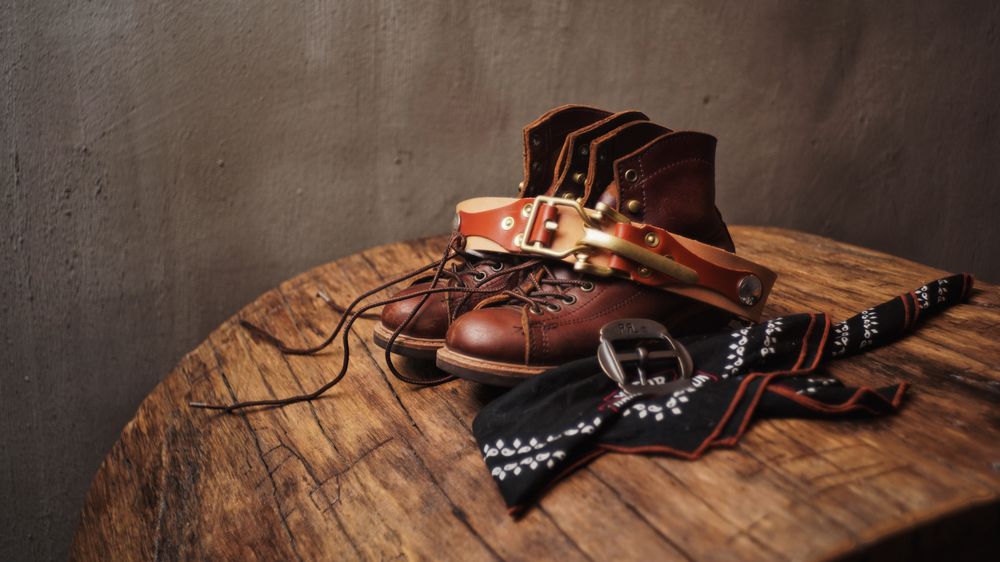
Steampunk boots are the foundation of an outfit in every sense. They are what you stand and walk in for hours, and they are the part of a costume that shows in every full-length photograph. A splendid coat, a good hat and a brass pocket watch can all be let down by a pair of modern trainers, and a plain outfit can be pulled together by a pair of good leather boots.
This guide explains why boots matter so much to the look, the main ways a boot fastens, the riding, military and work boots that give steampunk its characters, the spats and gaiters worn over them, boots for women, how to stay comfortable through a long day, and how to dress up a plain pair you already own. It names no makers or shops. Our guides to men's steampunk outfits and women's steampunk outfits show where boots fit in a whole outfit.
Why boots matter to the look
They finish the outline
A steampunk outfit is built from the top down, but people take it in from the feet up as often as the other way round. A long coat, a skirt looped up at the sides or breeches tucked in at the knee all lead the eye to the feet. If the feet are in modern shoes, the illusion of the nineteenth century stops there. Boots in brown or black leather, reaching above the ankle, carry the outfit all the way to the ground.
They tie in the leather and brass
Steampunk is a style of leather and metal: belts, straps, holsters, gauntlets and buckles. Boots are usually the largest piece of leather in an outfit, and brass buckles, eyelets or hooks on them repeat the metal of the goggles and the watch chain. A pair of boots in the same brown as the belts and gloves makes an outfit look planned rather than assembled.
They tell people who you are
The boot says a great deal about the character. Polished black lace-ups suggest a gentleman or a professional man. Tall riding boots suggest an aviator, an officer or an explorer. Heavy, scuffed work boots suggest an engineer or a stoker. Neat buttoned ankle boots with a small heel suggest a Victorian lady. Buckled boots with straps suggest a sky pirate or an adventurer. Choosing boots for a character, rather than wearing whatever is in the cupboard, is one of the quickest ways to make an outfit convincing.
They carry you through the day
Most steampunk gatherings in Britain involve a lot of standing and walking, often on grass, cobbles and old stairs, in weather that can change by the hour. A boot that looks perfect and hurts after an hour is the wrong boot. The section on comfort below matters as much as any of the styles.
Lace-up, button and buckle boots
A boot is held on the foot in one of a few ways, and each has its own history and its own look.
Lace-up boots: closed and open lacing
The two main kinds of lace-up are told apart by how the pieces holding the eyelets are sewn on. In closed lacing, the eyelet pieces are stitched under the front of the boot, so that they close neatly together. This is the lacing of the Oxford shoe, whose origin is unclear: one account traces it to the Oxonian, a half-boot with slits at the side that became popular at Oxford University around 1800; another links the name Balmoral, used for one form of it in the UK, to Prince Albert and his home at Balmoral Castle. Closed lacing looks smart, and suits a gentleman, a doctor or a detective.
In open lacing, the eyelet pieces are stitched on top of the front of the boot and can open wide, which makes the boot easier to put on and more adjustable. This is the lacing of the Derby and the blucher, named after the Prussian field marshal Gebhard Leberecht von Blücher, who had a boot made with side pieces lapped over the front to give his troops better footwear; the design was taken up by armies across Europe. Derbies became popular for sport and hunting in the 1850s and were worn in town by the turn of the twentieth century. Open lacing looks sturdier, and suits an explorer, an engineer or a soldier.
Button boots
Button boots fasten with a row of small buttons up the side. The V&A has a man's short boot of about 1851, in patent leather and snakeskin with a buttoned side fastening, and notes that side-buttoned boots were fashionable from the 1830s and were gradually adopted by women. Victorian women's boots were often made of stiff leather and buttoned tight, and the buttons were pulled through their holes with a buttonhook, a small metal hook on a handle. Between 1880 and the First World War boot buttons were found in nearly every household. A buttonhook is a good small prop to carry today, and a pair of button boots is one of the most Victorian things a steampunk can wear.
Buckle boots
Boots fastened with straps and buckles, often several up the shaft, are a steampunk favourite rather than a Victorian one. They look like equipment, they repeat the buckles of belts and harnesses, and they suit a sky pirate, an airship mechanic or an adventurer. Many modern buckle boots have a zip on the inside and buckles that are only for show, which makes them much easier to get on and off.
Elastic-sided boots
The V&A records that J. Sparkes-Hall patented the elastic-sided boot in 1837. Elastic gussets in the sides let the boot be pulled on with no laces or buttons at all. Our guide to men's outfits tells the story of this boot, now called the Chelsea boot, and it remains a neat, plain choice for a gentleman or a lady.
Riding, military and work boots
Riding boots
Tall riding boots, reaching to just below the knee, suit an aviator, a cavalry officer, an explorer and anyone in breeches. The Hessian boot was a light riding boot that reached the knee, with a decorative tassel at the top of each shaft and a V-shaped notch at the front. It was first worn by German soldiers in the eighteenth century, issued to light cavalry regiments, especially the hussars, and became popular in England in the Regency years of 1811 to 1820, when civilians wore it too, prized for its polished leather. A plain tall boot in brown or black leather does the same job today. Tuck breeches or narrow trousers inside it, and make sure you can bend the knee and climb a step in it.
Military boots
Military boots give steampunk its soldiers, officers and airship crews. The British and Commonwealth armies used a hobnailed boot, called the ammunition boot, from the 1860s. Hobnails are short nails with thick heads, set in a regular pattern over the sole to make it last longer and to grip on soft or rocky ground and snow, often with an iron plate on the heel and toe as well. They have one drawback that matters at modern events: they tend to slide on smooth, hard surfaces, such as stone floors and polished boards.
A modern ankle boot with a sturdy sole and open lacing, worn with puttees or gaiters, explained below, gives the look of an old military boot without the slipping. Brass or black eyelets and a high shine suit an officer, and a dull, scuffed finish suits a soldier in the field.
Work boots
Work boots suit the engineer, the stoker, the mechanic and the miner, the characters who keep the machines of steampunk running. They are heavy, laced, plain and well worn, in brown or black, and they look best a little scuffed. Hobnailed boots were long worn by workmen as well as soldiers. A modern work boot with a plain toe looks right once any bright logos are covered or blacked out. A pair with a protective toe cap is heavy for a long day but sensible if you will be building or carrying props.
Spats and gaiters
Spats and gaiters are coverings worn over a boot or shoe and the bottom of the leg. They began as practical protection against mud and wet, and they are now one of the smartest finishing touches in steampunk.
Spats
The word spats is short for spatterdashes. Spats cover the instep and the ankle and button round the ankle, and they were made of white cloth or grey or brown felt. They were worn by men, and less often by women, in the late nineteenth and early twentieth centuries, and fell out of everyday use in the 1920s, probably because dress became less formal. A pair of pale spats over plain black shoes makes a gentleman look very finished, and spats can turn a pair of ordinary shoes into something that looks like a Victorian boot.
Gaiters
Gaiters are longer: they cover the shoe and the bottom of the trouser leg, and some reach to the knee. From about 1700 many European infantrymen wore long linen gaiters, also called spatterdashes, over their stockings, and by the 1770s shorter ones reaching the middle of the calf were common. Military gaiters buttoned at the back, with a strap running under the foot to hold them down. Early gaiters were made of leather or canvas. In the Church of England, bishops and archdeacons wore black gaiters as everyday dress, buttoned up the sides and reaching to just below the knee. Leather or canvas gaiters suit a soldier, a gamekeeper, an explorer or a clergyman of your own invention.
Puttees
Puttees are long strips of cloth wound round the leg from the ankle to the knee. The word comes from the Hindi word for a bandage. They were adopted in the second half of the nineteenth century by soldiers serving in British India, and were in general use by the British Army with its khaki service uniform from 1902 until a new battledress came in in 1938. Puttees suit an explorer, a soldier or an aviator, and they are easy to make from long strips of wool or heavy cotton.
Wearing them
Choose spats or gaiters a shade lighter or darker than the boot or shoe, so that they show, and fasten them snugly enough that they do not twist round the leg as you walk. A strap under the sole holds them down. Check the strap before a long walk, because it takes the wear where the foot meets the ground.
Boots for women
The Victorian woman's boot
The V&A notes that ankle boots became fashionable for women around 1804, and the Victorian women's boots in its collection are laced, buttoned or elastic-sided. The museum has a pair of wedding boots made in 1865, of kid leather with elastic inner gussets and a silk rosette, worn at a wedding at St James's Church, Piccadilly, in February that year; the elastic did away with laces and buttons. Heels were coming back into fashion for women at the time. The V&A also has a pair of French boots of the 1860s or 1870s in yellow satin with black silk braid, small heels and black laces, and explains that fashionable silk and satin boots like these were imported into England from France in those decades, at a time when the shorter skirts made popular by the French Empress Eugénie drew attention to the feet.
Boots with skirts
With a long skirt, an ankle boot with a small heel is all that is needed, and it shows when the skirt moves. With a skirt looped up at the sides, a high-low skirt that is short at the front, or a skirt that stops above the ankle, the boot becomes part of the outfit and is worth choosing with care: laced or buttoned, in brown, black or a deep colour, perhaps with a contrasting toe. Our guide to steampunk dresses and skirts explains the skirts that show the boots best.
Boots with breeches and trousers
For an aviatrix, an explorer or a lady adventurer, tall boots with breeches tucked in, or lace-up ankle boots with gaiters, look practical and striking. Men's styles work very well on women here, and are often easier to walk in.
Heels
A small, solid heel of the kind the Victorians wore looks right and is comfortable for most people. A high, thin heel is hard work on grass, gravel and cobbles, and sinks into soft ground. If you love a higher heel, choose a thick one, and carry flat shoes for the walk between places. For a wedding, see our guide to a steampunk wedding.
Comfort on a long day
A steampunk day out can mean six or eight hours on your feet, and the boots decide how you feel at the end of it.
Wear them in
The NHS explains that blisters are mostly caused by friction, and that the way to avoid them is shoes that are comfortable and fit well, with new pairs broken in gradually. So wear new boots at home and on short walks for several weeks before a long event, a little longer each time, until they have softened where they bend.
Socks and insoles
The NHS also suggests thick socks for exercise, such as moisture-wicking sports socks, changed often if your feet sweat. Under a long skirt or trousers, nobody sees your socks, so wear the most comfortable pair you own and carry a spare. A cushioned insole, also invisible, makes a hard Victorian-style sole far kinder on a stone floor.
If a blister starts
Stop and deal with a sore spot as soon as you feel it rubbing. If a blister forms, the NHS advises covering it with a soft plaster or a padded dressing, not bursting it or peeling the skin, and keeping it clean; a pharmacist can suggest a dressing such as a hydrocolloid plaster, which may ease the pain. A few plasters in a pocket or a satchel are worth more than any prop.
The ground and the weather
Think about where you will be walking. Grass, mud and cobbles need a sole with grip and a low heel. A waterproofed leather boot copes with a wet field far better than a suede or fabric one. Old buildings mean stairs and stone floors, where smooth soles and hobnails slip. In summer, a heavy boot is hot, so a lighter ankle boot with spats can be the cooler choice.
Plan for the end of the day
A pair of plain comfortable shoes in a bag, left in the car or carried, means you can change for the journey home. Our guide to what to wear to your first steampunk event has more on planning a long day, and our guide to UK events explains when and where people gather.
Dressing up a plain pair
You do not need special steampunk boots. Most good steampunk boots began as plain leather boots, and a few changes turn a pair you already own, or a pair from a charity shop, into something that looks made for the part. Our guide to a steampunk costume on a budget explains where to look.
Laces and eyelets
Changing the laces is the simplest change of all. Thick waxed laces in brown, black or a deep red look older than thin modern ones, and leather laces look rugged. Lacing a boot straight across rather than in crosses gives a neater, more formal look.
Straps and buckles
A leather strap with a brass buckle fastened round the ankle or the top of the shaft gives any boot a working look. Two or three, one above the other, make a plain tall boot into a sky pirate's. Old belts cut to length make good straps; punch a hole for the buckle and finish the cut end neatly.
Spats and boot covers
Spats and gaiters are among the easiest things in steampunk to make. Cut two pieces of felt, canvas or wool to the shape of the instep and ankle, or longer for a gaiter, leaving enough to overlap at the side. Sew buttons down one edge and buttonholes or loops down the other, and add a strap of elastic or leather to go under the sole. A pair of covers like this can make a modern shoe or a plain boot look entirely Victorian.
Colour and finish
Polish changes a boot more than people expect. A dark polish rubbed into a tan boot and buffed gives an old, mellow colour; a high shine suits an officer; a dull, scuffed finish suits a working character. Leather dyes and paints can change the colour altogether. Dyes, paints and glues give off vapours as they dry, and the Health and Safety Executive says ventilation is always needed, so work outdoors or in a room with the windows open, wear gloves, and test on a hidden spot first.
Small details
A small brass gear or a buckle fixed to the side of the ankle, a contrasting toe cap painted on, or brass rivets along a strap all add character. Keep decorations off the parts of the boot that bend and off the inside of the ankle, where they will rub against the other boot as you walk. For the gauntlets, belts and other pieces that finish an outfit from the boots upwards, see our guide to the finishing touches.