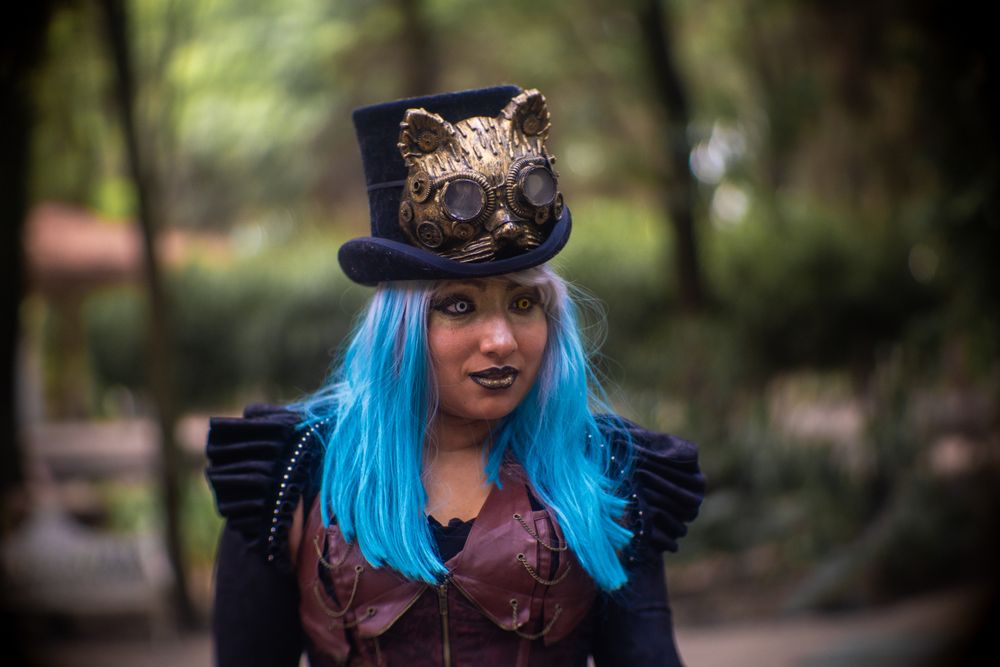
Steampunk goggles are the piece most people picture when they hear the word steampunk: two round brass eyepieces, a leather strap, perhaps a tinted lens, resting on the brim of a top hat. Imaginary airship pilots, engineers and explorers wear them, and so do the people who dress as those characters at real gatherings. A steampunk goggles hat, or a hat and goggles worn together, is one of the quickest ways to make an outfit read as steampunk from across a room.
The real goggles behind them go back further than many people think, and that is where this guide begins. For the way goggles fit into a whole outfit, see our complete guide to steampunk fashion.
What steampunk goggles are, and where they came from
In steampunk, goggles are a sign that the wearer does something: flies, drives, welds, experiments or explores. Steampunk is the Victorian age imagined with its machines left on show, and goggles belong to that idea because they are working equipment, made to guard the eyes against wind, glare, sparks or dust. A pair on the hat says that the wearer has just come down from somewhere high, or is about to go back up.
Older than the aeroplane
People protected their eyes long before the Victorians. The Inuit and Yupik peoples of the Arctic made snow goggles to prevent snow blindness, carving them from driftwood, bone, walrus ivory or caribou antler, with narrow slits to see through and a strap of sinew, leather or rawhide to hold them on. One pair of antler goggles from Alaska is dated to between the years 1000 and 1800.
The Victorians had goggles too. The Science Museum Group holds a pair of leather goggles with tinted glass lenses and two veils of silk mesh, made in England between 1850 and 1875, which belonged to a ship's carpenter on the Nares expedition to the Arctic in 1875. Royal Museums Greenwich holds another pair used on the same expedition, with tinted lenses set in black wire and a tortoiseshell frame with folding arms, which belonged to Lieutenant A. A. C. Parr of HMS Alert. The Science Museum Group also holds a leather mask with glass eyepieces that was apparently worn by guards on the Hull and Selby Railway, a line that opened in 1840, though the museum gives no date for the mask itself.
So goggles with a Victorian outfit are closer to history than is sometimes said.
The goggles of the first flyers and drivers
The goggles most steampunk pairs copy came a little later. In the early twentieth century, drivers of open cars wore goggles to keep dust and wind out of their eyes. The first pilot to wear goggles was probably Charles Manly, during his failed attempt in 1903 to fly Samuel Langley's aircraft, known as the aerodrome. Within about ten years of the invention of the aeroplane, goggles had become a necessity for pilots, because aircraft were growing faster and the wind stronger. Those flying goggles, with round lenses in a padded frame, are the shape most people now picture.
How they became the badge of steampunk
Goggles join the two halves of steampunk: the Victorian love of brass, glass and leather, and the sense of adventure in an age of airships that never quite came. Our guide to steampunk airships explains why the imaginary pilots who wear them matter so much to the style.
The parts: lenses, frames, straps and fittings
Every pair of goggles, real or costume, is made of the same few parts. Knowing what each one does makes it easier to choose a pair, or to make one, and to tell a pair that looks like equipment from a pair that looks like a toy.
Lenses
The lens is the glass or plastic you look through. Costume goggles come with clear, smoked, amber, green, blue or red lenses, and some have no lenses at all, only a disc of metal or mesh. Smoked and amber lenses look most like old working goggles. Coloured lenses are striking, but they darken everything you see, which matters later in this guide. Some steampunk goggles have extra lenses on hinges or small arms, so that a magnifier or a coloured filter can be swung down in front of the main lens.
Frames and eyepieces
The eyepiece is the cup that holds each lens and stands out from the face. In steampunk it is usually round and made of brass, copper or plastic painted to look like metal, often with rivets, screws or a ridged rim. A convincing eyepiece is deep enough to look like a real fitting, and has a soft edge of leather or foam where it meets the skin. The two eyepieces are joined by a bridge over the nose, which may be a strip of leather, a short chain or a metal piece that can be adjusted.
Straps
The strap holds the goggles on and runs round the back of the head, or round the crown of a hat. Leather straps with a buckle look right and can be adjusted. Elastic straps are more comfortable and easier to put on, and many good pairs use elastic covered in leather or fabric so that it looks like leather from a distance. The strap is usually the first part to wear out, so it is worth looking at how it is fixed to the eyepieces before you buy or make a pair.
Fittings
Fittings are the extras: side shields of mesh or leather, rivets, a tiny gauge, a cog on the bridge. One or two look purposeful; a dozen look crowded, and the extra weight pulls the goggles down the hat.
Round, welder's, aviator and jeweller's goggles
Steampunk goggles come in four main kinds, each borrowed from a different job. Choosing the kind that suits your character makes the whole outfit more convincing, because the goggles then tell the same story as the rest of the clothes.
Round goggles
Round goggles are the plain, all-purpose kind: two round eyepieces, a bridge and a simple strap. They suit almost anyone, from an inventor to a lady adventurer, and they are the easiest kind to wear on a hat because they sit flat against the crown. The Victorian snow goggles described above, with their tinted glass and leather, are close cousins.
Welder's goggles
Welder's goggles are deeper and heavier, with round eyepieces, dark lenses and often a front that flips up. They copy the goggles used in gas welding, the method of joining metal with a flame of oxygen and acetylene, which the French engineers Edmond Fouché and Charles Picard first developed in 1903. In steampunk they suit an engineer, a mechanic or a stoker, anyone who works with heat and metal. Real welding needs real protection, matched to the job: goggles made for a blowtorch flame are not the correct filters for arc welding, which uses an electric arc. Costume welder's goggles protect against none of it.
Aviator goggles
Aviator goggles copy the flying goggles of the early twentieth century. They usually have a padded frame, larger lenses and a wide strap made to go over a leather flying cap. They suit airship pilots, sky pirates and aviators, and they look most at home pushed up on a flying cap or a short top hat, as if the wearer has just climbed out of an open cockpit.
Jeweller's goggles
Jeweller's goggles are the most elaborate kind. They borrow from the tools of close work: jewellers and watchmakers use a small magnifier called a loupe to inspect stones, hallmarks and the movements of watches, and there are also magnifiers worn on a headband with a lens in front of each eye. Steampunk versions often have several lenses of different sizes on hinged arms, so that one or two can be swung in front of an eye. They suit a scientist, a clockmaker, an inventor or a surgeon. Their lenses stick out and catch on things, so keep them up on the hat while you move about.
Tinted round spectacles give a similar look in a much lighter form, and are far easier to see through. Our guide to steampunk glasses and sunglasses covers them.
Wearing them: on the hat, round the neck or over the eyes
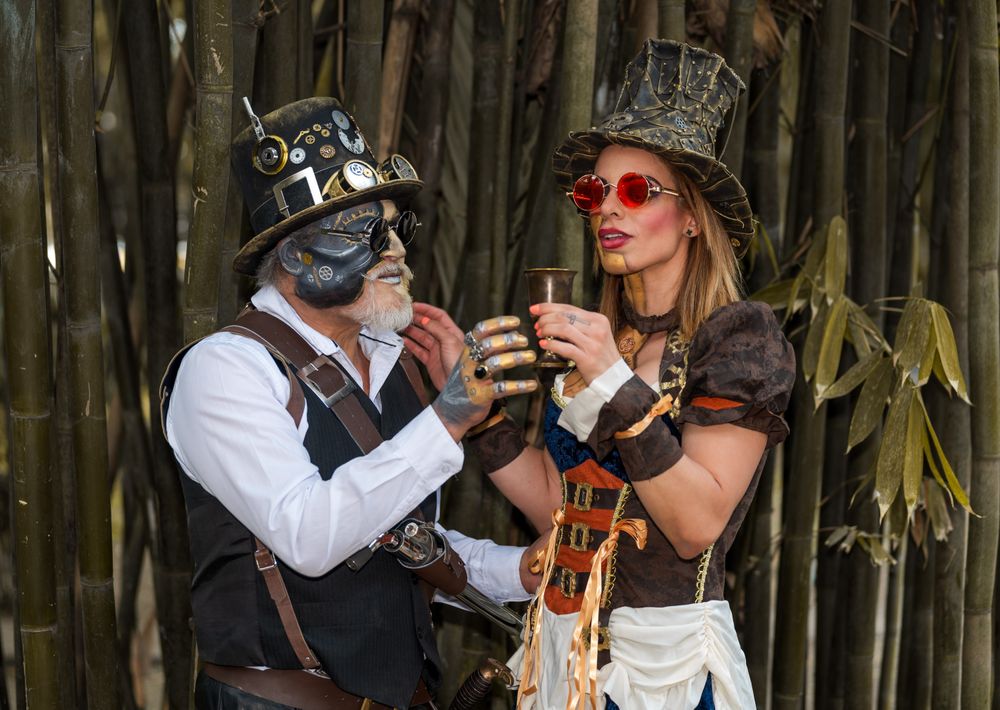
Most steampunks wear their goggles over their eyes only for a photograph, if at all. Each of the usual places says something slightly different about a character.
On the hat
Goggles on the brim of a top hat, or round the crown just above the brim, make the classic steampunk hat and goggles. They tell people the wearer flies or works with machines, without hiding the face. To fit them, run the strap round the crown and pull it snug, so that the eyepieces sit on the front of the brim or just above it. A strap that is too loose lets the goggles slide down over the eyes or slip off the back. On a smaller hat, a few stitches of thread through the strap, or a safety pin hidden behind the hat band, keep them where they belong. Our guide to steampunk hats and top hats covers the hats themselves.
Round the neck
Goggles round the neck suggest someone who has just landed or just finished a shift. It is the most comfortable place for a long day, and it suits characters who wear no hat, or only a flying cap. Make sure the strap is loose enough not to press on the throat, and that it can be lifted off quickly over the head.
Over the eyes
Goggles over the eyes look dramatic in photographs, but few people wear them that way for long. Most costume goggles narrow the view to the sides and below, they can mist up, and tinted lenses darken everything. Pull them down for the photograph and push them back up afterwards.
Seeing through them safely
Costume goggles are not eye protection
The most important point comes first. Costume goggles, however solid they look, are not made or tested to protect the eyes. Their lenses may be thin plastic that can crack, and their frames are not designed to stop anything flying into the eye. Never wear them in place of real eye protection.
For any real workshop job, such as cutting, drilling, grinding, sanding or working with chemicals, wear eye protection made for that job. The Health and Safety Executive's guidance on protective equipment names the hazards to the eyes as chemical or metal splash, dust, projectiles, gas and vapour, and radiation. It lists safety spectacles, goggles, face screens, face shields and visors as the choices, and says the protection should give the right combination of protection for the hazards, suit the task, and fit the person wearing it properly. Its welding guidance adds that welders need filters that meet the relevant standards, and goggles when chipping slag or brushing welds. A pair of real safety goggles can sit on the bench beside the costume pair; only one of them belongs over your eyes while the drill is running.
Tinted lenses in the dark
Smoked, amber, green and red lenses all cut the light reaching your eyes. That is pleasant on a bright afternoon and risky indoors, at dusk or at an evening event, when you may not see a step, a kerb, a trailing cable or a small child. The Highway Code tells drivers not to use tinted glasses, lenses or visors at night or in poor visibility if they restrict vision, and the same good sense applies on foot. After dark, push the goggles up, or wear a pair with clear lenses.
Never drive in costume goggles of any kind: even with clear lenses, the eyepieces block the view to the sides.
Stairs, crowds and the edges of your view
Round eyepieces cut off the edges of what you see, especially below. On stairs you need to see your feet and the edge of each step, so push your goggles up before you go up or down, and hold the handrail, above all if you are also wearing a long skirt or a long coat. In a crowd, narrowed vision makes it easy to walk into someone or to miss a step. Goggles with lenses on arms stick out further than you think, so turn your head slowly.
Most costume goggles will not fit over ordinary glasses, so if you wear glasses, the hat is the place for your goggles.
Children
Children love goggles. Keep a child's goggles on a hat or round the neck, check that the strap comes off easily, and do not give goggles with small screws, rivets or loose fittings to very young children, who may put small parts in their mouths. For masks, the Chartered Trading Standards Institute suggests face paint instead, so that children can see where they are going, and the same thinking applies to goggles over the eyes. Our guide to steampunk for Halloween has more on children's costumes.
Making or dressing up a plain pair
Goggles are among the easiest steampunk pieces to make or improve. A plain pair can be turned into a steampunk pair in an afternoon, and a pair made from scratch costs very little. Our guide to a steampunk costume on a budget gives the simplest version, from jar lids and plastic packaging; this section goes a step further.
Starting from a plain pair
Plain, cheap fancy dress goggles make a good base, because they already have a strap and a shape that fits a face. Take off the strap first, then work through these changes:
- Paint the frame. Paint the plastic black or dark brown, let it dry, then brush brass, copper or bronze paint lightly over the raised edges with an almost dry brush, so the dark colour stays in the hollows. It looks like metal that has been handled for years. Cover the lenses with tape before you start.
- Add rims. A ring of thin leather, craft foam or cord glued round each eyepiece makes it look deeper and more solid.
- Change the strap. Replace a thin elastic strap with a strip of leather cut from an old belt, with its buckle, or slide the elastic inside a tube of leather or fabric.
- Add a fitting or two. A few rivets, a small cog on the bridge, or a side shield of fine mesh. Stop before it looks crowded.
- Change the lens colour. Thin coloured film cut to fit behind clear lenses turns them amber, green or smoke. Remember what tinted lenses do after dark.
Once a pair of goggles has been painted, drilled or altered, it is a costume piece, whatever it started life as. Never use it for real work afterwards.
Safety while making
- Wear real eye protection while you cut, drill or file anything for your costume goggles. It is the job the costume pair cannot do.
- Craft knives. The Health and Safety Executive's advice on hand knives recommends knives with retractable blades where possible, and names cutting away from the body, and the dangers of blunt knives, among the things every user should be taught. Cut on a board, away from your body, and change blades often.
- Paint and glue. Solvent paints and glues give off fumes that can cause headaches, nausea and dizziness, and the Health and Safety Executive says ventilation is always needed when they are used; for lower-risk products, open doors and windows may be enough. Work outdoors or by an open window, and follow the instructions on the tin.
- Edges. Cut metal, mesh and hard plastic can be sharp. File or sand every edge smooth, especially anything that will sit near the eyes or against the skin.
For bigger projects, see our guide to making steampunk props safely.
Looking after brass and leather
Good goggles last for years if they are looked after. Museum conservators, whose job is caring for old objects, have written a great deal about brass and leather. Their advice is for museum pieces, but the reasons behind it apply to any brass and any leather.
Brass and copper
Brass darkens, or tarnishes, over time, and handling speeds it up. The Canadian Conservation Institute, which advises museums, explains that bare fingers leave moisture, corrosive salts and oils on clean metal. Wiping goggles with a soft dry cloth after each wear removes most of that. A green or bluish-green deposit on brass or copper is often verdigris, a group of copper salts that forms on copper, bronze and brass; wipe it off, and keep the goggles dry.
Think before polishing. The institute warns that polishing is abrasive: it removes tarnish and some surface metal with it, and repeated polishing wears away fine detail. It also warns that some metal polishes contain very hard particles that can scratch the softer copper alloys, and that many contain ammonia. For steampunk goggles, a little darkening in the hollows looks better than a mirror shine anyway, so polish only the raised edges, gently, and only when they need it. A thin coat of wax, buffed off, gives some protection against both the air and handling, the institute says. Many costume goggles are not brass at all but painted plastic or plated metal, and on those any polish will take off the finish, so use only a dry cloth.
Leather
Leather straps and eyepiece pads take the most wear, because they touch skin, sweat and rain. The same institute warns that most leathers are damaged by direct contact with water, and that some kinds may shrink, stiffen or stain. Keep straps out of the rain where you can, and if they do get wet, blot them with a towel and let them dry slowly at room temperature. It also advises against oil-based dressings on museum leather, because in time the oils oxidise and can stiffen and darken the leather and attract dust, and against saddle soap, which is alkaline while leather is naturally acidic. For a costume strap, a wipe with a barely damp cloth is usually all it needs.
Where brass meets leather
Metal and leather in contact for a long time can harm each other: the institute warns that metal touching leather can cause staining and corrosion. That is exactly how goggles are made, so the places where the strap meets the eyepieces are the ones to check. A green mark on the leather there is a sign to clean and dry both parts.
Storing them
Store goggles somewhere dry, in a cloth bag or a box, not crushed under other things. Damp harms both materials: the institute says mould can grow on leather once the relative humidity of the air rises above 65 per cent, so a damp loft, garage or car boot is a poor home for them. Keep them out of strong sunlight, which fades leather and makes it brittle. Store them with the strap slack, not stretched round a hat for months, so that any elastic keeps its spring. Kept like that, a pair will be ready for the next event and the one after. For where people gather to wear them, see our guide to UK events.