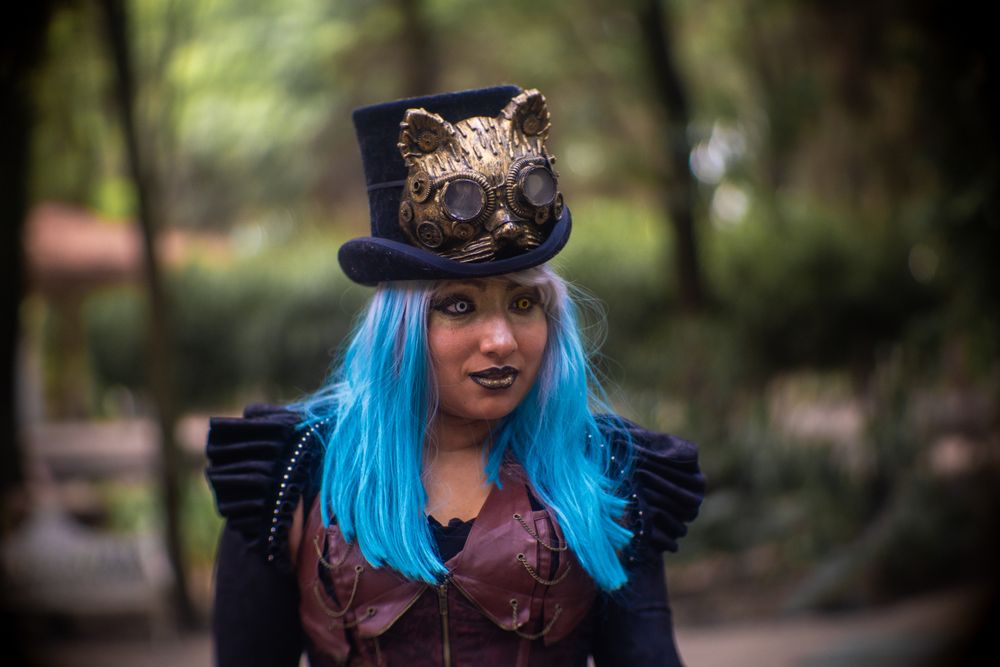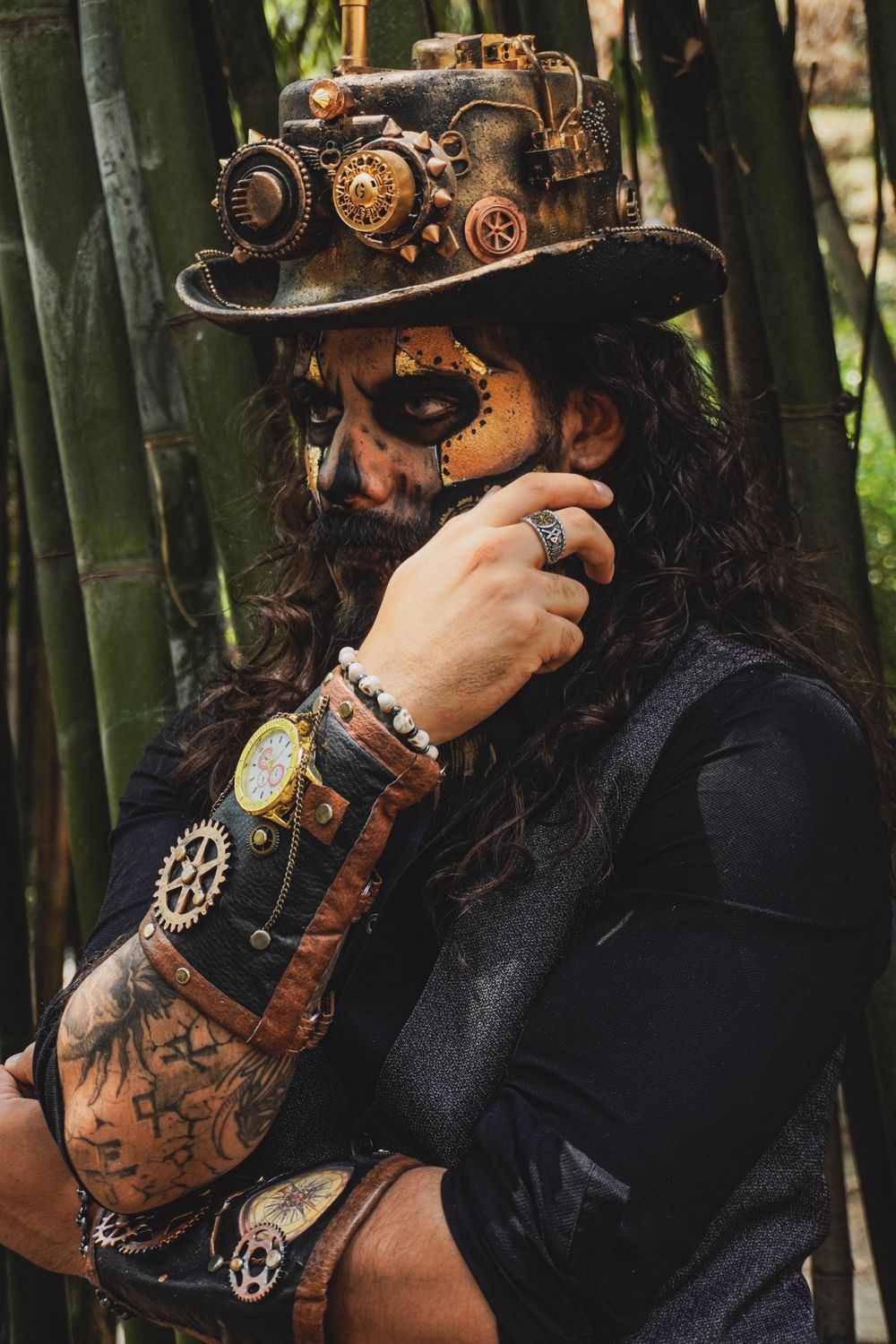
Steampunk jewellery is the smallest part of a steampunk outfit and often the part people look at longest. A brooch made from the wheels of an old watch, a key on a chain, a locket at the throat or a ring shaped like a serpent can say more about a character than a whole coat. In America the word is spelt jewelry, so steampunk jewelry is the same thing under another spelling.
This guide explains what makes a piece of jewellery steampunk, the gears, keys and watch parts it is made from, each kind of jewellery in turn, the real Victorian jewellery it borrows from, the metals and how to look after them, and how to make your own without putting yourself or a child at risk. It names no makers or shops. Our guide to steampunk fashion shows where jewellery fits in a whole outfit.
What makes jewellery steampunk
Steampunk is the Victorian age imagined with its machines left on show, and its jewellery follows the same idea. Two kinds of piece meet in it. The first is the working part: a gear, a key, a spring, a dial, a rivet or a valve, taken out of a machine and worn as an ornament. The second is the Victorian keepsake: a locket, a cameo, a jet brooch, a watch chain or a mourning ring, the jewellery real people wore in the nineteenth century. The best steampunk pieces bring the two together, so that a cameo sits in a frame of tiny cogs, or a locket opens to show clockwork instead of a photograph.
The materials
The metals are warm ones: brass, copper, bronze and gilt, with silver, steel and blackened metal for a darker look. Leather appears as cords and cuffs, glass as small domes over a dial, and stones are usually dark or deep in colour rather than bright.
The story behind it
A good piece looks as though it has a use or a history. A pendant that looks like a gauge suits an engineer, a compass on a chain an explorer, and a small key someone with a secret. Choosing jewellery for a character, rather than for the look alone, is what keeps a steampunk outfit from looking like a costume shop's.
Less is more
One strong piece at the throat, one at the wrist and perhaps a ring is plenty. Six gear brooches pinned across a waistcoat look like a market stall.
Gears, keys and watch parts
Gears and cogs
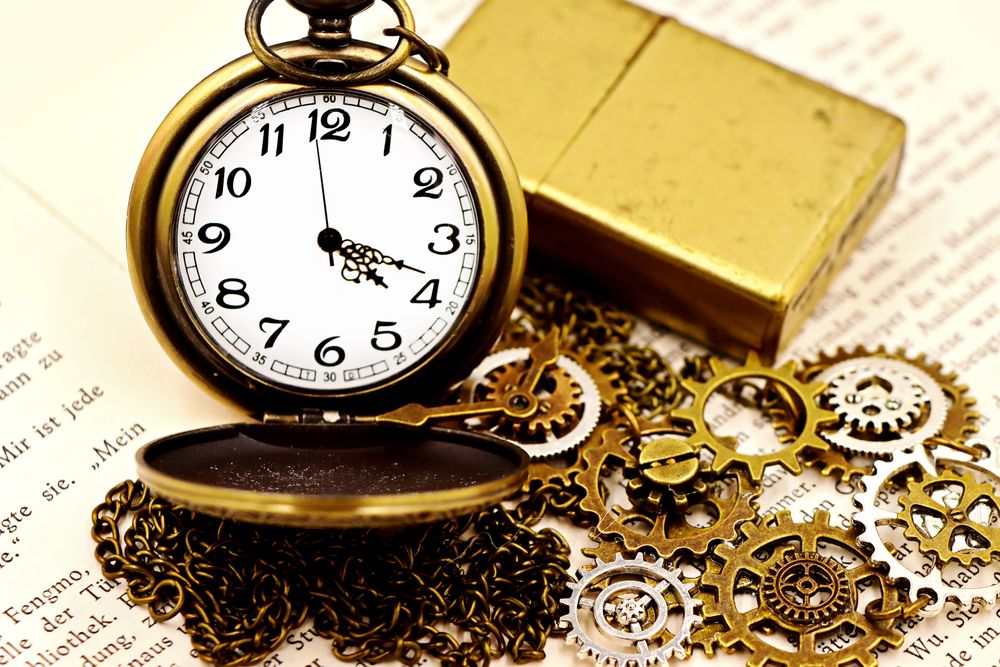
The gear is the symbol of steampunk, and gear jewellery is everywhere: single cogs as pendants, clusters as brooches, small ones as earrings and cufflinks. Gears look best layered, a large one behind and a smaller one in front, slightly turned, so that the teeth catch the light at different angles, or meshed together as though they could still turn. Our guide to cogs, gears and machines explains what real gears do, which helps in arranging them convincingly.
Watch parts
The inside of an old mechanical watch is a tray of tiny, beautiful parts: wheels with fine teeth, springs, bridges, screws and the round plate the movement is built on. Jewellers who work in steampunk set these under small glass domes, fix them into rings and cufflinks, or use a whole movement as the centre of a pendant. A watch movement in a pendant, with the balance wheel showing, is one of the most recognisable steampunk pieces of all. Our guide to steampunk watches and pocket watches explains the parts and what each one does.
Keys
Keys are the other great steampunk ornament, and the Victorian age was a great age of locks. Joseph Bramah patented his lock in London in 1784, and from 1790 his shop window carried a challenge offering 200 guineas to anyone who could pick or open it. No one claimed the prize until the Great Exhibition of 1851, when the American locksmith Alfred Charles Hobbs opened it after about 51 hours of work spread over 16 days. A key worn on a chain carries something of that story of secrets and security.
The old keys most often used in jewellery are long, with a round bow at the top and a short, shaped bit at the end. A skeleton key, in the strict sense, is a key with most of the middle of its bit cut away so that it can pass the wards, the fixed obstacles inside a warded lock, and open several locks rather than one. Any old key with a round bow looks right on a long chain, a bracelet or a brooch.
Other parts
Small springs make earrings, rivets make studs, and compass roses, propellers, anchors and insects with clockwork wings are all common designs.
Necklaces and pendants
A necklace sits where everyone looks first, so it is the best place for the main piece of jewellery in an outfit.
The pendant on a chain
A single pendant on a chain suits almost every character: a gear, a key, a compass, a small gauge, a watch movement under glass or a locket. Brass, bronze and antique-finish chains suit the warm metals; a fine dark chain suits a gothic outfit. A long chain sits well over a corset, and a short one against a high collar.
Lockets
A locket is a pendant that opens to show a space for a photograph or another small keepsake, usually worn on a chain and often made of gold or silver. Lockets were common in the Victorian age. Around 1860 lockets began to replace mourning rings as the favoured kind of mourning jewellery, and some had a glass pane at the front, so that a lock of hair inside could be seen without opening the locket and losing it. The V&A has a mourning locket made in Britain in 1871, of gold, black and white onyx and diamonds set in silver, with glazed compartments inside holding hair; the museum notes that lockets were at the height of their popularity from the 1860s to the 1880s, and that they could mark a wedding as well as a death.
In steampunk, a locket can hold a photograph of a character's lost love, a tiny map or a scrap of an invention's plans.
Chokers and collars
A velvet or lace choker, worn close round the neck with a cameo, a gear or a small key at the front, suits a Victorian lady or a gothic character. A leather collar with brass fittings suits an aviator or a sky pirate.
Brooches, pins and cufflinks
Brooches
A brooch is the easiest piece of steampunk jewellery to wear, because it pins onto anything: a lapel, a cravat, a hat band, a collar or the strap of a corset. A gear brooch at the throat of a high-necked blouse is a classic women's look, and a small brooch on the lapel of a frock coat suits a man just as well. Cameo and jet brooches, explained below, are the Victorian versions, and a brooch that sets a cameo against a ring of small gears is steampunk at its best.
Tie pins and stick pins
Tie pins were first worn by English gentlemen at the beginning of the nineteenth century, to hold the folds of their cravats in place. By the 1870s they were being made in quantity, in designs such as animal heads and horseshoes, and by the 1890s women had begun to wear stick pins too, with their sporting clothes. A pin with a small gear, a skull, an insect or a single dark stone, pushed through a cravat, is the simplest piece of jewellery a steampunk gentleman can wear.
Cufflinks
Cufflinks first appeared in the 1600s but became common only at the end of the eighteenth century. By the middle of the nineteenth they were in fashion with middle-class and upper-class men, because the stiffer, starched cuffs of the time were hard to close with simple buttons, and the factories of the industrial age made them in every price range. The traditional kind joins two round discs with a short chain. Cufflinks made from watch parts or small gears under glass suit a steampunk shirt with turned-back cuffs, and they are a good piece of jewellery for a groom.
Rings, earrings and bracelets
Rings
Steampunk rings are often bold: a watch movement under a glass dome, a single large gear, a small working compass, or a band made to look riveted. The serpent ring is a Victorian favourite that suits the style very well. The V&A notes that Queen Victoria wore a serpent bracelet to her first council meeting in 1837 and was given a serpent and emerald engagement ring by Prince Albert, and that the serpent was at its most fashionable in jewellery in the 1840s. A snake swallowing its own tail, called the ouroboros, stood for eternity, which is why it appeared on love tokens and on mourning jewellery alike. For rings at a wedding, see our guide to a steampunk wedding.
Earrings
Drop earrings, which hang below the lobe, suit the Victorian line, especially with hair worn up. Small gears, keys, tiny lockets, jet drops and springs all make good earrings. Keep them light, because brass is heavier than it looks. Clip-on earrings are a good choice for anyone without pierced ears.
Bracelets and cuffs
A bracelet can be delicate, such as a fine chain with a single charm or a serpent coiled round the wrist, or it can be a wide leather cuff with brass fittings, a gauge or a watch set into it. The leather cuff suits an aviator or an engineer, and sits well beside a gauntlet. A charm bracelet with a key, a gear and a compass tells a character's story on one wrist.
Cut steel, the Victorian sparkle
One kind of old jewellery is almost steampunk already. Cut steel jewellery was made from steel studs riveted or screwed closely together onto a plate, each one polished so that it caught the light and sparkled like the diamonds that were so fashionable. It was being made in Woodstock in Oxfordshire from around 1720, and later in Birmingham, where Matthew Boulton was a leading maker, and it stayed popular until the end of the 1930s. A buckle, a brooch or a bracelet in cut steel is Victorian, sparkling and made of polished machine-age metal all at once.
Victorian jewellery it borrows from: jet, cameos and lockets
Much of what makes steampunk jewellery look Victorian comes from three kinds of real nineteenth-century jewellery. Jewellery historians often divide Victoria's reign of 1837 to 1901 into three periods: a Romantic period to about 1861, full of gold and natural shapes such as flowers and serpents; a Grand period to about 1885, bolder, with jet and other dark materials; and an Aesthetic period to the end of the reign, with soft colours and shapes such as butterflies and roses.
Jet
Jet is a black gemstone made from fossilised driftwood that has soaked up bitumen from the rock around it. The jet of Whitby, on the Yorkshire coast, dates from about 183 million years ago, and the V&A notes that it has been dug from the shale near Whitby since at least Roman times. After Prince Albert died in 1861, Queen Victoria wore mourning for the rest of her life, and her mourning dress included Whitby jet. Whitby Museum says that at the height of the Victorian trade, between 1860 and 1880, there were over 200 jet factories in the town employing about 1,500 people, supplied by 300 mines, and the trade began to decline in the 1880s.
The V&A notes that the stages of mourning could even be shown by how highly the jet was polished. Because real jet was in such demand, many other materials were passed off as it: black glass, known as French jet, and vulcanite, a hardened rubber, among them. Whitby Museum counts between 20 and 30 different materials sold as Whitby jet over the years. Real jet feels warm to the touch, unlike glass, which feels cool. A jet brooch is Victorian, gothic and, with a small brass gear beside it, steampunk all at once. Our guide to steampunk, gothic and Victorian explains where the three styles meet.

Cameos
A cameo is a carving in raised relief, usually a head in profile, cut so that the picture stands out from a background of a different colour. Its opposite, a picture cut into the surface, is called an intaglio. Ancient cameos were cut from stones such as onyx and agate, whose layers of colour give the pale figure on a dark ground. The Victorians saw a great revival of shell cameos, carved from conch and helmet shells, and after 1850 they became popular souvenirs of the Grand Tour, the long journey round Europe that many well-off travellers made. Torre del Greco, near Naples in Italy, is still the world centre of shell cameo carving.
Lockets and hair jewellery
Lockets, as described above, often held hair. The V&A explains that throughout the Victorian period there were hair artists who turned locks of hair into jewellery, chosen from printed catalogues of designs, with a promise that the hair would not be mixed up with anyone else's. Not all of it was for mourning: hair jewellery was also given as a keepsake of love and friendship. Our guide to Victorian mourning dress explains the rules that this jewellery followed.
Metals, and looking after them
Brass, copper and bronze
Brass is an alloy of copper and zinc, usually about two parts copper to one of zinc. Bronze is copper mixed with tin instead. Both, and copper itself, have the warm golden or reddish colour that steampunk loves. They also change with time. Brass corrodes in the presence of moisture and some acids, and copper reacts with sulphur in the air to form a dark layer that can later turn into a green-blue coating of copper carbonate, called a patina. Some people like that old look and leave it. If you prefer it bright, a soft cloth after wearing keeps it shining longer.
Silver
Silver tarnishes, darkening over time, mainly because it reacts with hydrogen sulphide, a sulphur gas in the air. The tarnish forms a thin layer on the surface and stops there, so it can be cleaned off. A soft silver cloth deals with light tarnish. Store silver in a closed bag or box, away from the air, and it tarnishes much more slowly.
Gold, silver and the hallmark
In the UK, anything sold as gold, silver, platinum or palladium must carry a legally recognised hallmark if it weighs more than a set amount: 1 gram for gold and 7.78 grams for silver. A hallmark is a set of small marks struck by an Assay Office: a sponsor's or maker's mark, a mark for the metal and its purity, and the Assay Office's own mark, sometimes with a date letter too. So a piece described as silver-coloured, silver-tone or antique silver finish is usually not silver at all, which is fine for a costume, as long as you know what you are buying.
Skin and metal
Some people react to metals in cheap jewellery. The NHS lists some metals, including nickel, among the things that can cause allergic contact dermatitis, an itchy rash on the skin that touched the cause. If your skin reacts to a piece, stop wearing it.
Everyday care
- Put jewellery on last, after perfume, hairspray and make-up, and take it off first.
- Take it off before washing, swimming or a shower. Water spots brass and loosens glue.
- Wipe it with a soft, dry cloth after wearing.
- Store each piece in its own pouch or a lined box, so the gears and keys do not scratch each other and the chains do not tangle.
Making your own
Steampunk jewellery is one of the easiest things in the style to make at home. Our guide to a steampunk costume on a budget has more ideas for finding the parts.
What you need
- Findings, the small metal fittings jewellers use: jump rings, the little rings that join one part to another; bails, the loops that hang a pendant from a chain; brooch backs; earring hooks; and blank rings and cufflinks with a flat pad to glue onto.
- Two pairs of small pliers, ideally flat-nosed, to open and close jump rings.
- Glue made for metal, or a two-part glue.
- Parts: gears, keys, watch parts, buttons, chain and beads.
Three simple pieces
A key pendant. Thread an old key onto a jump ring, add a small gear on a second jump ring beside it, and hang both from a chain. Open a jump ring by twisting the ends sideways, one towards you and one away, never by pulling them apart, so it closes neatly again.
A gear brooch. Glue two or three gears of different sizes onto a brooch back, the largest at the bottom, slightly overlapping, with a bead or a small stone in the middle. Let it set overnight.
Working safely
Glues and paints give off vapours as they dry, and the Health and Safety Executive says ventilation is always needed when working with them, so work in a room with the windows open, and keep glue off the skin. Wear something to protect your eyes when cutting or snipping metal, because small pieces fly.
Never take apart a watch or clock with luminous numbers or hands made before the 1970s. Their paint may contain radium, which has a half-life of about 1,600 years, so it is still radioactive today. An intact dial is usually low risk, but taking one apart can free flakes of paint that can be breathed in or swallowed. Take gears only from watches and clocks without luminous dials, as our guides to watches and to a costume on a budget also say.
Small parts, button batteries and children
Gears, jump rings, beads and watch parts are exactly the size a small child puts in their mouth, so keep them in a closed box, out of reach, and clear the table when you finish. Take particular care with any piece that lights up. Button batteries, the small flat round batteries in watches and in light-up jewellery, react with saliva to make caustic soda, and if one sticks in a child's food pipe it can burn a hole, cause internal bleeding and kill. The government's advice is to store spare button batteries securely out of children's reach, to keep anything whose battery compartment is not secured by a screw away from small children, to recycle used ones promptly because a flat battery can still badly hurt a small child, and, if you think a child has swallowed one, to take them straight to A&E or call 999, even if there are no symptoms, without letting them eat or drink or making them sick.
At gatherings such as the one in our guide to the Whitby Steampunk Weekend, home-made pieces are often the ones people ask about.