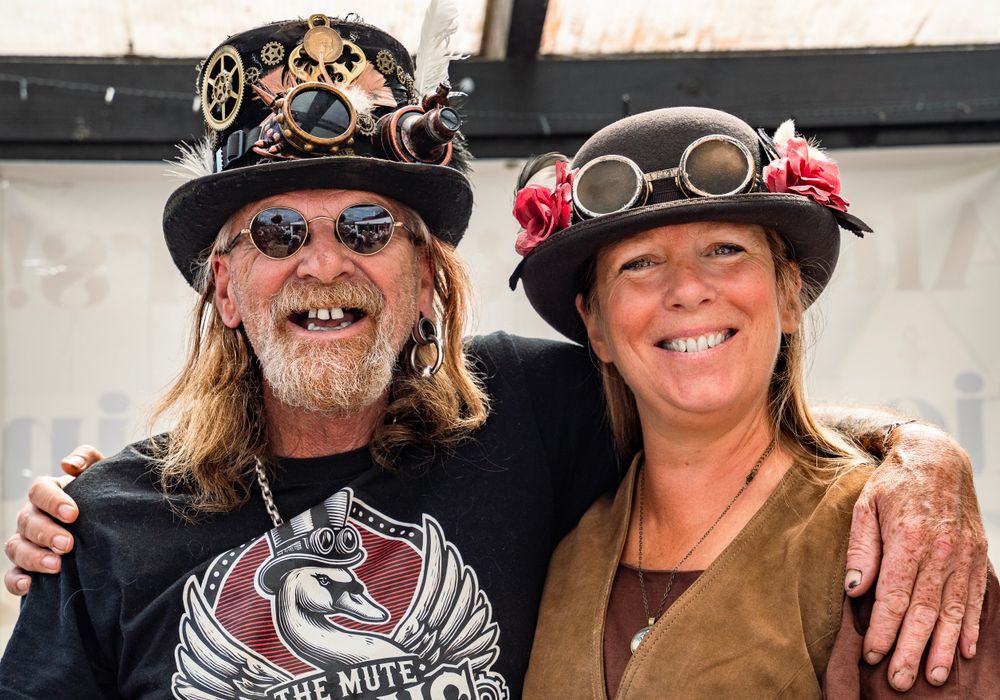
Steampunk music is music made by people who love the style, and it sounds as varied as they do: folk tunes on accordion and violin, cabaret songs, dark electronic music, loud punk and English hip-hop about tea and moustaches. What the bands share is a story. They dress as Victorian adventurers, airship pirates or clockwork robots, and their songs belong to an imagined nineteenth century. Many people find the style through the steampunk giraffe band, the American group Steam Powered Giraffe, whose members perform as singing robots.
This guide explains what steampunk music sounds like and the instruments and sounds it borrows, then goes through bands that call themselves steampunk and Steam Powered Giraffe in particular. It looks at Victorian music hall, the real popular music of the period, and at music at steampunk events, and ends with how to put together a steampunk playlist. We name bands only where a good source describes them as steampunk, and we say nothing about tours, tickets or where to listen.
What steampunk music sounds like
A look and a story more than a sound
There is no single steampunk sound, as there is a single sound of, say, a brass band. The Steampunk article on Wikipedia lists musicians as different as a dark wave band, a hip-hop artist, a punk band and a progressive rock group. What makes them steampunk is that they take the look and the story seriously: the costumes on stage, the characters the musicians play, the songs about airships, inventors, explorers and machines.
Old styles with modern energy
Even so, some styles turn up again and again. Folk music, with fiddles and accordions, suits songs of travel and the sea. Cabaret and vaudeville, the variety show of American theatres, suits stage characters and comic songs. Dark wave and industrial music, with their heavy electronic sounds, suit songs about factories and machines. Many bands mix several of these with modern rock, so that an old-sounding tune is played with an electric guitar and drums. Abney Park, one of the best known steampunk bands, has described its own style as a mix of gypsy rock, dance music, electro swing and industrial dance, which gives an idea of how wide the field is.
Not only music to listen to
Steampunk music is often as much theatre as sound. Bands perform in character, between songs they tell the story of their airship or their inventor, and the audience is invited into the joke. A recording gives you the songs; a live show gives you the whole thing. That is why so many steampunk acts put as much work into costumes, props and stage characters as into the music, and why the best way to understand the style is to see a band play.
Lyrics about the age of steam
The words matter as much as the music. Steampunk songs tell stories of airship voyages, mad inventors, lost expeditions and clockwork hearts, and many bands build a whole history round their records. Some, such as The Men That Will Not Be Blamed for Nothing below, use Victorian settings to comment on life today. If you like the stories, our guide to steampunk books has more of them.
The instruments and sounds it borrows
Squeezeboxes and strings
The concertina is one of the most Victorian of instruments. The Science Museum Group, which holds an early mahogany one, credits Charles Wheatstone with inventing it, with a patent dated 19 December 1829. Accordions, concertinas, violins, cellos, banjos and pianos all fit steampunk because they were the instruments people actually played in the nineteenth century, in parlours, pubs and music halls. One steampunk band, The Men That Will Not Be Blamed for Nothing, even includes a musical saw, played with a bow.
Brass and percussion
Brass instruments, trumpets, horns and tubas, look as steampunk as they sound, all polished tubing and valves, and a band that adds one gains a costume piece and a sound at once. Percussion is where many bands have fun with found objects: pans, pipes, chains and old tools struck like drums suggest a workshop or a ship's engine room. A simple shaker or drum built from old parts is steampunk making in its purest form; our guide to making steampunk props safely covers the tools.
The sound of the machine
Steampunk musicians also borrow the sounds of machinery: the tick of clockwork, the hiss of steam, the clank of pistons, the crackle of an old record. Those noises are a reminder that the Victorians invented recorded sound. According to the Science Museum, Thomas Edison invented the phonograph in 1877: a voice funnelled through a cone made a sharp metal point vibrate and cut grooves into a turning cylinder of soft tinfoil, and later cylinders were made of wax. Playing the grooves back reproduced the sound.
Machines that sing
Steampunk loves the idea of a machine that sings, and history has one. Daisy Bell, the song about a bicycle built for two, was written by the English songwriter Harry Dacre in 1892 and first became popular in a London music hall. In 1961 a computer at Bell Labs in America was programmed to sing it, one of the earliest demonstrations of a computer speaking. The singing robots of Steam Powered Giraffe, and the clockwork creatures in our guide to steampunk robots, animals and insects, come from the same idea.
Bands that call themselves steampunk
Abney Park
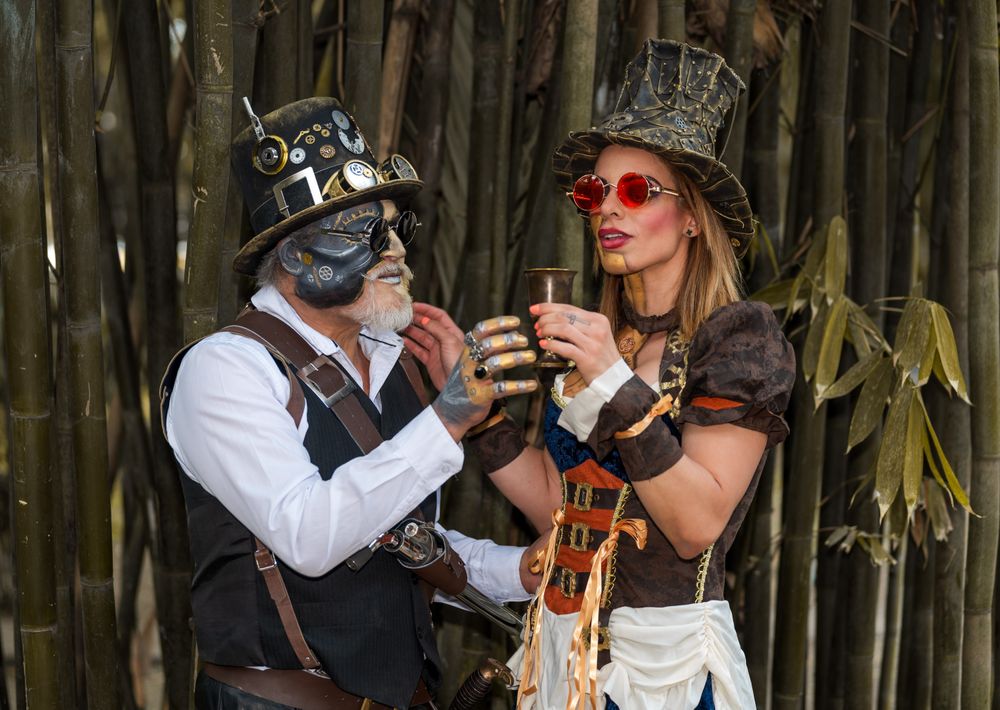
Abney Park, from Seattle in the United States, formed in 1997 as a gothic industrial band led by the singer and songwriter Robert Brown. Early in 2005 he reinvented it as a steampunk band, with characters for every member and a story in which the band's plane collides with a time-travelling airship, HMS Ophelia, and they take it over as airship pirates. Lost Horizons (2008) was their first fully steampunk album, followed by Æther Shanties (2009) and The End of Days (2010). Their world became a role-playing game, Airship Pirates, in 2011, which our guide to steampunk games describes.
Vernian Process
Vernian Process, from San Francisco, began in 2003 as the solo project of the singer Joshua Pfeiffer and later became a band. Its name comes from Jules Verne, and its music, described as neoclassical dark wave, is themed round Victorian scientific romance and its modern descendant, steampunk.
The Men That Will Not Be Blamed for Nothing
The Men That Will Not Be Blamed for Nothing are a British band, formed in London in 2008 by Andrew O'Neill and Andy Heintz. They play fast, loud punk, mostly about Victorian subjects, and their first album, released in 2010, was later given a new title, and is now called The Steampunk Album That Cannot Be Named for Legal Reasons. The band began as part of the steampunk scene and later moved away from the label, which is worth knowing: not every musician wants to be filed under it.
Chap hop
Chap hop is an English style that mixes hip-hop with the manners of the English gentleman, rapping about tea, cricket and the weather. It began in the United Kingdom in the mid to late 2000s. Its artists include Mr. B The Gentleman Rhymer and Professor Elemental, the stage name of the British performer Paul Alborough, whose song Cup of Brown Joy, a video of about 2008, first drew wide attention to him. Professor Elemental is closely linked with steampunk and is a popular act at steampunk events.
Rush
Clockwork Angels (2012), the last studio album by the Canadian rock band Rush, is a concept album telling a steampunk-inspired story written by their drummer and lyricist Neil Peart. Its cover, by Hugh Syme, shows a clock with alchemical symbols in place of numbers. The writer Kevin J. Anderson turned the story into a novel the same year.
Other names to know
The Steampunk article on Wikipedia names several more acts linked with the style: the singer Paul Roland, whom it credits as an early pioneer; Frenchy and the Punk; Lee Presson and the Nails; and Doctor Steel, whose act it describes as industrial hip-hop opera. It also notes that some well-known musicians outside the scene, such as Lindsey Stirling and David Guetta, have made music videos with steampunk settings. A video like that is not the same as a steampunk band, but it shows how far the look has travelled.
Steam Powered Giraffe, the band people search for
Who they are
Steam Powered Giraffe is an American musical act from San Diego, in California, formed in 2008. When people search for the steampunk giraffe band, this is the group they mean. The band was founded by the twins David Michael Bennett and Isabella Bunny Bennett, with Jonathan Sprague and Erin Burke. The four began on 22 January 2008, busking as robot characters in Balboa Park, the large public park in San Diego.
The robots and their story
What makes them unusual is the act. The performers play robot musicians, in costume and in character, and the band has a long invented history in which the robots were built in the late 1890s. That history is told through their albums, their stage shows and a comic. Their act mixes music with robot mime, puppetry, ballet and comedy, and their music is described as folk rock, pop and vaudeville. The robots have names: The Spine is played by David Michael Bennett, one of the founders. The line-up has changed over the years, so check the band's own site for who plays whom today.
Their records
Their first album was Album One (2009). It was followed by The 2¢ Show (2012), MK III (2013), The Vice Quadrant: A Space Opera (2015), Quintessential (2016) and 1896 (2020). In 2024 they released the music for the video game SteamWorld Heist II, a sequel to one of the steampunk games in our games guide. They have also recorded with Professor Elemental, on the song Sky Sharks (2015).
Why they matter to steampunk
Steam Powered Giraffe show what steampunk music does best: they are a costume, a story and a band at once. Many steampunks first met the style through them, which is why so many people look for them by the description rather than the name.
Finding out more
The band's own website is the place to check the current line-up and the robots' story. Besides the music, it carries a section on the band's invented history, its comic, published online, and its podcasts. The name is three words, Steam Powered Giraffe, which is worth knowing when you search, because many people remember it only as the robot band or the giraffe band.
Music hall and the Victorian songs behind it
What music hall was
Music hall was the popular entertainment of Victorian Britain. According to the V&A, it grew out of London taverns and coffee houses, where people ate, drank and joined in the singing, and by the 1830s out of song and supper rooms open late into the night. In 1852 Charles Morton opened the Canterbury Hall in Lambeth, the first music hall built for the purpose, with 700 seats at tables and food and drink served during the show. Its star was the comic singer Sam Cowell, and his popularity led Morton to build a larger and grander hall on the same site, which opened in 1856. Morton wanted women in the audience too, and introduced Ladies' Thursdays, though the halls soon gained a rowdier reputation.
The songs and the stars
Comic songs were the heart of music hall, and audiences were loud and joined in. Champagne Charlie, with music by Alfred Lee and words by George Leybourne, who made it famous, was first performed in Leeds in 1866. Leybourne's stage look included a cut-down top hat, which caused a stir, and he was known as Champagne Charlie ever after: a reminder that the small, odd top hats of steampunk costume have a long history on stage. Daisy Bell, which first became popular in a London music hall sung by Katie Lawrence, is said to have begun as a joke about the import duty Harry Dacre paid on a bicycle he took to America, which would have been double for a bicycle built for two. Stars such as Marie Lloyd, Dan Leno and Vesta Tilley, a male impersonator, played to huge crowds, and the biggest names sometimes appeared at several halls in one night. From the late nineteenth century, stranger speciality acts joined the singers.
From music hall to variety
In Edwardian times, variety theatres with fixed seats took over from the halls with their tables. The London Coliseum opened on 24 December 1904, and the first Royal Variety Performance was held on 1 July 1912. Television later emptied many theatres. Steampunk musicians borrow music hall's comic songs, its sing-along spirit and its stage characters, and a chap hop artist in a tweed suit is a music hall turn by another name. Our guide to Victorian London describes the city the halls belonged to.
Music at steampunk events

What to expect
Music is part of most steampunk gatherings, from a single performer in a corner of a market to evening concerts at the larger weekends. You may hear a band, a chap hop act, a singer with a piano, or a record player turning out old songs. For which events happen where, see our guide to steampunk events in the UK, and check each organiser's own site before you travel.
Dressing for a concert
A concert is a good excuse to dress up, and audiences at steampunk events often match the band. Think about comfort: you may stand or dance for hours, a top hat blocks the view of the person behind you, and large props are awkward in a crowd. Our guide to what to wear to your first steampunk event covers comfort and the event's own rules on props.
Joining in
Many steampunk acts expect the audience to join in, as music hall audiences did, with choruses to sing and characters to answer back. Performers at small events are often happy to talk afterwards, and many sell their own recordings. Ask before you film a whole performance, and respect a performer who asks you not to.
Looking after yourself and others
Concerts can be loud, especially punk and industrial acts, so stand back from the speakers, and bring ear plugs if loud music troubles you or you are taking children. Leave room for people who want to dance, and for those who use a wheelchair or need to sit. Keep goggles, canes and props close to you in a crowd, and follow the event's own rules on what can be carried; the events guide links to them.
Making a steampunk playlist
Mix the styles
A good steampunk playlist moves between moods: a folk-flavoured airship song from Abney Park, a dark, cinematic track from Vernian Process, a loud burst from The Men That Will Not Be Blamed for Nothing, a comic turn from Professor Elemental, and a song from Steam Powered Giraffe. Add something from Clockwork Angels for a longer story.
Add the real Victorians
Mix in the songs the steampunk era was built on: music hall songs such as Champagne Charlie and Daisy Bell, sung by modern performers, and concertina tunes. Old recordings have the crackle of the period, though the earliest were made long after many of these songs were written.
Words to look for
Bands are not always labelled steampunk. Look also for chap hop, dark cabaret, gypsy rock, electro swing, dark wave, folk punk and neo-Victorian, and follow the links between musicians who have recorded together, such as Professor Elemental and Steam Powered Giraffe. Soundtracks are another rich seam: the music from steampunk films and games is often written to sound like the age of steam.
Match the playlist to the job
Different moments need different lists. For making a costume, choose cheerful, steady songs; for a party, the loud and the sing-along; for a quiet evening of reading, instrumental tracks and soundtracks. If you are dressing as a character, give them a theme tune. Our guide to steampunk fashion will help with the costume to go with it.
Making music of your own
Steampunk has always been about making things rather than only buying them, and music is no different. A tune you already play on the piano, guitar or concertina becomes steampunk with new words about an airship or an inventor and a costume to perform it in. Writing a song for a character you dress as is a good first step, and a small group of friends with a few acoustic instruments can sound remarkably like a Victorian parlour. Old music hall songs whose copyright has run out are a ready-made songbook to practise on, and audiences at steampunk gatherings tend to enjoy an enthusiastic amateur as much as a polished band.