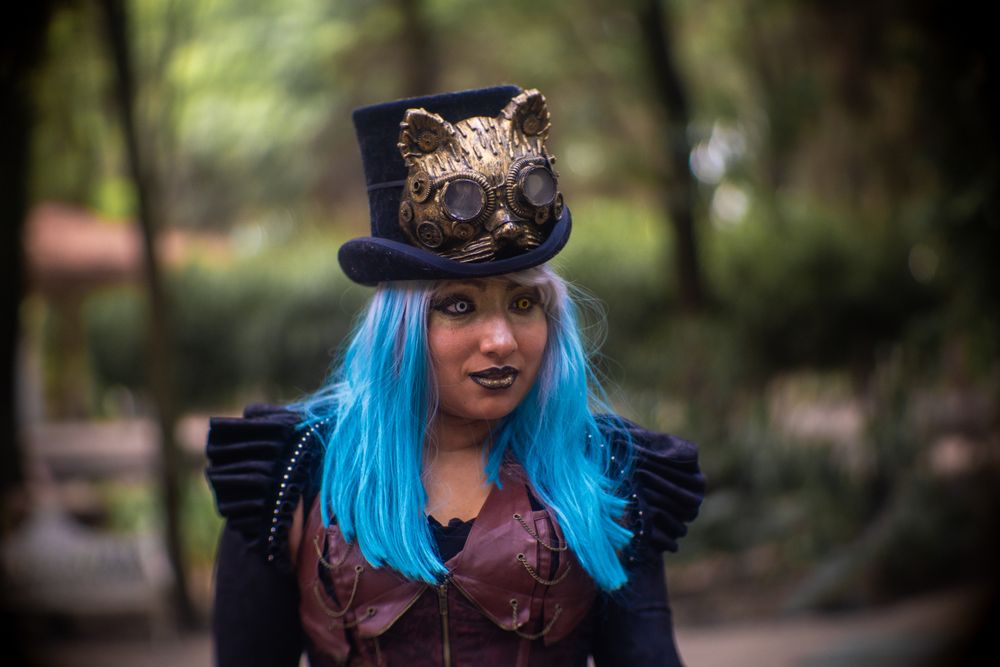
Steampunk make-up and steampunk hair are the parts of an outfit that cost least and change most. The same coat and hat can belong to a pale Victorian lady, a soot-smudged engineer or a clockwork figure, depending on the face and the hair beneath them. Steampunk makeup, as it is often spelt, has no single correct look, and steampunk hairstyles range from the smooth Victorian bun to bright dyed hair under a small top hat.
This guide starts with how to choose make-up for a character, then the real Victorian face and how to copy it with modern products, make-up that looks like brass, rust and machinery, hairstyles for long and short hair, moustaches, beards and sideburns, and how to wear hair and hats together. It ends with how to try make-up safely, which matters more than any of the looks.
Make-up that suits the look
Steampunk make-up falls into three broad looks, and the character you are dressing as decides which one to use.
The natural Victorian
A clear, even skin, softly defined eyes and a gentle colour on the lips and cheeks. It suits a lady of society, an inventor's patron, a governess, a bride or any character meant to look as a real Victorian woman might. It is the most elegant look, and the easiest to wear for a whole day.
The dark and dramatic
Smoky eyes in brown, plum or charcoal, a deep red or berry lip and a paler skin. It suits a gothic steampunk outfit, a villain, a vampire hunter, a stage performer or an evening event. It is closer to the look of the Victorian stage than the Victorian drawing room.
The working and mechanical
Metallic colour on the eyes and cheekbones, smudges of oil or soot, painted rivets, seams or gears. It suits an engineer, an airship mechanic, an automaton or anyone half turned into a machine. It is the most fun and the most obviously steampunk.
Colours that work
Whatever the look, the steampunk colours carry over from the clothes: bronze, copper, gold, warm brown, plum, burgundy, deep red and smoky grey. Bright blues, pinks and greens look modern unless your outfit uses them on purpose. Choose one feature to lead, the eyes or the lips, and keep the rest quiet. A face with metallic eyes, dark lips and painted gears all at once is hard to read from more than a step away.
Lasting a long day
Steampunk gatherings are long, often outdoors, and a hat and goggles press on the forehead. A light base lasts better than a heavy one, powder helps it stay put, and a small mirror and a few products in a pocket or a bag let you mend it at lunch.
The Victorian face: pale skin, dark eyes and a soft lip
What the Victorians thought of make-up
Respectable Victorian women were careful about make-up. Heavy, visible make-up was associated with actresses and with women of bad reputation, so women who used cosmetics often kept it to themselves. The ideal was a pale, almost translucent complexion, which was taken as a sign of a life of leisure spent indoors rather than at work in the sun. Commercial products were not yet common, and many women made their own at home. The Science Museum Group describes home-made cold creams and lotions as a Victorian alternative to visible make-up, part of a taste for natural beauty that pushed heavy white face paint out of fashion.
The poisons in the powder box
Some of what Victorian women did use was dangerous. The Science Museum Group notes that lead-based white make-up was mostly replaced by safer pearl white and talc only by the early 1900s. So-called safe arsenic complexion wafers, which were meant to be eaten, were still sold into the twentieth century. An 1866 book on beauty included arsenic in its recipes for hair dye, and an 1874 magazine article recommended an ointment made with mercury to bring back the eyelashes. Belladonna, from the deadly nightshade plant, had been used to widen the pupils of the eyes in the name of beauty since Roman times. None of these should ever be copied. The look is easy to make with modern products, and the history is better left in the museum.
Copying the look today
- Start with a light base a shade close to your own skin, or a touch paler, rather than a heavy white.
- Set it with a little powder, so the skin looks matt and smooth rather than shiny.
- Define the eyes softly, with brown or grey on the lid and a little mascara, and brush the brows neatly into shape.
- Add a faint flush of rose on the cheeks, blended well, so that it looks natural.
- Finish with a soft rose or berry colour on the lips, pressed on with a fingertip rather than drawn in a sharp line.
For the darker version of the same face, keep the skin pale, take the eyes deeper with plum or charcoal blended out towards the temples, and use a deep red on the lips. That gives the gothic side of steampunk without any painted machinery at all. Our guide to Victorian fashion for women shows the clothes this face was meant to go with.
Brass, rust and machine make-up
Our guide to steampunk for Halloween explains full machine faces, with metallic skin, painted rivets and cracked porcelain. Here are lighter versions that suit an ordinary day out in costume.
A touch of brass
Copper or bronze eye shadow on the lids, and a gold or bronze highlight along the top of the cheekbones and the bridge of the nose, catch the light like polished metal. With a brown or plum lip, it looks warm and finished without looking like a costume, and it suits almost any steampunk character.
Rust and patina
Rust can be suggested with orange, red-brown and dark brown eye shadow, dabbed on with a small sponge in uneven patches at the temple or along the jaw, then softened at the edges. A little green or teal dabbed in the same way looks like the patina on old copper. Keep it to one area of the face, so it reads as a deliberate effect.
The engineer's smudge
A smudge of dark brown or grey eye shadow on one cheekbone, the side of the nose or the forehead looks like oil or soot from the engine room. Put it where a hand might have wiped it, and blend one edge. For an airship mechanic who has spent the day in goggles, leave a clean ring round each eye and dust the rest of the face lightly with a soft brown, so it looks as though the goggles have just come off. Our guide to steampunk goggles explains the goggles themselves.
A single gear
One small gear painted at the temple or the outer corner of the eye, in gold with a darker outline and a highlight on the teeth, says steampunk at once. Draw it first in a soft eye pencil, then fill it in. Small, flat card or foam gears can be stuck on, but only with an adhesive made for skin, and never with ordinary glue.
Never craft paint
Metallic craft paint, acrylic paint and spray paint are not made for skin, and they should never go on the face or body, however good the colour looks. For every effect in this section, use make-up or face paint sold for use on skin.
Hairstyles for long hair
Victorian women wore their hair long and, once grown up, pinned up. The styles changed through the reign, which gives steampunk several to choose from.
What the Victorians wore
In the 1840s hair was usually parted in the centre, with the side hair smoothed back over the ears or looped and braided, and the bun or knot moved from the crown down to the back of the head. Long single curls, sometimes called spaniel curls, could hang down at the front. In the 1860s hair was still parted in the middle and smoothed or waved over the ears, then pinned into a roll or a low bun at the back of the neck, often held in a decorative hairnet, and kept in place with hair oil and pomade. The chignon, hair wrapped at the back of the head, was much in vogue in England in that decade. Early in the 1890s curled or frizzed fringes and hair swept to the top of the head were in fashion; by the end of the decade hair was often worn in a large, soft mass with a bun on top.
The low Victorian bun
- Part the hair in the centre and comb it smooth.
- Draw the sides back loosely over the tops of the ears.
- Gather everything at the nape of the neck and tie it.
- Twist the length and coil it round the tie into a bun, then pin it with hairpins pushed in towards the middle.
- Cover it with a hairnet or wrap a ribbon round it for the 1860s look.
The high bun of the 1890s
- Brush the hair up and back, loosely, so it is full round the face rather than flat.
- Tie it high on the crown.
- Twist it into a bun on top of the head and pin it.
- Gently pull a little hair loose at the front and sides, so it frames the face softly.
The braided crown
Two plaits taken over the top of the head from behind the ears and pinned where they meet make a braided crown. It stays neat all day, sits well under a small hat, and suits a lady adventurer or an aviatrix. Loose curls and ringlets at the sides, made with rollers or rags overnight, add a romantic touch to any of these styles. Steampunk does not insist on natural colours, and a bright dyed head of hair under a small top hat is a familiar sight. Our guide to women's steampunk outfits shows these styles with whole outfits.
Hairstyles for short hair
Short hair suits steampunk very well, particularly for the working characters: the aviator, the engineer, the mechanic and the explorer, whose hair would be cut short for practical reasons.
Short hair for women
A short cut swept to one side and smoothed with a little wax looks neat and practical under a flying cap or a bowler. Very short hair suits goggles pushed up on the forehead, because nothing gets caught in the strap. Shorter hair can also be dressed with a velvet band, a ribbon, a small clip with a gear on it, or a tiny hat fixed with a comb. For a Victorian look with short hair, a clip-in bun or a hairpiece at the back of the head gives the shape of a long style for a day.
Short hair for men
Victorian men's hair was short by the end of the century. In the 1840s curled hair was still fashionable, and by the 1890s men's hair was generally worn short. Men in the early nineteenth century commonly used Macassar oil on their hair, and the fashion for oiled hair was so strong that housewives took to laying small cloths over the backs of chairs to protect them. Around 1850 these began to be called antimacassars, a name still used today.
The modern version of the oiled look is a side parting, combed sharply, with a little pomade or wax for shine and hold. A centre parting looks more old-fashioned still. For an engineer or an explorer, a slightly untidy cut looks right, as though there has been no time for the barber. Our guide to men's steampunk outfits shows how the hair fits the rest of the outfit.
Moustaches, beards and sideburns
Facial hair is one of the strongest Victorian signals a man can wear, and there are many styles to choose from.
A Victorian fashion
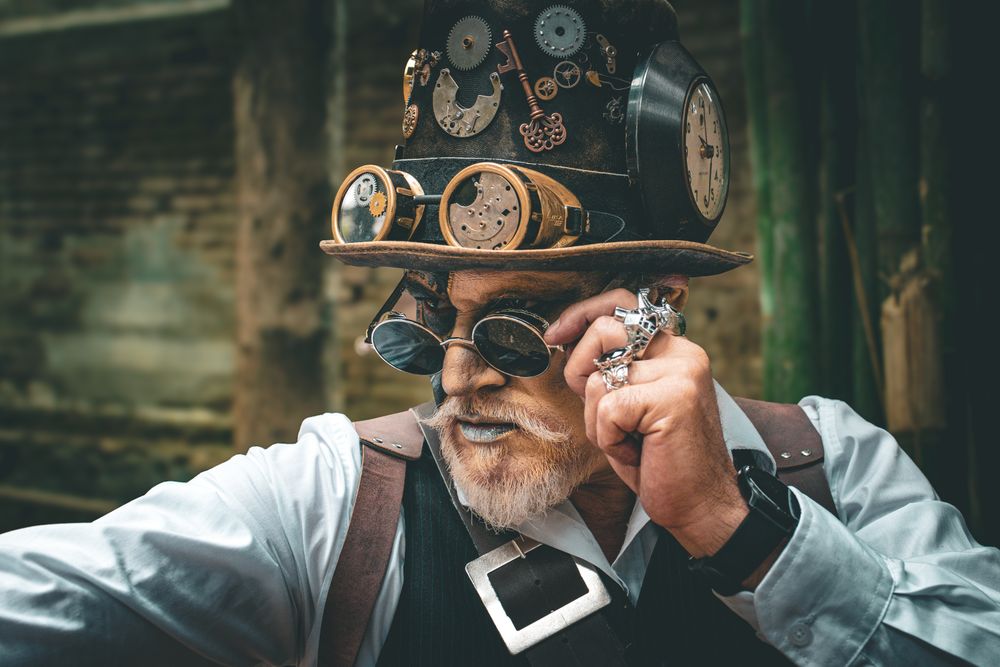
Beards became much more popular after the revolutions of 1848 and were linked at the time with ideas of manliness and courage, which is a large part of why the bearded gentleman is the picture many people have of a Victorian man. Moustaches were very fashionable by the 1860s, and in the West their popularity peaked in the 1880s and 1890s. Moustaches were a compulsory part of British Army uniform until 1916. By the 1890s a short pointed beard with a generous moustache was a typical look, and early in the twentieth century beards slowly fell from fashion.
The styles
- The handlebar: a bushy moustache with small ends pointing upwards, shaped with wax.
- The walrus: a bushy moustache hanging down over the lips, often covering the mouth.
- Side whiskers: sideburns grown long, hanging well below the jaw line. Nineteenth-century sideburns were often far more extravagant than any seen today.
- Mutton chops: full side whiskers with the chin shaved. When they join a moustache across the upper lip, they are sometimes called friendly mutton chops.
- The full beard, trimmed short and neat for a gentleman or left long for an explorer.
The word sideburns itself comes from the nineteenth century. It is an altered form of burnsides, named after the American Civil War general Ambrose Burnside, who wore thick side whiskers joined by a moustache, with his chin clean-shaven.
Wax, and the moustache cup
Victorian men often waxed their moustaches to keep them stiff, and that caused a problem at tea time: steam from a hot drink melted the wax, which dripped into the cup. The moustache cup, with a ledge inside the rim to keep the moustache dry, is generally said to have been invented in the 1870s by the British potter Harvey Adams. Moustache wax is still easy to find today. Warm a little between the fingers, comb it through, and twist the ends into shape.
False facial hair
Anyone who cannot grow the moustache their character needs can wear a false one. False facial hair is usually fixed with spirit gum, an adhesive made from alcohol and a resin, which has been a standard tool of the theatre since at least the 1870s. It is removed with a remover made for it, or with alcohol, cocoa butter or petroleum jelly. Use only an adhesive sold for skin, and try a little on the inside of the arm first.
Hair and hats together
A steampunk outfit almost always has a hat, and the hair has to suit it. The two are best planned together.
Plan the hair for the hat
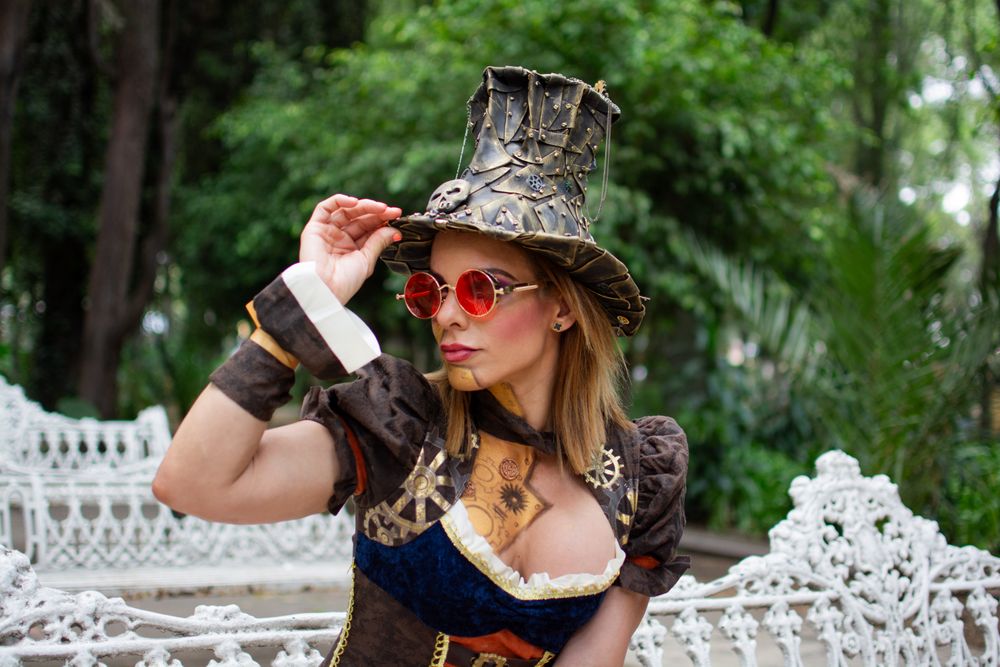
A full-sized top hat or a bowler sits low on the head, so it suits hair worn low: a bun at the nape, a low plait or short hair. A mini top hat or a small riding hat sits on top of or in front of the hair, so it suits a high bun or a braided crown behind it. A flying cap covers most of the head, so the hair either goes under it in a low plait or shows below it at the back. Our guide to steampunk hats and top hats explains how to measure for a hat with your hair as you will wear it, and how to keep a small hat on with combs and elastic.
Hatpins
A hatpin is a long decorative pin that holds a hat to the head through the hair. Their popularity soared in the 1880s, when bonnets gave way to hats, and they remained a standard part of a woman's dress into the 1910s, usually 15 to 20 centimetres long. From 1910 some American cities limited their length, and some required the points to be covered, so that they would not hurt anyone. A hatpin with a gear or a small stone on the end is a good steampunk detail, but in a crowd, cover the point or choose a short one.
Goggles and hair
Goggles worn on a hat sit on the brim, but goggles worn on the head have a strap that goes round the hair. Put the strap above a low bun or below a high one, so it does not pull the style apart, and choose an elastic strap rather than a buckle that catches. For short hair, the strap can sit straight round the head.
At the end of the day
Any hat worn all day flattens the hair beneath it. A style built round the hat, rather than a loose blow-dried one, survives being covered and uncovered, and a few spare hairpins and a small comb in a pocket put right whatever the hat undoes.
Trying make-up safely
Make-up for a costume often means new products, strong colours and long hours on the skin, so a little care beforehand saves a sore face on the day.
Use only products made for skin
Use make-up and face paint sold for use on the skin, and nothing else. In Great Britain the Office for Product Safety and Standards advises checking that a cosmetic's packaging shows the name and address of the Responsible Person, the person or business responsible for it, together with a batch number, a use-by date where one applies, and a list of ingredients, all in English and easy to read. It advises being wary of a product with no named Responsible Person, with information that is not in English or is poorly written, or marked for professional use only.
Patch test anything new
Try any new product on a small patch of skin, such as the inside of the arm, a day or two before you wear it on your face, and do not use it if the skin reacts. Hair dye needs more care still. The NHS explains that many permanent and some semi-permanent hair dyes contain a chemical called PPD, which can cause allergic reactions, and advises testing a dye on a strand of hair at least 48 hours before using it, wearing gloves to apply it, and stopping if you react or feel unwell. It also warns that black henna tattoos can contain high levels of PPD, and that having had one can make a reaction to hair dye more likely.
On the day
- Keep glitter, powder and metallic make-up out of the eyes, and do not share eye make-up or brushes.
- Use only an adhesive made for skin for false lashes, false moustaches and stick-on gears.
- For children, the Chartered Trading Standards Institute's advice is to wear face paint rather than a mask, so they can see where they are going.
- Take everything off before you go to sleep, gently, with a cleanser or the remover made for the product.
If something goes wrong
If the skin becomes red, itchy or sore, wash the product off with water and a mild cleanser and do not use it again. The NHS's advice on hair dye reactions is that sudden swelling of the lips, mouth, throat or tongue, or difficulty breathing or swallowing, is an emergency and needs a call to 999. With the right products, tested first, steampunk make-up is safe and great fun, and with a well-chosen piece of steampunk jewellery it finishes the outfit.