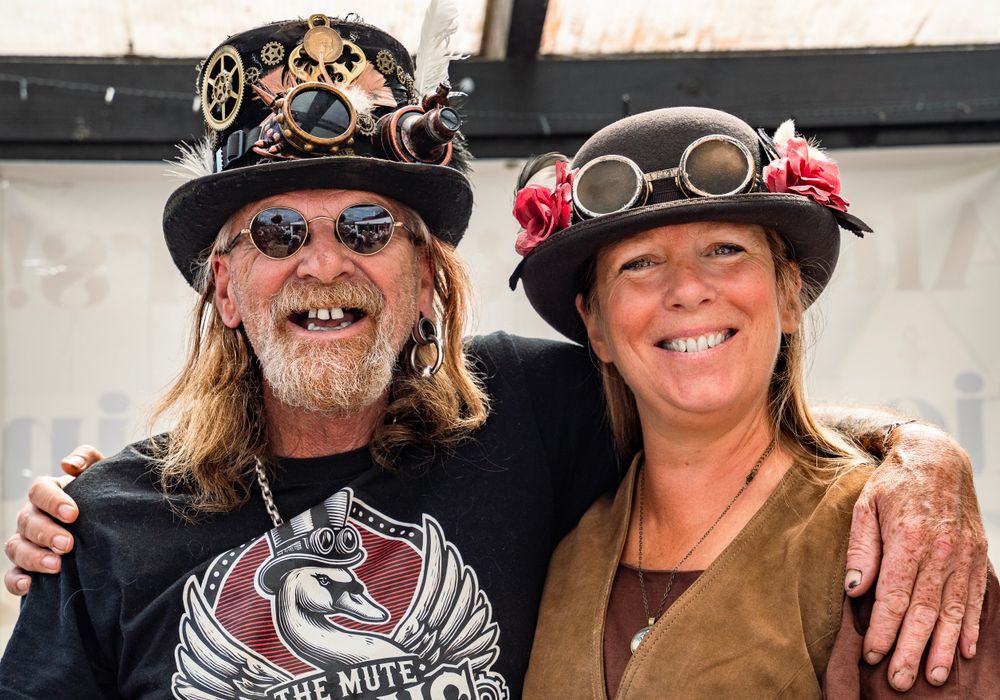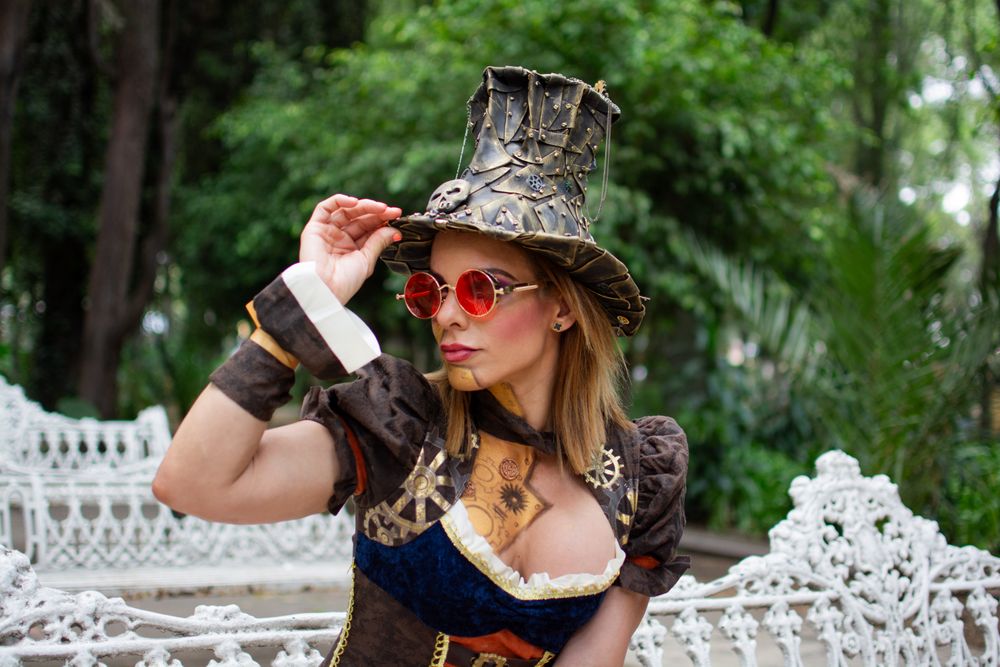
Steampunk glasses and steampunk sunglasses are the quieter relations of the goggles. A pair of small round spectacles in a thin metal frame, a pince-nez on a ribbon, or tinted lenses with little shields at the sides gives a face the look of a Victorian scientist, traveller or engineer. Unlike most goggles, you can see through them properly all day, and they need no hat to hold them.
This guide explains where round glasses came from, the pince-nez, the monocle and the lorgnette, coloured lenses and side shields, how to wear glasses with goggles and hats, how to have your own prescription made up in the style, and how to choose sunglasses that really protect your eyes at an outdoor event. Our guide to steampunk goggles covers the bigger eyewear that sits on the hat.
Round glasses, and where they came from
The first spectacles
Spectacles are far older than the Victorian age. The first were probably made in central Italy, in Pisa or Florence, by about 1290. The College of Optometrists describes the earliest kind as simply two lenses in mounts, riveted together at the ends of their handles. The oldest frames that survive, rivet spectacles found at the convent of Wienhausen in Germany, date from about 1400, and the first shop given over to making spectacles opened in Strasbourg in 1466.
Arms over the ears
For centuries a pair of spectacles had nothing to hold it on but the nose. The modern style, with side arms called temples, was developed some time before 1727, and the London optician Edward Scarlett is credited with it. His early arms were made of iron or steel and gripped the sides of the head without yet hooking over the ears. Once spectacles could stay on by themselves, they could be worn all day while the hands did something else.
Steel wire and small round lenses
Before spectacles became a fashion item, frames were made to do a job, and nearly all lenses were round, oval or a simple straight-sided shape. By the Victorian years an ordinary pair was a thin frame of steel wire holding two small lenses, the kind now kept in the Science Museum Group's collection. Lenses were improving too: the first lenses to correct astigmatism, a common fault of focus, were designed by the British astronomer George Airy in 1825.
That is the look steampunk borrows: a fine metal frame, small round lenses, and nothing heavy. Round glasses suit almost every character in the style, from a professor in tweed to an airship captain in a greatcoat, and they change a face far less than goggles do. Brass-coloured, gunmetal and black frames all look right; very thick plastic frames look like the twentieth century.
Pince-nez, monocles and lorgnettes
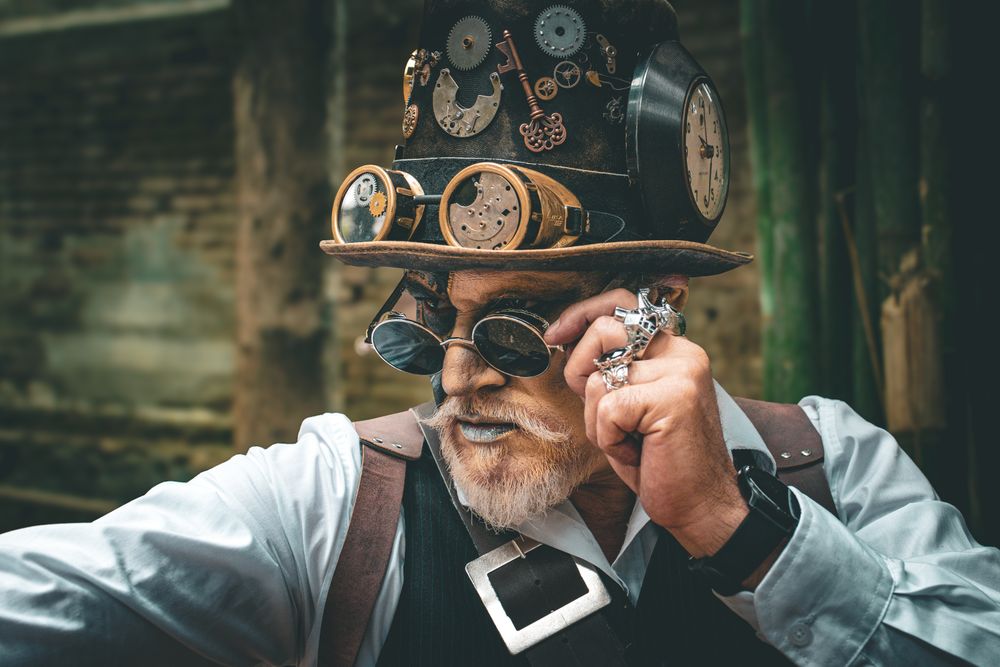
Not every pair of Victorian lenses had arms. Three older ways of wearing them are still among the most characterful pieces a steampunk can carry.
The pince-nez
Pince-nez are spectacles with no arms at all, held on by a frame that pinches the bridge of the nose. The name is French for pinch and nose, and English speakers sometimes called them nose-nippers. The modern kind appeared in the 1840s and was at its most popular from about 1880 to 1900. On one common design, the C-bridge, a curved and springy metal bridge shaped like a letter C gives the grip; on another, a small spring between the lenses holds them in place. Because pince-nez slipped off easily, they were usually fixed to the clothes or an ear by a chain, a cord or a ribbon.
A pince-nez on a black ribbon, pinned to a waistcoat or a lapel, is a lovely detail for a doctor, a scholar, a clerk or a lady inventor. An old pair found in an antiques shop will have lenses made for someone else's eyes, so wear it for the look rather than for seeing.
The monocle
A monocle is a single round lens held in front of one eye by the eye socket itself. The Prussian antiquarian Philipp von Stosch used one as a magnifier in the 1720s, to look closely at engravings and gems, but the monocle did not become part of a gentleman's dress until the nineteenth century. It was in fashion in the late nineteenth and early twentieth centuries, and faded as spectacles themselves improved. The earliest kind, a plain metal ring with a lens, was worn in England from the 1830s. In the 1890s came the gallery monocle, with a raised rim that kept the lens clear of the eyelashes. Most hung from a cord or wire fixed to the clothes and tied to a ring round the lens.
In steampunk the monocle belongs to an aristocrat, a villain or a very grand inventor. Always wear one on a cord, so that when it falls out, as it will when you laugh, it drops onto your waistcoat and not onto the ground.
The lorgnette
A lorgnette is a pair of spectacles on a handle, held up to the eyes rather than worn. Sources disagree on who invented it: some name the English instrument maker George Adams the Elder, around 1770, and others his son George Adams the Younger, around 1780. Fashionable women often preferred a lorgnette to spectacles, and it was much used at the opera and the theatre. Some handles open into a little case that the lenses fold into. Scissors-glasses, two lenses on a forked handle held under the nose, were fashionable alongside them from the second half of the eighteenth century into the early nineteenth.
A lorgnette on a chain at the waist, raised now and then to inspect someone's outfit, suits a society lady or a lady explorer, and it is the most theatrical way of wearing lenses there is.
New pieces in the old styles
Genuine old pince-nez, monocles and lorgnettes turn up in antiques shops and at fairs, but they can be fragile, and their springs and hinges may be tired after a century or more. For a costume that will be worn all day, a modern piece made in the old style, with plain lenses, is often the better choice, and the old one can stay safe at home. Whichever you have, keep it in a small hard case in your bag between photographs, because a pince-nez or a monocle dropped on a stone floor rarely survives.
| Kind | How it stays on | In fashion | Suits |
|---|---|---|---|
| Round spectacles | Arms over the ears | Through the Victorian age | Almost anyone |
| Pince-nez | Pinches the nose, with a cord | About 1880 to 1900 at their peak | A doctor, a scholar, a clerk |
| Monocle | Held by the eye socket, with a cord | Late 1800s and early 1900s | An aristocrat or a villain |
| Lorgnette | Held up by a handle | Late 1700s and the 1800s | A society lady at the opera |
Coloured lenses and side shields
Tinted lenses before sunglasses
Tinted lenses are older than the sunglasses we know. In China, flat panes of smoky quartz were used in the twelfth century or earlier to protect the eyes from glare, though they did nothing to correct sight. Around 1752 the optician James Ayscough experimented with blue and green tinted spectacle lenses, because he believed coloured glass could correct particular problems with the eyesight; keeping out the sun was not his aim. Sunglasses worn against the sun became widespread much later, in the early 1920s, and cheap ones made in large numbers followed at the end of that decade.
Victorian eye preservers
The Victorians did wear tinted glasses against glare, wind and dust, and two pairs in the Science Museum Group's collection show what they looked like. One, dated between 1851 and 1900 and supplied by a firm in Manchester, is described as tinted eye preservers: spectacles of steel wire with side shields. The other, made in England between 1850 and 1870, is a pair of protective spectacles with tinted cup-shaped lenses and side pieces of wire mesh. Both are exactly the kind of eyewear a steampunk railway traveller, engineer or explorer would carry.
Side shields
Side shields are small extra lenses, or panels of mesh or leather, fixed at the outer edges of a pair of spectacles so that the eye is covered at the side as well as the front. They make round glasses look practical and slightly mysterious, halfway between spectacles and goggles, and they are the easiest way to give an ordinary round pair a steampunk character. Mesh side shields suit an engineer or a stoker; tinted glass ones suit an aviator.
Choosing a colour
Red and amber lenses look warm and go well with brass and copper. Green and smoked grey look older and more practical, the colours of a working pair. Blue suits a cooler outfit in silver, grey and black. Very dark lenses hide the eyes, which works for a villain or a mysterious stranger but makes a friendly character harder to talk to.
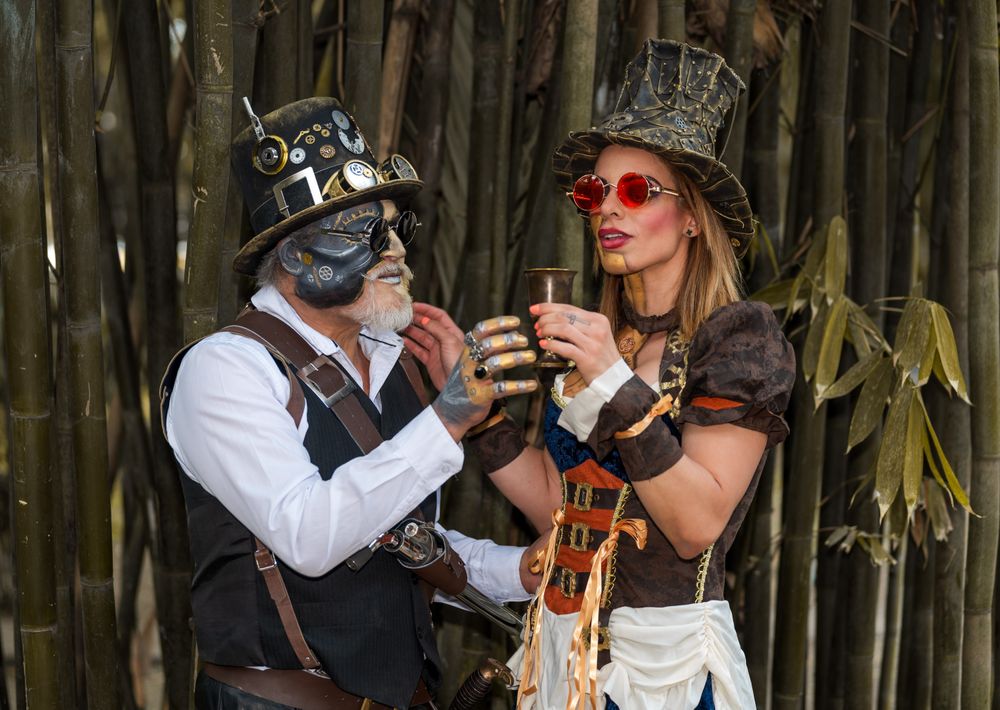
A tint on its own is a colour, not protection. Whether a coloured lens is safe to wear in strong sun depends on how it was made and tested, which the last section of this guide explains.
Wearing them with goggles and hats
Glasses and goggles together
Most costume goggles will not fit over ordinary glasses, so if you wear both, the goggles go on the hat and the glasses stay on your face. This reads well as a character: the working pair is pushed up out of the way, and the everyday pair is for seeing. A scientist with clear round spectacles and a pair of jeweller's goggles on the brim, or an aviator with tinted round glasses and flying goggles round the neck, looks properly equipped.
Glasses under a hat
Put your glasses on first and the hat second, so that the hat band sits over the arms rather than pushing them out of place. If a tight hat band presses the arms into the sides of your head, it can become uncomfortable within an hour; a slightly looser hat, or arms that run below the band, will be better on a long day. Our guide to steampunk hats and top hats explains how to measure for a hat that fits.
Chains and cords
A spectacle chain or a fine cord, fixed to the ends of the arms and hanging behind the neck, is a Victorian-looking detail and a practical one. At a busy event, glasses taken off for a photograph are easy to put down and lose. On a chain they simply hang on your chest until you need them. A pince-nez or a monocle should always have its cord.
Five ways to wear them
- The scientist: clear round spectacles, jeweller's goggles on a top hat.
- The aviator: green or amber round glasses with side shields, flying goggles round the neck.
- The society lady: a lorgnette on a chain at the waist, beside a small watch on a chatelaine.
- The villain: a monocle on a black cord, or very dark round lenses.
- The engineer: smoked lenses with mesh side shields, and a smudge of oil on one cheek.
Glasses in photographs
Round lenses catch the light, and in photographs taken with a flash they can turn into two white discs that hide the eyes. Tilting the head very slightly down, or turning a little to one side, usually moves the reflection away. Tinted lenses photograph well in daylight but can look like two dark holes indoors, so lift them onto the brow of the hat for a portrait if you want your eyes to show. A pair of glasses pushed up onto the forehead or the hat brim is itself a good steampunk look, the sign of someone who has just finished close work.
For the chatelaine, see our guide to steampunk watches and pocket watches, and for the face around the glasses, our guide to steampunk make-up and hair.
Prescription glasses in the style
Your own lenses in a round frame
If you already wear glasses, the best steampunk glasses of all are your own prescription in a round metal frame, because they look right and you can see through them. The NHS recommends having your eyes tested every 2 years. After a test, the optometrist is legally required to give you your prescription, and the NHS says you should never feel obliged to buy glasses from the place where you had the test. So you can take your prescription to any optician who offers the frame you want.
NHS sight tests are free for some people, including children under 16, young people of 16 to 18 in full-time education, people aged 60 or over, and people with diabetes or glaucoma, among others, and some can have an optical voucher towards the cost of glasses. The NHS pages list everyone who qualifies.
Things to ask the optician
Small round lenses look most Victorian, but they leave less lens in front of the eye. If your prescription is strong, or you wear varifocals, ask the optician how a small round lens will work for you before you choose the size. A thin metal frame in a brass, gold or gunmetal colour looks most like the Victorian steel ones. A light tint can be added to prescription lenses, and clip-on tinted lenses can turn a clear pair into sunglasses, but read the last section before wearing either in strong sun.
Contact lenses and plain glasses
If you wear contact lenses, you can wear a costume pair with plain, unpowered lenses over them for the look. Never wear someone else's prescription glasses, or an old pair from an antiques shop, as your everyday glasses: their lenses were made for another person's eyes.
Driving to the event
The Highway Code says you must be able to read a vehicle number plate in good daylight from 20 metres, and that if you need glasses or contact lenses to do so, you must wear them at all times while driving. A pince-nez, a monocle or a costume pair is not a substitute. Drive in your real glasses, and change at the other end.
Sunglasses for outdoor events
Many steampunk gatherings in Britain are at least partly outdoors, and some are held in high summer. For when and where they happen, see our guide to UK events, and for planning a whole outfit around a long day, our guide to what to wear to your first steampunk event.
Why the lens matters more than the colour
The College of Optometrists says that sunglasses protect against glare and also against harmful ultraviolet light, and that it is a common misconception that the darker the lens, the more protection it gives. A dark lens that does not filter ultraviolet light can even be worse than none, because the pupil opens wider behind it and lets in more of the light that is not filtered. The College adds that children are especially vulnerable, because their pupils are larger and the lenses inside their eyes are clearer.
The marks to look for
The College of Optometrists advises choosing sunglasses with the CE mark or the British Standard BS EN ISO 12312-1:2013, which ensures they give a safe level of protection from ultraviolet light. In law, eyewear made to protect against sunlight is personal protective equipment of the simplest category, and Great Britain recognises both the UKCA mark and the CE mark on it. So look for a UKCA or CE mark on the frame or the label.
Costume glasses with tinted lenses and no such mark may darken the view without blocking ultraviolet light at all. Never assume a costume pair is safe for the sun because it looks dark. If you love a pair of steampunk sunglasses that carries no mark, wear it for photographs in the shade, and keep a marked pair in your pocket for the rest of a bright day.
Filter categories
Sunglasses made to the standard are also given a filter category from 0 to 4, according to how much light the lens lets through:
- Category 0 lets through 80 to 100 per cent of light: for fashion, indoors or cloudy days.
- Category 1 lets through 43 to 80 per cent: for weak sun.
- Category 2 lets through 18 to 43 per cent: for medium sun, and the range recommended for driving in daylight.
- Category 3 lets through 8 to 18 per cent: for strong sun, or glare off water or snow.
- Category 4 lets through 3 to 8 per cent: for intense sun high in the mountains, and must carry a warning that it is not to be worn while driving.
For a summer afternoon at a British event, a category 2 or 3 lens in a round frame is a sensible choice. No sunglasses of any category are made for looking at the sun itself: the law on protective eyewear treats observing the sun as a different thing altogether.
After dark
Evening events, balls and torchlit walks call for clear lenses. The College of Optometrists says not to wear tinted lenses at night or when visibility is poor, and the Highway Code tells drivers not to use tinted glasses, lenses or visors at night or in poor visibility if they restrict vision. On foot the same sense applies: a dark lens hides steps, kerbs and cables. Take your tinted glasses off when the sun goes down, and let them hang on their chain until morning.