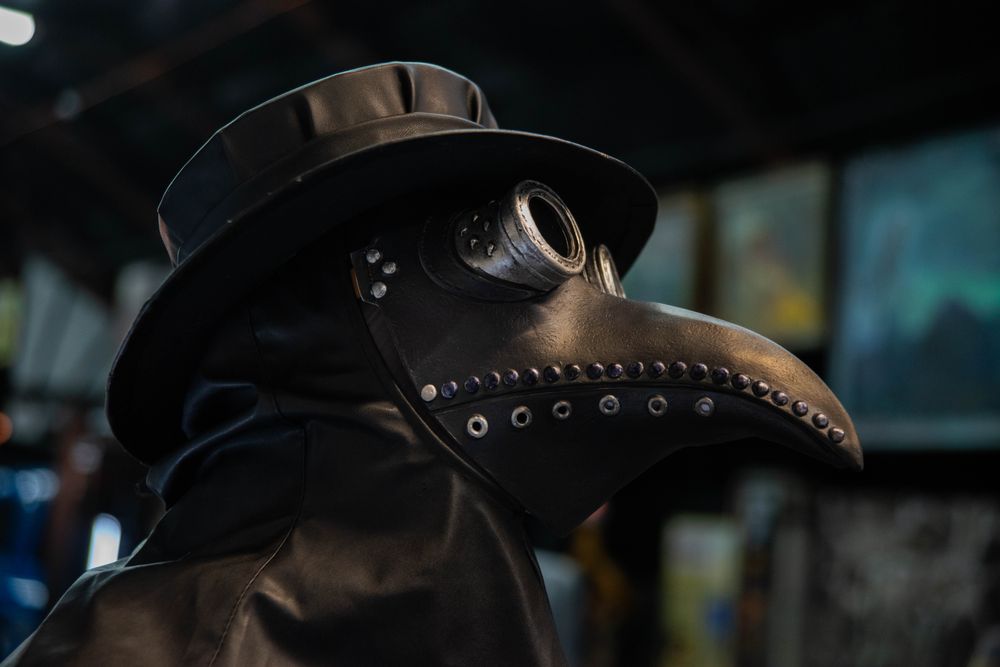
A steampunk mask is a mask made to belong to an imagined Victorian age of machines: a beaked plague doctor's mask with brass rivets and goggle lenses, a respirator with filters and hoses for breathing in a smoky engine room, or a masquerade half mask of leather and filigree. Steampunk masks are less common than hats and goggles, but they are some of the most striking pieces at any gathering, and the steampunk plague doctor in particular has become one of the best-known characters in the style.
This guide explains how masks fit into steampunk, then goes carefully through the history of the plague doctor, which is more disputed than most costume guides admit. It explains why old gas masks must never be worn, looks at half masks and the masquerade tradition, covers breathing, seeing and comfort, and ends with making or decorating a mask. For the plague doctor as a Halloween costume, see our guide to steampunk for Halloween.
Masks in steampunk
Masks suit steampunk for the same reason goggles do: they look like equipment. A steampunk world is full of steam, smoke, sparks and strange air, and a character who works in it might need to cover the face. A mask also changes who you are more completely than any other piece of costume, which suits a style built on invented characters.
The main kinds
- The plague doctor's mask, with a long beak and round glass eyes, usually worn with a wide hat and a long dark coat.
- The respirator, a mask over the nose and mouth with one or two round filters, sometimes with hoses running to a pack on the back, made to look like a Victorian breathing machine.
- The half mask, covering the eyes and the upper part of the face, in leather, painted card or metal-look filigree, often with gears or a single lens over one eye.
- The full face mask, a smooth or mechanical face, worn by characters such as automatons, clockwork people and mysterious villains.
Who wears them
The plague doctor suits a doctor, an alchemist or a dark character. A respirator suits an engineer, a stoker, a sky pirate or anyone working in poisoned air. A half mask suits a masked ball, a thief, a spy or a gentleman of mystery. A full face mask suits an automaton, a clockwork figure that moves by itself. The mask works best when the rest of the outfit belongs to the same character: a respirator with an engineer's apron and boots, a half mask with an evening coat or a ball gown.
The plague doctor: the history behind the beak
The plague doctor wears a long-beaked mask with glass eyes, a wide-brimmed hat, a long coat or robe, gloves and boots, and carries a cane. It is one of the most recognisable costumes in the world, and it is not Victorian at all. Its real history belongs to the seventeenth century, and much of that history is uncertain.
What the costume was for
Doctors in the seventeenth century believed that disease travelled through bad air, an idea called miasma. The beak was filled with sweet-smelling things, such as roses, carnations, lavender, peppermint, camphor, cloves or a sponge soaked in vinegar, to guard against that bad air. The theory was wrong, but the rest of the costume may still have helped. The Royal College of Physicians Museum points out that waxed or oiled coats, hoods, hats and gloves were probably more effective against the fleas that spread plague than the beak was against the air. The cane let a doctor point to where a patient needed attention, examine without touching, and keep people at a distance.
Not the Black Death
There is no evidence that the beaked costume was worn during the Black Death of the fourteenth century, or at any time in the Middle Ages, although it is often shown that way. A physician called Johannes Jacobi recommended masks for plague doctors as early as 1373, but gave no description of them.
Charles de Lorme, 1619
The costume is usually credited to Charles de Lorme, physician to King Louis XIII of France, who described a protective outfit of goat leather, with a beaked mask filled with perfume, for an outbreak in 1619. Modern research says his account should be treated with strong caution, and a University of Münster essay on the plague doctor says only that the idea may possibly have been his.
Rome, 1656
The earliest known reference to the beak mask in use, according to the medical historian Marion Maria Ruisinger, concerns the plague in Rome in 1656, recorded by the Danish physician Thomas Bartholin in 1661. An engraving by Paul Fürst from about 1656 shows a plague doctor of Rome in the full outfit and introduces him as "Dr Beak". That engraving is the picture most modern costumes copy, but it was not a neutral record: most depictions of the plague doctor come from satirical writings and political cartoons. The physician Jean-Jacques Manget described a similar Roman costume in 1721.
Where it was worn, and where the sources disagree
Here the good sources part company. Ruisinger's study, published in 2020, finds the beak mask mentioned no earlier than the middle of the seventeenth century, and then only in Italy and southern France, with no proof at all that it was used during plague outbreaks in central Europe. The University of Münster essay agrees that it is documented only for France and Italy. But an article published in 2015 on the Royal College of Physicians Museum's website says that during the Great Plague of London in 1665, when most physicians left the city with their wealthy patients, the apothecaries who stayed to treat the sick adopted the plague doctor's costume. Some historians go further and argue that the plague doctor began as a figure of fiction and satire, and that real doctors copied it later. The honest answer is that the beaked doctor certainly existed in seventeenth-century Italy, probably in France, and whether he ever walked the streets of London is disputed.
The masks in museums
Only two beaked plague masks are known to survive, one in the German Museum of Medical History in Ingolstadt and one in the German Historical Museum in Berlin. Ruisinger, writing from the Ingolstadt museum, examined both. The Ingolstadt mask was bought at auction from a Stuttgart art dealer in 2002; its beak has no breathing holes, its eye glasses are set unnaturally wide, and it shows no signs of use. The Berlin mask, bought at auction in Austria in 2006 and dated to between 1650 and 1750, is made of cotton velvet, a poor material against infection, and its use in plague times is thought highly unlikely. Her conclusion is that nobody knows whether they were made as replicas for historical interest or as fakes for the art market. The Science Museum Group holds a different protective mask catalogued as worn to prevent the plague, made perhaps in Europe between 1850 and 1920, long after the beaked doctors.
Venice, and the mask today
A character called Il Medico della Peste, the plague doctor, appeared in the Italian comic theatre known as the commedia dell'arte, with a white beaked mask and glass-covered eye holes. The beaked mask is still worn at the Carnival of Venice, where today it is mostly decorative. Plague doctor costumes became popular again during the pandemic that began in 2020.
Making it steampunk
The plague doctor already has much of the steampunk look: leather, round glass eyes, a dark coat and a hat. To push it into the 1800s, give the beak brass rivets, frame the eyes with goggle lenses, add a small gauge or filter canister at the side, and swap the wide hat for a top hat. A long coat with leather straps suits it well; our guide to steampunk coats and jackets covers the choices.
Gas masks and respirators as costume
The respirator, a mask over the nose and mouth with round filters, is the most mechanical of steampunk masks. It suggests an engine room, a mine, a smoky industrial city or the deck of an airship, and it goes well with an engineer's or a sky pirate's outfit. It is also the mask with a real danger attached, because the obvious shortcut, an old gas mask, is one that must never be taken.
Never wear an old gas mask
Old gas masks are common. From 1938, the whole British population was issued with gas masks in case of air attacks with poison gas, though poison gas was never used against Britain during the Second World War. Wartime equipment was recalled in 1945, but nobody knows how many masks are still in private hands. In 1988 a government minister told Parliament that, because of the possible health hazard from asbestos in the filters, anyone who has a wartime gas mask should contact the local environmental health officer for advice on disposing of it safely.
Schools have been given the same warning. Advice to Lincolnshire schools in December 2013 passed on the Health and Safety Executive's view that children and teachers should not wear or handle a Second World War gas mask unless it can be clearly shown that that particular mask does not contain asbestos. There is no way to tell by looking at it.
So the rule is simple. Never wear an old gas mask or military respirator of any kind as part of a costume, never breathe through one, and never take one apart or cut open its filter. If you find one in a loft or inherit one, leave it alone and ask your local council's environmental health team what to do.
A safe respirator
A steampunk respirator should be a costume, not a breathing device. The best ones are made from scratch, from craft foam, leather or card, with filters made from tins, jar lids or plastic bottle caps painted to look like brass. Leave the mouth and nose open behind the decoration, or build the mask to sit below the nose like a scarf, so that you are always breathing ordinary air. Hoses can be made from flexible tubing or corrugated card and run to a small pack on the back. A costume never needs a real filter.
Half masks and masquerade masks
The half mask covers the eyes and the upper part of the face, and leaves the mouth free for talking, eating and breathing. It is the easiest steampunk mask to wear for a whole evening, and it comes with a long history of its own.
The Venetian masks
The earliest documented mentions of masks in Venice date from the thirteenth century, and in 1339 a law banned vulgar disguises and visiting convents while masked. The mask makers of Venice received the statute of their own guild on 10 April 1436. The city's masks came in several kinds. The bauta covered the whole face, with no mouth and a chin that jutted out so the wearer could eat and drink; it was worn with a three-cornered hat and a cloak, mainly by men. The moretta was a small black velvet oval with no mouth, worn by women and held in place by biting a button on the inside; it fell out of use around 1760. The volto is the plain white mask covering the whole face. The colombina, a half mask over the eyes, nose and upper cheeks, often decorated with gold, crystals and feathers, is a modern creation. In 1797 the Emperor Francis II outlawed the carnival and the wearing of masks. It returned in 1979.
Masquerade balls in Britain
Masked balls came to London from Venice. A Swiss count is credited with bringing the Venetian masquerade to London in 1708, with the first held at the opera house in the Haymarket. Vauxhall Gardens, refurbished in 1732, became a popular outdoor setting for masquerades, and in the 1770s Teresa Cornelys held masquerades at Carlisle House in Soho Square. Masquerades soon had a reputation for unseemly behaviour, and they carried on regardless.
The steampunk half mask
A steampunk half mask takes the masquerade shape and adds the workings: a leather mask with rivets round the eyes, a filigree mask painted brass, a mask with a single magnifying lens over one eye, or one with a small cog at the temple. Black, brown, copper and deep red all suit the style. A half mask suits evening dress best, a frock coat or a ball gown, and works especially well at a masked ball, where it is expected. Pair it with a top hat or a small decorated hat; our guide to steampunk hats and top hats has ideas. A masked ball also suits the darker, more romantic side of the style that our guide to steampunk, gothic and Victorian styles describes.
Breathing, seeing and comfort
A mask sits directly on the face, so it affects three things at once: how easily you breathe, how much you can see, and how long you can bear to wear it. Get those right and a mask can be worn all evening.
Breathing
- Never wear anything that seals over the nose and mouth. Ruisinger's study of the Ingolstadt mask noted that its sealed linen and beak with no breathing holes would make breathing difficult, which is a good lesson for anyone making one.
- Leave the nostrils and mouth open behind the mask, or give a beak and a respirator wide openings underneath.
- Masks are hot. Take yours off for a few minutes every so often, and drink plenty of water.
- If you feel dizzy, short of breath or faint, take the mask off straight away and sit down somewhere cool.
Seeing
- Make the eye holes larger than you think you need, so that you can see to the sides and down at your feet.
- Tinted lenses in a mask darken everything, as tinted goggles do. Our guide to steampunk goggles explains seeing safely through them after dark.
- Push the mask up, or take it off, on stairs, when crossing roads and in crowds.
- For children, the Chartered Trading Standards Institute's advice is to wear face paint instead of a mask, so they can see where they are going.
Comfort and fit
A mask held on by a single thin elastic soon digs in. Wide ribbons tied behind the head, a leather strap with a buckle, or two straps, one above the ears and one below, spread the weight. A long beak pulls a mask forward, so a plague doctor's mask needs a strap over the top of the head as well as round the back. Pad any edge that presses on the nose or cheekbones with a strip of felt or foam. If you wear glasses, try them under the mask before the day; a half mask cut high over the nose often fits over them.
Events and rules
Some gatherings have their own rules about masks, props and costume weapons, and those rules differ from one event to the next, so read them before you set off. For when and where people gather, see our guide to UK events.
Making or decorating a mask
Masks are rewarding to make, because a simple shape can be turned into something remarkable with paint and a few fittings. Start with a plain mask and decorate it, or build one from paper, foam or leather.
Decorating a plain mask
A plain half mask of card, plastic or leather is the easiest start. Paint it black or dark brown, let it dry, then brush metallic gold, brass or copper paint lightly over the raised parts with an almost dry brush, so the dark stays in the hollows. Add rivets round the eye holes, a small cog at the temple, a curl of wire or a lens from an old pair of glasses over one eye, glued firmly and kept clear of the eyes themselves.
Papier-mâché
Papier-mâché is paper mixed with water and a binder, which hardens as it dries. Torn strips of paper are soaked in a paste of flour and water, wallpaper paste or thinned craft glue, laid over a shape and left to dry slowly. A blown-up balloon makes a good shape for a mask; a cone of card taped to it makes a beak. Several layers, each dried before the next, make a strong mask that can be trimmed, painted and fitted with straps.
Leather
Leather masks are made by moulding: the leather is soaked in water so that it becomes far more pliable, shaped by hand or over a form, and left to dry, when it stiffens and holds the shape. The leather usually used for stamping patterns is vegetable-tanned leather, dampened first. Dyes for leather may be carried in oil, alcohol or water, so dye in a room with the windows open.
Craft foam
Craft foam is light, cheap and easy to cut, and it suits respirators and beaks, which would be heavy in leather. Cut the pieces from a paper pattern, glue them edge to edge, seal the foam with a coat of glue or primer, and paint it. Filters can be bottle caps or small tins, and hoses can be flexible tubing.
Safety while making
- Craft knives. The Health and Safety Executive's advice on hand knives recommends retractable blades where possible, and names cutting away from the body, and the dangers of blunt knives, among the things every user should be taught. Cut on a board, and change blades often.
- Glue, paint and dye. Solvent products give off fumes that can cause headaches, nausea and dizziness, and the Health and Safety Executive says ventilation is always needed when they are used. Work outdoors or with the windows open, and let a mask air for a day before you wear it, so that it is not giving off fumes right under your nose.
- Edges. Sand or file every cut edge of metal, plastic or card that will touch the face, and keep anything sharp well away from the eyes.
- Small parts. Keep masks with small fittings away from very young children.
For larger projects, see our guide to making steampunk props safely. A mask that you can breathe and see through, and that stays comfortable all evening, is the one people will remember.