Steampunk accessories are what turn a good set of clothes into a character. Two people in the same waistcoat and top hat become an airship engineer and a society inventor the moment one straps on a gauntlet and the other opens a lace parasol. A pair of steampunk wings, a brass-plated arm or a battered leather satchel tells everyone at a glance what the wearer does, where they have been and what kind of story they belong to.
This guide covers the finishing touches: gloves and gauntlets, belts, holsters and pouches, wings and mechanical arms, parasols, canes and walking sticks, badges and medals, and bags. It explains what UK law says about carrying anything that looks like a gun or a blade, and ends with the most useful skill of all, knowing when to stop. The clothes underneath are in our guides to women's steampunk outfits and men's steampunk outfits.
Gauntlets and gloves
From armour to costume
The gauntlet began as armour for the hand. By the twelfth century soldiers wore mittens of chain mail, which stopped cuts but not crushing blows, and in the early fourteenth century came gauntlets of overlapping steel plates, made both as mittens and with separate fingers. A lighter kind, the demi-gauntlet, covered only the back of the hand and the wrist, which left the fingers freer to move. A knight is said to have thrown down a gauntlet as a challenge, which is where the phrase comes from.
The steampunk gauntlet keeps that idea of the hand as something armoured and equipped. It is usually a leather glove or a fingerless glove with a long, stiff cuff, fitted with brass plates over the knuckles, rivets, buckles, a small gauge or a watch face on the back of the wrist. It looks like a tool as much as a garment, which is the whole point.
Victorian gloves
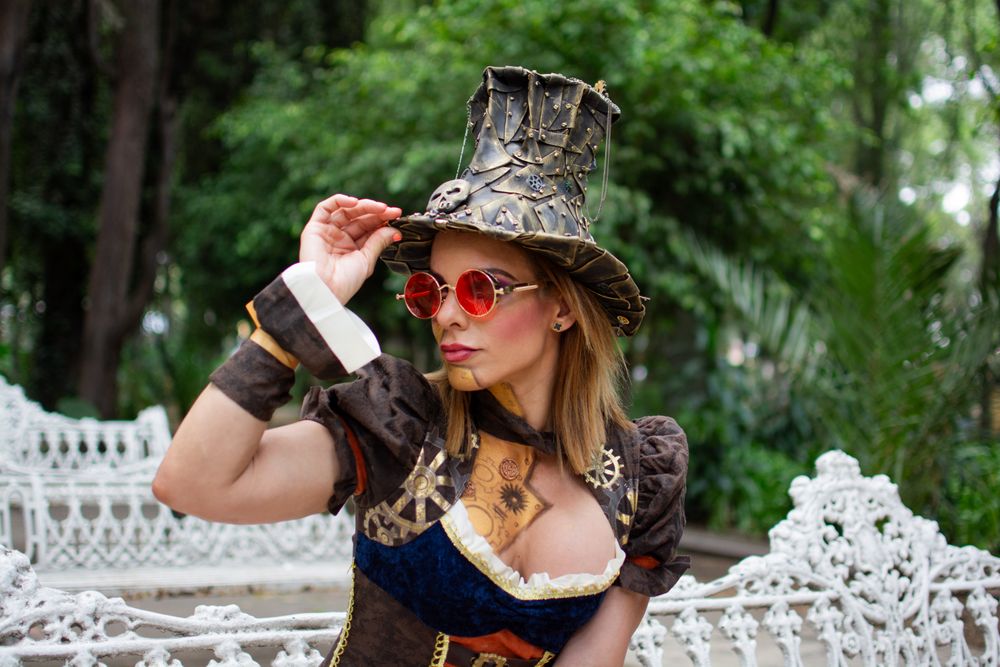
Gloves were a large part of Victorian dress. By the 1870s buttoned gloves of kid leather, silk or velvet were worn with evening and dinner dress, and long suede gloves were worn in the day and at teatime. Thin, washable white cotton gloves, called Berlin gloves, were widely worn through the century. Ladies' gloves came in three main lengths: to the wrist, to the elbow, and opera length, reaching over the elbow towards the top of the arm. In women's fashion, a gauntlet can also mean an extended cuff with little or no covering for the hand, often worn with evening gowns.
Choosing and wearing them
One gauntlet makes a statement; two can look like a suit of armour. Most people wear a single gauntlet on the hand they do not write with, and a plain glove or nothing on the other. Fingerless leather gloves suit an engineer or a mechanic, lace or fine leather gloves suit a lady, and long gloves to the elbow suit an evening outfit. If you wear a wristwatch, a watch set into a gauntlet's cuff hides it, as our guide to steampunk watches and pocket watches explains.
A simple gauntlet can be made from the cuff of an old leather glove and a strip cut from a leather belt, with brass paper fasteners or rivets for the plates. Cut leather with a sharp craft knife on a cutting board, always away from your body, and fit the cuff loosely enough that your wrist can bend.
Belts, holsters and pouches
Belts
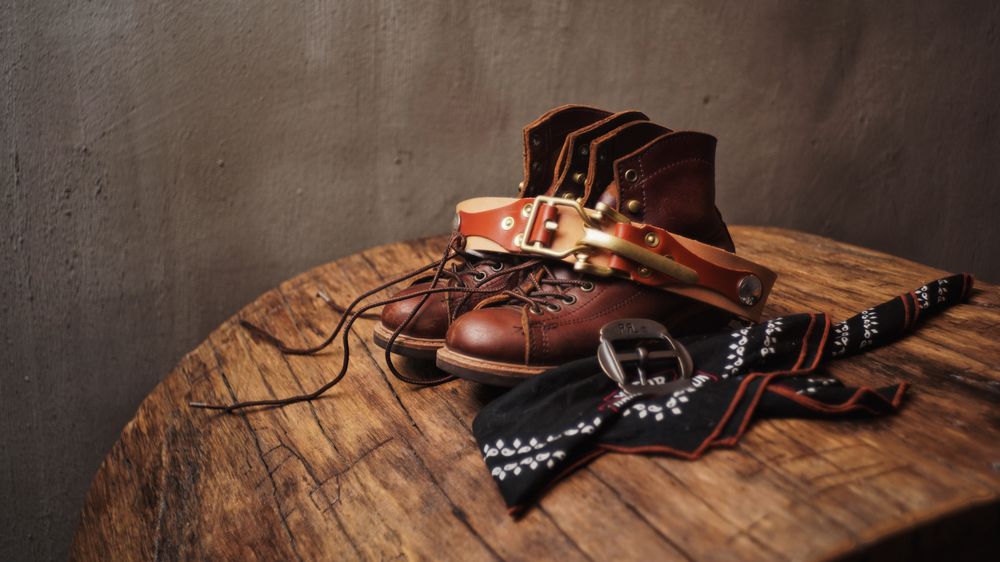
Belts are where a steampunk outfit carries its equipment. Wide brown leather belts with brass buckles, two or three worn together at different angles round the hips, give the look of someone who works with tools. A belt over a long coat brings it in at the waist, and a narrow belt across the chest can carry a pouch or a holster.
The Sam Browne belt
One real Victorian belt is worth knowing. The Sam Browne belt is a leather belt with a second strap passing over the right shoulder, worn by military and police officers. It is named after Samuel Browne, a general of the British Indian Army who lived from 1824 to 1901. He lost his left arm to a sword cut during the Indian rebellion of the 1850s, and without a left hand to steady his scabbard he found his sword hard to draw, so he added a strap over the opposite shoulder to hold it. After limited use in India, the British Army adopted the belt across the service in 1900, during the Second Boer War. A Sam Browne belt suits an airship officer or a colonial explorer perfectly.
Pouches
Pouches look best when they seem to hold something: a compass, a map, spare goggle lenses, a small tool. They are also the most practical part of any outfit, because a pouch on the belt is where your phone, money, keys and a programme can live out of sight. Two or three pouches look purposeful; a belt hung with eight looks like a market stall.
Holsters and prop guns: what the law says
A holster with a prop pistol or a ray gun is a favourite steampunk accessory, and it is the one that most needs care outside the event itself. Under section 19 of the Firearms Act 1968, which applies in England, Wales and Scotland, it is an offence to have an imitation firearm with you in a public place without lawful authority or a reasonable excuse, and it is for the person carrying it to prove they had one. The Act defines an imitation firearm as any thing which has the appearance of being a firearm, whether or not it can fire anything.
That means a painted plastic toy can count if it looks like a gun, and a passer-by or a police officer cannot tell from across a street that your pistol is made of resin. The sensible habit is simple: carry a prop gun to and from an event in a closed bag, bring it out only inside the event and only where the event's own rules allow, and never point it at anyone. Every gathering sets its own rules on props and costume weapons, and our guide to UK events explains where to find them.
Knives and sheaths
The law on blades is stricter still. Under section 139 of the Criminal Justice Act 1988, which applies in England and Wales, it is an offence to have any article with a blade or a sharp point in a public place, except a folding pocketknife whose cutting edge is no longer than 3 inches. The government's own guidance adds that lock knives are not covered by that exception. It is a defence to show a good reason, such as use at work, religious reasons or national costume, and a court decides whether a reason was good. The government gives the maximum penalty for an adult as 4 years in prison, an unlimited fine, or both. A sheath on a steampunk belt should hold something blunt and obviously fake, or nothing at all.
Wings and mechanical arms
Steampunk wings
Steampunk wings imagine a flying machine worn on the back: brass ribs, leather or canvas panels, rivets, gears at the joints, and sometimes real feathers. They draw on a very old dream. The word ornithopter, for a machine that flies by flapping its wings, comes from the Greek words for bird and wing. Leonardo da Vinci began studying the flight of birds in 1485, and concluded that people were too heavy and not strong enough to fly with wings strapped to their arms; the machine he sketched instead had the pilot lying flat, working large wings with levers, pedals and pulleys. In the 1870s inventors built small flapping models powered by rubber bands, and in 1890 Gustave Trouvé's model ornithopter flew 80 metres, driven by small charges of gunpowder. Steampunk wings belong to that world of brave Victorian experiment.
Making and wearing wings
Good costume wings are light. A frame of thin dowel, garden cane, wire or plastic tube, covered with fabric, thin foam or card, and painted to look like brass and leather, can look heavy while weighing very little. They hang from a harness of straps over the shoulders and round the chest, so that the weight sits across the back rather than pulling on the neck. Hide the harness under a waistcoat or a corset, or make it part of the look with buckles.
Before you build, think about width. Wings that stretch a metre either side look wonderful in a field and cause trouble in a doorway, on a train, in a queue or in a crowded hall, where every turn sweeps someone's drink or face. A pair that folds flat against the back, or lifts off the harness in a moment, is far easier to live with. Wings also catch the wind like a sail, so on a breezy day outdoors keep them small or take them off. An event may have its own rules on large props, so check before you go.
Mechanical arms
A mechanical arm is usually a sleeve built over the real arm: a tube of foam, card or plastic pipe, painted to look like brass and steel, with pistons, rivets and gauges along it, and a glove or gauntlet at the end. The best ones leave your hand free to use, because you will need it to eat, pay and shake hands. Keep the arm light, round off any hard edges, and remember that it makes your arm wider than you are used to, especially in a crowd. For the craft of making them, see our guide to making steampunk props safely.
Parasols, canes and walking sticks
Parasols and umbrellas
The two words say what each is for: umbrella comes from the Latin for shadow, and parasol from Latin words meaning to shield from the sun. Carrying one in the rain was not always respectable. Jonas Hanway, who died in 1786, is credited as the first man to carry an umbrella habitually in London, which he did for about thirty years in spite of public ridicule. Samuel Fox is credited with the steel-ribbed umbrella in 1852; before that, umbrellas had frames of wood or whalebone, which were expensive and hard to fold when wet.
A parasol in black or ivory lace, or in a dark silk with a brass handle and tips, is one of the most elegant steampunk accessories, and on a sunny day out it is useful as well. Keep it closed in a crowd, where its points are at the height of other people's eyes, and hold it upright when you walk with it shut.
Canes and walking sticks
Around the seventeenth or eighteenth century the walking stick became an essential part of a European gentleman's wardrobe, and the most admired were lavish: Voltaire is said to have owned eighty. A walking stick of the late nineteenth century was often called a dress cane. Some were made with a hollow compartment at the top for a small flask, and were known as tippling canes.
A steampunk cane might have a brass handle, a small gauge or compass set into its head, or a hidden compartment for a rolled map. If you really rely on a stick for walking, decorate the handle of a proper one rather than leaning on a prop. For a stick that fits, the top of the handle should reach your wrist when your arms hang at your sides, wearing the shoes you will walk in, and a rubber tip, called a ferrule, gives grip on most surfaces.
Swordsticks and swords
Many old canes hid a blade, and a swordstick is exactly the steampunk detail some people want. It is also on the government's list of banned weapons, which it describes as a hollow walking stick or cane containing a blade that may be used as a sword. The same list includes swords with a curved blade of 50 centimetres or more. Never buy or carry a real swordstick, and treat any costume sword as the knife law above treats a blade: blunt, obviously a prop, carried to the event in a bag, and worn only where the event's rules allow.
Badges, medals and insignia
What they say about a character
A badge tells people which ship you fly with, which guild of engineers you belong to, or which invented society gave you your medal. Insignia are one of the cleverest ways to give a costume a story, because people ask about them, and the answer is whatever you have decided.
Real medals belong to the people who earned them
Real decorations carry real history. The Victoria Cross was instituted by Royal Warrant on 29 January 1856 to recognise the bravery of soldiers and sailors in the Crimean War of 1854 to 1856. It bears the words For Valour, and its ribbon was at first dark blue for the Royal Navy and crimson for the Army. Legend says the first crosses were cast from the bronze of guns captured from the Russians, though the National Army Museum notes another theory, that the metal came from a captured Chinese cannon.
A real gallantry medal, or a copy of one, belongs to the person who earned it, so a steampunk costume is far better with medals of its own invention. Nobody can mistake a Distinguished Order of the Brass Propeller for the real thing, and it says far more about your character.
Making your own
A medal is easy to make from a large metal button, a washer or a single brass gear, hung from a short length of striped ribbon on a brooch pin. Choose a symbol that belongs to your character: a cog for an engineer, a propeller for an aviator, an anchor for a sky navy officer, a compass for an explorer, a clock face for a time traveller. Wear medals on the left side of the chest, as real ones are worn, and keep to two or three. Enamel pins, cap badges and patches can go on a hat band, a lapel or the flap of a satchel. Our guide to steampunk jewellery has more on brooches and pins.
Bags, satchels and cases
The Gladstone bag
The Gladstone bag is a small travelling case of stiff leather built over a rigid frame that opens into two equal halves. It is named after William Gladstone, who lived from 1809 to 1898 and was Prime Minister four times, and the first one was made by J. G. Beard at his leather shop in Westminster. By the end of the nineteenth century doctors had taken it up to carry their instruments, which is why it suits a steampunk doctor, surgeon or mad scientist.
The carpet bag
A carpet bag is a travelling bag opening at the top, made from pile carpet, often Brussels carpet, with simple handles and a frame that closes it. It was popular luggage in Europe and the United States in the nineteenth century. In America it gave its name to the carpetbaggers, the Northerners who moved South after the Civil War in search of money or power. A carpet bag suits a travelling inventor, a governess or a wanderer.
Small bags for women
The reticule was a small drawstring bag, like a modern evening bag, used mainly from about 1795 to 1820, when narrow skirts and thin fabrics made the old tied-on pockets hard to use. It was also called a ridicule or an indispensable, and was made first of netting and later of velvet, silk and satin. Later Victorian women hung useful things from a chatelaine at the waist, which our guide to steampunk watches describes.
Satchels, map cases and instrument cases
A leather satchel worn across the body is the most useful steampunk bag of all, because it leaves both hands free and is hard to snatch in a crowd. A cylindrical map case on a strap suits an explorer, and a small wooden box with brass corners can be an instrument case for a scientist. Whatever the bag, pack it for the day: water, a phone, money, keys, plasters for your feet, and somewhere to put a hat you have taken off.
Knowing when to stop
The commonest mistake with steampunk accessories is to wear all of them at once. A gauntlet, wings, a holster, a parasol, three medals, a monocle and a satchel together stop telling a story and start looking like a display.
One statement and a few details
A good rule is one large piece and two or three small ones. The large piece might be a pair of wings, a mechanical arm, a single gauntlet or a parasol. The small ones might be a medal, a pouch and a watch chain. The large piece catches the eye from across the room; the small ones reward people who come closer.
Ask what your character would carry
Every accessory should have a reason to be there. An aviator carries goggles, gloves and a map case, not a parasol. A society lady carries a parasol and a reticule, not a holster. If you cannot say why your character has something, leave it at home, and the outfit will be stronger for it.
Think about the whole day
Everything you wear, you carry for hours. Before an event, put on the whole outfit and walk about, sit down, go up and down stairs and try to buy a cup of tea. Anything that catches, drags, digs in or needs a free hand you do not have is a candidate to leave behind. Then look in a mirror and take one thing off. Our guide to what to wear to your first steampunk event has more on dressing for a long day, and our guide to steampunk fashion lists the other mistakes that make a costume look cheap.